
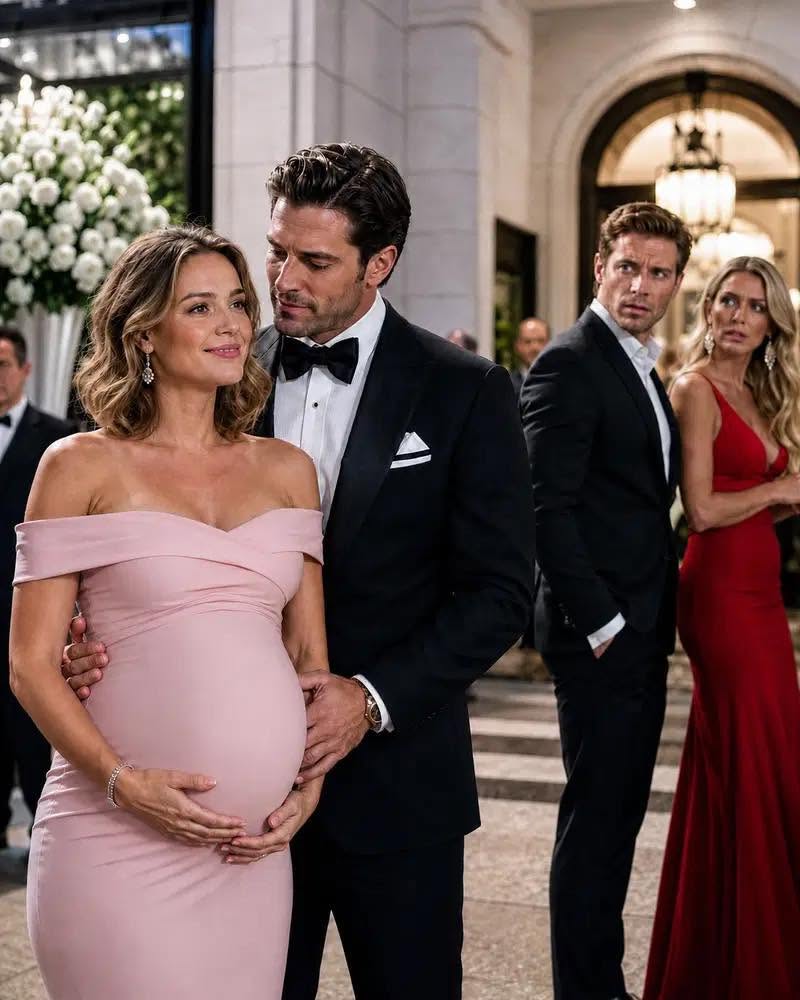
The room went quiet.
Diane had been part of Hayes Vision since the second round of funding. She was sixty-two, razor-sharp, wealthy enough that she did not need to flatter men like Liam, and one of the few people who truly knew how much of the company’s early public trust had come from Olivia’s work.
Liam looked at her.
“She never told me.”
“That she was pregnant?”
“Yes.”
Diane’s eyes were cold.
“You threw her out.”
“I didn’t throw her out. We divorced.”
“You changed the locks on the penthouse three days after settlement.”
His face heated.
“She agreed to move out.”
“She was your wife for six years.”
“She didn’t support where I was going.”
Diane gave one short laugh.
It was not kind.
“Liam, that woman built the language that convinced half this board you were more than a talented engineer with a temper. She softened you for investors. She made your ambition digestible. The public trusted Hayes Vision because Olivia made you sound like a man who cared about people.”
Khloe, who had been sitting on the sofa scrolling through her phone with frantic resentment, looked up.
“Are we really praising his ex-wife right now?”
Diane turned toward her.
“No, Ms. Monroe. We’re identifying an operational risk.”
Khloe’s face tightened.
“I’m not the problem here.”
Diane’s gaze returned to Liam.
“No. You are.”
The words fell like a verdict.
By the following week, Nora Whitcomb had submitted three motions and a single demand letter.
No press statement.
No emotional television appearance.
Only paper.
And paper frightened Liam far more than public outrage ever could.
Public outrage could be handled. It rose, spread, trended, then disappeared beneath the next famous catastrophe. Paper remained. Paper moved through court records, inboxes, board files, insurance evaluations, and investor audits.
The first letter demanded that all internal Hayes Vision communications connected to Olivia Carter’s unpaid strategic labor, brand development, crisis planning, executive messaging, and intellectual contribution be preserved.
The second questioned the fairness of the divorce agreement on the basis of misrepresentation and excluded compensation.
The third informed Liam through his attorneys that Olivia was pregnant with twins and that every future exchange concerning parental responsibility, medical costs, and child support would be handled through legal counsel.
Twins.
Liam read that single word alone in his office after everyone else had left.
Twins.
He dropped heavily into his chair.
Beyond the window, the city burned with light, vast and indifferent. For a long while, he did not move. He saw Olivia in their old Queens apartment, sitting cross-legged on the floor among takeout cartons, polishing the speech that had convinced his first serious investor to call him back. He saw her at the hospital after his father’s stroke, sleeping upright in a plastic chair because she did not want him to wake up alone. He saw her at launches, interviews, funerals, airports, always close, always making sure he appeared steady.
He had confused steadiness with a lack of ambition.
He had confused loyalty with dependence.
He had confused love with something that could keep surviving neglect simply because it always had before.
His phone buzzed.
Khloe.
The message read: Are you coming over or should I assume your pregnant ex ruined our night again?
He stared at the screen.
For the first time, her beauty felt noisy and exhausting.
He turned the phone facedown.
Two days later, the board scheduled an emergency meeting.
Olivia was not there.
Nora was.
Mara was there as well, carrying a sealed declaration and a hard drive filled with drafts, timestamps, email chains, recorded voice notes, and payment records. Diane sat at the head of the table while Liam faced his own attorneys from the opposite side, his expression tight and unreadable.
Nora began first.
“My client is not seeking public spectacle. She is seeking compensation, correction, and protection.”
Liam’s attorney shifted in his seat. “Mrs. Carter already signed a settlement.”
“Ms. Carter signed while material facts were withheld, while her professional contributions were mischaracterized, and while Mr. Hayes was engaged in conduct that directly affected valuation and negotiation context.”
Liam lowered his eyes to the table.
Nora went on, “We have evidence that Hayes Vision continued using strategic materials created by Ms. Carter after the divorce while representing them as internally developed. We also have evidence of communications in which Mr. Hayes acknowledged she would be compensated when liquidity improved.”
“That was marital conversation,” his lawyer said.
Mara opened the hard drive case.
“No,” she said. “It was business.”
Everyone in the room turned toward her.
Mara kept her voice even. “I was present for several of those meetings. Olivia was not introduced as a wife. She was introduced as strategic communications lead. The company benefited from that work. Publicly. Repeatedly.”
Liam finally lifted his head.
“Mara.”
She held his gaze.
“You knew,” he said.
“I knew she was doing the work. I didn’t know you planned to pretend she hadn’t.”
Silence settled over the table.
Diane folded her hands together.
“How much exposure are we talking about?”
Nora pushed a document across the table.
“Conservatively? Seven figures in unpaid compensation and licensing value. More if we litigate publicly and include reputational damages.”
Liam’s attorney lost color.
“And parental matters?” Diane asked.
“Separate,” Nora said. “But Mr. Hayes will not approach my client outside formal channels again.”
Liam flinched.
“I wasn’t going to hurt her.”
Nora’s expression stayed perfectly still.
“You already did. We are discussing how to make sure you stop.”
The board reached a settlement before trial.
Quietly.
At great cost.
Hayes Vision released a carefully constructed correction recognizing Olivia Carter as a founding strategic contributor to the company’s early identity and public trust architecture. She received compensation substantial enough for strangers to call it a victory, though Olivia understood that no amount of money could repay the years she had spent disappearing inside another person’s story.
But money gave her something pain never had.
Choices.
She left the Brooklyn walk-up and moved into a bright apartment near Prospect Park with an elevator, a real nursery, and windows that caught the morning sun. She hired a doula. She bought two brand-new cribs, not because secondhand was beneath her, but because choosing them felt like taking back a kind of tenderness Liam had tried to diminish.
Luma Life started at her kitchen table.
Not with a polished public launch.
With ten women on a private video call.
A single mother from Queens.
A former executive from Boston.
A teacher in New Jersey whose husband had left after a prenatal diagnosis.
A nurse in Atlanta who cried silently with her camera off for the first twenty minutes, then turned it on and said, “I didn’t know I needed this.”
Olivia listened.
That was what she had always done well before Liam turned listening into labor nobody compensated.
Now she shaped it into a mission.
Ethan’s foundation funded the first pilot program, but he remained at a distance unless she invited him closer. When she sent the proposal, he returned it with notes in the margins, not praise. Practical questions. Legal concerns. Scaling models. Mental health partnerships. He treated her idea as something real enough to question.
She liked that far more than flattery.
One afternoon in January, with snow drifting gently beyond the windows, Ethan came to see the new office space Luma Life had rented for three months — two rooms above a women’s health clinic, with old wooden floors and a bathroom sink that dripped whenever the handle turned too far.
“It’s not glamorous,” Olivia said.
“It’s better than glamorous.”
“Because?”
“Because it looks like work happens here.”
She smiled.
The twins shifted beneath her sweater.
Ethan noticed, but he did not make the moment sentimental.
“May I ask something personal?”
“That depends.”
“Are you happy?”
The question caught her off guard.
She looked around the room: the folding chairs, the boxes of donated books, the whiteboard crowded with names and deadlines, the faint smell of fresh paint, the sound of women laughing downstairs at the clinic’s reception desk.
“I’m not sure happy is the word yet,” she said. “But I’m no longer waiting to be rescued from my own life.”
Ethan nodded slowly.
“That may be better.”
Their friendship developed in rooms filled with ordinary things.
Coffee turning cold during budget meetings.
Rain tapping against glass while they reviewed grant applications.
One exhausted evening when Olivia’s ankles were so swollen that she pretended not to notice, and Ethan silently slid a footstool beneath her desk without saying a word.
He never called her strong as though strength were the fee she owed for being abandoned.
He never made her pregnancy feel tragic.
He never touched her belly without asking first.
The first time he asked, it was because one of the twins kicked so hard that her notebook jumped on the table.
Olivia laughed, startled.
Ethan looked alarmed.
“Is that normal?”
“Yes.”
“That looked like a boardroom protest.”
“It felt like one.”
He smiled. “May I?”
She studied him for a moment.
Then nodded.
He placed one careful hand against the side of her belly, his touch light, reverent, and temporary.
The baby kicked again.
Ethan’s face changed.
Not with possession.
With wonder.
Olivia looked away because that expression was almost too much to hold.
By then, Liam had started appearing in places.
Not close enough to be called harassment.
Not far enough to seem accidental.
Across the street from the clinic.
At a café near Nora’s office.
Outside a bookstore Olivia visited on Sundays.
He looked thinner. Less polished. Khloe was rarely beside him anymore. The tabloids had turned against her too, and without the shine of victory, their romance seemed to have lost the audience it had been built for.
One cold afternoon, Olivia stepped out of a prenatal appointment and found Liam waiting near a black SUV.
Nora had warned her not to engage.
But something inside Olivia was tired of being shadowed by the ghost of a man who mistook regret for redemption.
She stopped ten feet away.
“What do you want?”
Liam’s eyes moved to her stomach, then returned to her face.
“You look well.”
“I asked what you want.”
He swallowed.
“To apologize.”
“You did. Through counsel.”
“That wasn’t enough.”
“No,” she said. “It wasn’t. But more words won’t change that.”
He took a small step forward, then stopped when she stiffened.
“I didn’t know about the twins.”
“You knew about me.”
The answer hit him.
She watched it land and did not soften the impact.
“I know,” he said.
For once, there was no defense after it.
The street was wet with melted snow. A cyclist shouted at a taxi. Somewhere nearby, chestnuts were roasting, their warm scent drifting through the cold air.
“I thought you needed me,” Liam said. “That was the story I told myself. That I was the one with vision, risk, power. And you were… stability.”
“Furniture,” she said.
His eyes closed.
“I hate that you’re right.”
“I don’t need you to hate it. I need you to understand it.”
“I do.”
“No,” Olivia said quietly. “You’re starting to. That is not the same thing.”
His face cracked slightly.
“Is there any chance we can ever—”
“No.”
He looked at her helplessly.
She placed one hand over her belly.
“You are going to be their father. That means you will have responsibilities. Financial, legal, emotional if you earn it. But you will never again be my home.”
His mouth trembled.
“I loved you.”
“I know,” she said.
That seemed to wound him more.
“Then why—”
“Because love without respect becomes appetite. You wanted my comfort, my work, my loyalty, my softness, my forgiveness. You consumed everything I gave you and called it marriage.”
A taxi hissed past them.
Liam looked down.
When he lifted his eyes again, they were wet.
“I’m sorry.”
“For what?”
He looked confused.
“For everything.”
“That’s too easy.”
He drew a breath.
“For making you smaller because your strength reminded me I wasn’t self-made. For letting people believe I built alone. For replacing intimacy with image. For humiliating you in public because I was too cowardly to admit I’d already failed you in private.”
Olivia felt the words settle inside her, not as healing, but as confirmation.
A door shutting properly.
“Thank you,” she said.
Hope flickered across his face.
She let it fade gently.
“But apology is not a key.”
He nodded once, slowly, as if learning the outline of a consequence he could not bargain away.
Ethan arrived then, without any dramatic entrance. He stepped out of the clinic behind Olivia carrying her folder and a paper bag from the café downstairs.
He stopped when he saw Liam.
The two men looked at one another.
Liam’s gaze moved to the bag, the folder, and the quiet ease with which Ethan stood near Olivia without taking ownership of the space around her.
Jealousy passed across his face before he could hide it.
“You’re with him?” Liam asked.
Olivia almost laughed.
After everything, he still wanted a category that placed him at the center.
“I’m with myself,” she said. “Ethan is walking me home.”
Ethan said nothing.
That silence was elegant.
Liam looked from him to Olivia, then to her belly.
For the first time, Olivia saw full understanding reach him: she was pregnant, yes, but no longer abandoned; injured, yes, but not waiting; tied to him forever through the children, but no longer available for his return.
He had left her for a woman who made him feel watched.
Now he was watching Olivia become someone he could never have again.
The twins were born during a spring rainstorm.
Two girls.
Grace and Lillian.
Grace arrived furious, red-faced and loud, as if personally offended by the entire medical process. Lillian came six minutes later, quieter, wide-eyed, with one tiny hand curled against her cheek.
Olivia cried when she heard them.
Not prettily.
Not softly.
She sobbed with the raw, relieved exhaustion of a woman who had carried far more than children for nine months. She had carried humiliation, fear, legal war, public judgment, financial uncertainty, and the stubborn belief that a life could still be built after betrayal.
Ethan waited in the hallway because Olivia had asked him to.
Mara arrived with flowers.
Nora sent a frighteningly practical gift basket filled with legal folders, nipple cream, and the best noise machine money could buy.
Liam came the following day.
He entered the hospital room quietly, carrying no flowers, no camera-ready present, no performance.
Only himself.
Olivia sat upright in bed with Grace sleeping against her chest and Lillian tucked into the bassinet beside her. Her hair was messy. Her face was pale. Her body ached in places she had not known could hurt.
She had never looked less glamorous.
She had never felt more powerful.
Liam stood at the foot of the bed.
“They’re beautiful,” he whispered.
“Yes.”
He looked at Grace, then Lillian, then Olivia.
“Thank you for letting me come.”
“They deserve to know their father,” she said. “If you become someone worth knowing.”
He accepted it.
No argument.
No wounded pride.
Maybe it was the beginning of change.
Maybe it was only shock.
Olivia no longer needed the answer immediately.
Six months later, Luma Life launched publicly.
Not at the Plaza.
Olivia refused that.
They chose a restored library in Brooklyn, with tall windows, warm lamps, flowers from a neighborhood market, and folding chairs filled with women who had found the platform in its earliest days. Women who had cried during calls. Women who had typed their stories at midnight. Women who had believed their worst chapter would be the only one anyone remembered.
Olivia stood on the small stage in a cream suit, her daughters asleep in a double stroller near the front row while Mara sat beside them like a glamorous aunt with dangerous lipstick.
Ethan stood near the back.
Liam stood even farther back, invited only because Grace and Lillian were there, and because Olivia had decided that peace required boundaries, not disappearance.
He watched her speak.
Not as his ex-wife.
Not as a scandal.
Not as the woman he had lost.
As Olivia Carter, founder of Luma Life, strategist, mother, survivor, builder.
“I used to think the most humiliating thing that ever happened to me was being replaced in public,” she told the room. “I was wrong. The most humiliating thing was realizing how long I had helped someone else build a life while apologizing for wanting one of my own.”
The room grew still.
“But humiliation is not the end of a woman,” she continued. “Sometimes it is the place where she finally stops negotiating her worth.”
The applause began slowly.
Then fully.
Then like weather.
Olivia looked out at the faces, the tears, the women rising one by one.
Her gaze moved over Liam.
He was crying.
She felt compassion.
Not longing.
That difference was freedom.
After the event, Ethan found her near the library steps as rain softened the evening street.
“You were extraordinary,” he said.
“I was nervous.”
“I know. Your left hand kept touching your sleeve.”
She glanced at him. “You noticed that?”
“I notice you.”
The sentence landed softly, without demand.
Behind them, Mara was loading the babies into the car. Liam stood nearby, speaking quietly with Nora about the custody schedule, looking for once like a man learning to be useful without being central.
Olivia looked at Ethan.
For months, he had been careful. Respectful. Present without pressure. He had seen her at her weakest and had never treated weakness as permission. He had supported her work without consuming it. He had held her daughters with wonder, changed diapers badly, and once arrived at midnight with formula after the delivery app failed and Olivia had called everyone else first because of pride.
“You know I’m complicated,” she said.
His mouth curved.
“I have accountants.”
She laughed.
“I’m serious.”
“So am I.” He stepped closer, leaving enough room for refusal. “I’m not asking you to be uncomplicated. I’m asking whether I may keep walking beside the life you’re building.”
The old Olivia would have tried to give a perfect answer.
The new one let herself breathe.
Then she placed her hand in his.
Not because she needed a billionaire.
Because this man had never once tried to make her smaller.
Across the steps, Liam saw them.
Pain crossed his face.
Then something like acceptance followed it.
He looked down at Grace in the stroller, adjusted her blanket, and did not interrupt.
That, too, was a kind of ending.
Years later, strangers would still tell the story the way strangers always tell stories.
He left his wife for a model.
She appeared pregnant at his gala.
A billionaire fell in love with her.
He lost everything.
But the real story was not Liam’s jealousy or Khloe’s fading headlines or even Ethan’s quiet devotion.
The real story was a woman standing in a white dress beneath chandeliers, carrying two lives inside her body, and realizing that the man who abandoned her no longer had the power to define her.
The real story was tea in a cold Brooklyn kitchen.
A terrifying lawyer with silver hair.
A foundation card resting on a coffee shop table.
Two cribs beside a window.
A platform built from pain and transformed into shelter.
Two daughters growing up knowing their mother’s silence had never meant surrender.
And Olivia, who once believed she had been left behind, finally understood the truth.
She had not been left.
She had been released.
And once she stopped reaching for the man who had dropped her, both of her hands were finally free to build a life no one could ever take from her again.
See more on the next page
Advertisement