
Part 2
He made himself empty of all of it.
Cinder took one step.
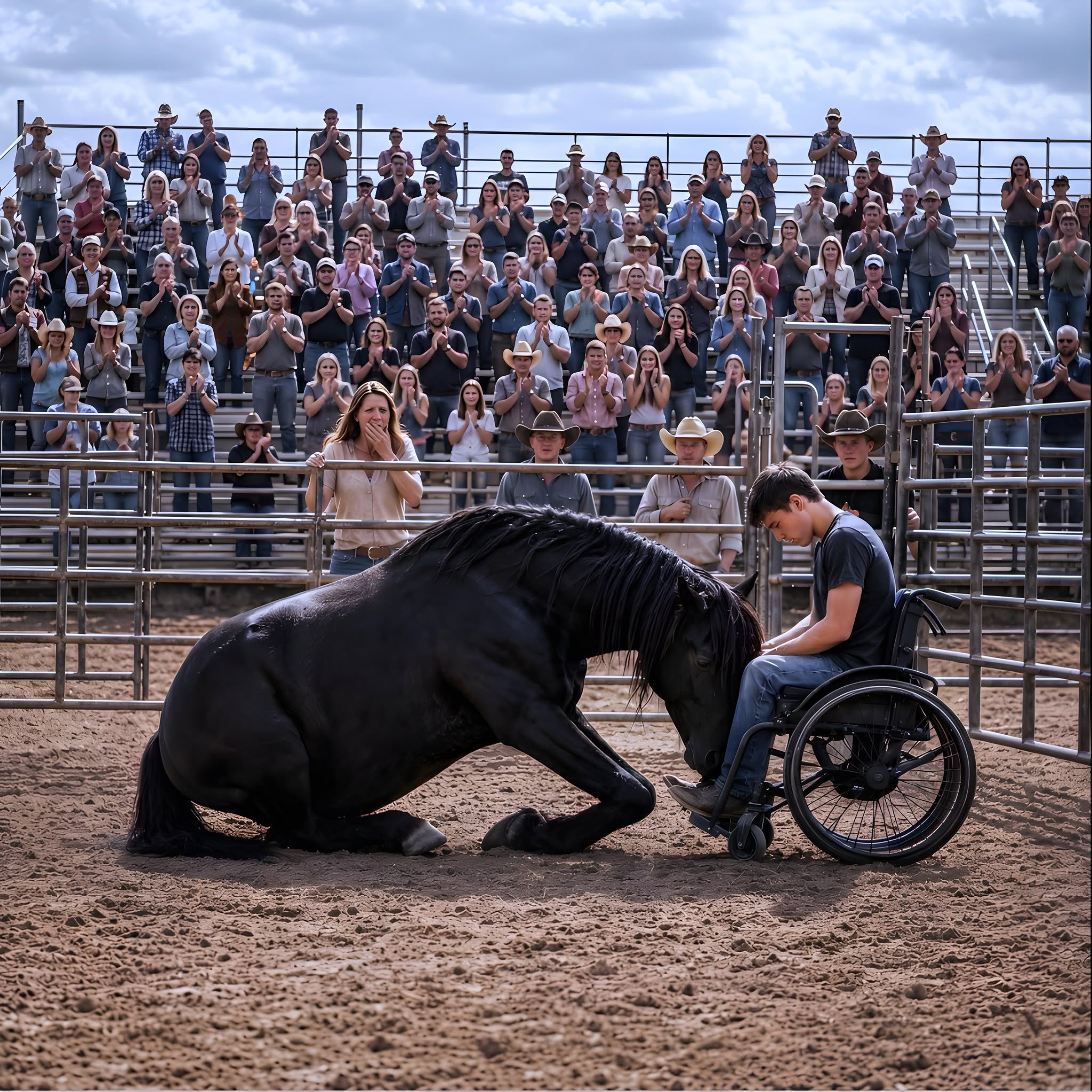
The sound of that hoof in the dirt seemed to pull every person in the arena forward without anyone moving. Tessa had both hands on the fence now. Her mouth was pressed into a white line. She was close enough to see Nolan’s fingers trembling, and far enough away to know she could not reach him in time.
The mustang came another step.
His head lowered a fraction. His neck stretched out, long and tense, as he tried to understand the chair, the metal, the rubber, the boy who did not reach for him. When he stopped, his muzzle hovered inches from Nolan’s boots. Warm breath moved across the leather and sent a small fan of dust over the footplates.
Nolan did not lift his hand.
Cinder breathed again, heavier this time. The tight cords in his neck softened. His ears moved forward, then sideways, listening. Slowly, almost grudgingly, he let his head fall lower until his nose hung near Nolan’s knees.
To people who knew horses, it was not obedience. It was not a trick. It was a release, fragile and real, offered by an animal who had been refusing the world for days.
To everyone else, it looked as if the wild black horse had bowed to the boy in the wheelchair.
The applause came late
The applause came late, as if people had to remember what sound was. It began in scattered claps from the far side of the arena, then spread across the seats in a wave. Some people stood. Someone whistled. The announcer said something into the microphone, but Nolan did not catch the words.
The only thing that reached him was the horse’s breath against his shins.
For one clean minute, Nolan was not in the wrecked body he had learned to hate. He was not the boy everyone pitied, or the boy his mother watched with careful eyes, or the boy who had once ridden and now could only sit beside the ring. He was a horseman again, not because he had climbed into a saddle, but because a frightened animal had understood him.
Then the handlers moved in, slow and wide. They kept their hands low and their voices lower. Cinder lifted his head, but he did not explode. He allowed himself to be guided toward the holding alley, still watchful, still wild, but no longer trying to destroy every boundary around him.
Tessa got to Nolan before the gate fully closed.
She grabbed the handles and pulled, her strength sharpened by fear. The chair stuck once in the loose footing. She yanked harder, and Nolan let her because the clarity that had carried him into the ring was draining away as fast as it had come. Behind the safety fence, she crouched in front of him, her hands moving over his arms, his chest, his shoulders, checking for injuries that were not there.
” she whispered
“What were you thinking?” she whispered. Her voice broke on the last word, and she swallowed hard before trying again. “Nolan, look at me.”
He could not.
The crowd was still clapping. People were leaning over rails, pointing phones toward him. A man in a straw hat said, “That kid’s got something,” and another answered, “Or he’s lucky to be breathing.”
Nolan stared past them all at the churned-up dirt where Cinder had stood. The heaviness in his chest, the old familiar weight, was already returning. His legs lay unmoving before him. His chair was jammed with dust. His mother’s fear wrapped around him like a hand he could not pull away from.
Tessa touched his cheek, careful now. “Please say something.”
Nolan’s fingers closed around the cold metal rims. He had no words for what had happened in the arena. No words for the brief quiet inside him. No words for how badly he wanted it back.
So he said nothing at all.
The crash came later, once the arena was behind him.
Nolan sat in the narrow strip of shade cast by a stock trailer, arms aching from the fight with the arena dirt. The back lot of the fairgrounds carried a different kind of noise than the grandstand. Here, the sounds were work sounds: trailer chains clinking, truck doors slamming, horses shifting in metal compartments, men calling instructions over the rumble of diesel engines. Dust had caked itself into the tread of Nolan’s tires so thickly the rubber looked gray.
His mother had gone to get water
His mother had gone to get water, though they both knew she had gone mostly because she needed a place to breathe where he could not see her hands shaking.
“You always roll into bad ideas that calmly?”
The voice came from Nolan’s left.
He turned his chair just enough to see an older man walking toward him with the loose, economical stride of someone who had spent a lifetime conserving energy around large animals. He wore sun-faded jeans, a pearl-snap shirt, and a sweat-darkened hat with a brim bent from weather rather than style. His beard was trimmed close and mostly gray. His eyes were pale, direct, and not especially kind, which Nolan found easier to tolerate than pity.
“You’re Sam Carver,” Nolan said.
The man’s eyebrow lifted. “That’s what they put on my checks.”
“You run the holding pens.”
“I try to. Black horse disagrees.” Sam leaned his shoulder against the trailer and studied Nolan the way he had studied Cinder, not rudely, but without looking away from what was true. “I saw what you did in there.”
“I didn’t do anything.”
Sam gave a short laugh without humor. “Kid, I’ve watched grown men ruin horses by doing too much. Don’t insult me by pretending doing nothing is easy.”
Nolan looked down at his hands. Fine tremors still ran through his fingers, though he curled them against his palms to hide it. “He was scared.”
You were the only one who cared enough to change
“Plenty of folks saw that. You were the only one who cared enough to change your own body over it.” Sam pushed his hat back. “You broke your eyes off him. You softened your shoulders. You gave him the center instead of taking it. That isn’t luck.”
The compliment landed where Nolan did not want to be touched. He turned his chair a few inches away, the small motion meant to end the conversation. “I used to ride.”
“I know.”
That made him look up.
Sam did not smile. “I watched you at a junior finals in Carson Valley. You were, what, fourteen? Maybe fifteen. Sorrel mare, white blaze. You had good timing. Quiet hands.”
The memory struck harder than Nolan expected. He saw the old arena, heard a crowd he had not thought about in years, felt for one cruel second the muscular lift of a horse beneath him. Then the picture collapsed into the weight of his legs on the footplates.
“I don’t ride now,” he said.
“No,” Sam said. “You don’t.”
Most people rushed to soften that kind of statement. Sam let it sit there plain.
Nolan hated him a little for it and trusted him a little for the same reason.
Sam glanced toward the north pens. “Cinder’s in pen six by the back fence. I’m going to feed before dark. You can come by tomorrow morning, if you’re curious.”
“I’m not.”
“All right.”
Sam stepped away from the trailer.
Nolan expected him to add something hopeful, something about gifts or second chances or how horses healed people. Instead the old trainer stopped after two steps and looked back over his shoulder.
“The horse doesn’t know what you lost,” he said. “He only knows how you feel standing in front of him.”
Then he walked off.
Tessa did not ask about the conversation when she returned. She handed Nolan a bottle of water, sat on the trailer ramp beside him, and looked out over the fairgrounds with red-rimmed eyes. That evening, instead of starting the long drive home, she rented a room at a low-slung motel near the highway. She said the heat had worn her out. Nolan knew better. She had seen him follow something with his eyes for the first time in months, and she was afraid to move too quickly and scare it away.
By dawn, he was awake before her.
He waited until she stirred, then said, “I want to go back.”
Tessa lay still for a moment, staring at the ceiling. “To the fairgrounds?”
“Yes.”
She turned her head on the pillow. Her face held every argument she wanted to make. Too dangerous. Too much. Too soon. Instead she sat up and rubbed both hands over her face.
“Give me ten minutes,” she said.
The morning air at Pine Draw still held a thin edge of cold, but the ground was already warming. Nolan pushed himself down the service lane behind the barns, where the dirt had been chewed into ruts by trucks, trailers, boots, and hooves. Every few yards his small front wheels found a hole and stopped dead. He learned quickly to lean back, lift the casters, and drive forward with his shoulders. By the time he reached pen six, sweat had gathered along his hairline.
Cinder was moving the fence.
Not literally, though it felt close. He traveled the same line again and again, head high, tail tight, hooves striking hard. In the open country, that energy would have carried him across miles. Inside the pipe panels, it only folded back on itself until the horse seemed trapped inside his own skin.
Nolan stopped ten feet from the fence and locked his brakes.
He did not speak. He did not lift a hand. He simply sat where Cinder could see him and looked at the ground between them.
Sam appeared a few minutes later with a flake of alfalfa tucked under one arm. He tossed it over the panel. The hay hit the dirt softly, but Cinder jumped as if it had bitten him.
“Still wound tight,” Sam said.
Nolan kept his gaze lowered
Nolan kept his gaze lowered. “You chase him with the helicopter?”
“Wasn’t me, but yes. Federal contractors gathered that band last week. He’s been run, sorted, separated, hauled, penned, and stared at by half the county since then.” Sam rested his forearms on the top rail. “Every person who walks up to him wants something. A halter. A signature. A sale. A performance. No wonder he thinks humans are bad news.”
Cinder edged toward the hay, then snatched a mouthful and retreated to the far side of the pen.
Sam looked down at Nolan’s chair. “You don’t come at him like the rest of us.”
“I can’t.”
“That may be the most useful thing about you.”
Nolan’s mouth tightened. “That’s a terrible thing to say.”
“It’s a true thing.” Sam’s voice held no apology. “You can’t rush him. Can’t chase him. Can’t jump at his head. Can’t fix a bad decision with quick feet. Around a horse like that, all those limits force you to be honest.”
Nolan stared at the dirt caked around his wheels. “If he comes through that fence, I’m done.”
“Yes.”
Again, the simple answer. No comfort. No lie.
Sam lowered his voice. “I’m not asking you to crawl in there and save him. I’m asking whether you’re willing to sit where he can learn you won’t take anything from him.”
Nolan looked at Cinder
Nolan looked at Cinder. The mustang’s ribs still worked hard beneath the dusty coat. He kept one eye on the men, one ear on the far gate, every part of him divided between hunger and fear.
“I don’t know how to do this anymore,” Nolan said.
Sam leaned away from the fence. “Then don’t do much.”
It started that way.
For hours, Nolan did almost nothing.
He parked outside pen six in the morning and stayed through the building heat. He learned where the shade fell and where the dirt was firm enough to hold his wheels. He learned how much movement made Cinder lift his head and how little it took for him to settle again. He learned that the horse could tolerate the sound of his brakes if he clicked them once and waited afterward. He learned that a wheelchair rolling backward did not mean retreat to a horse unless the body above it softened too.
See more on the next page
Advertisement
To see the full cooking instructions, go to the next page or click the Open button (>) and don't forget to SHARE it with your friends on Facebook.