
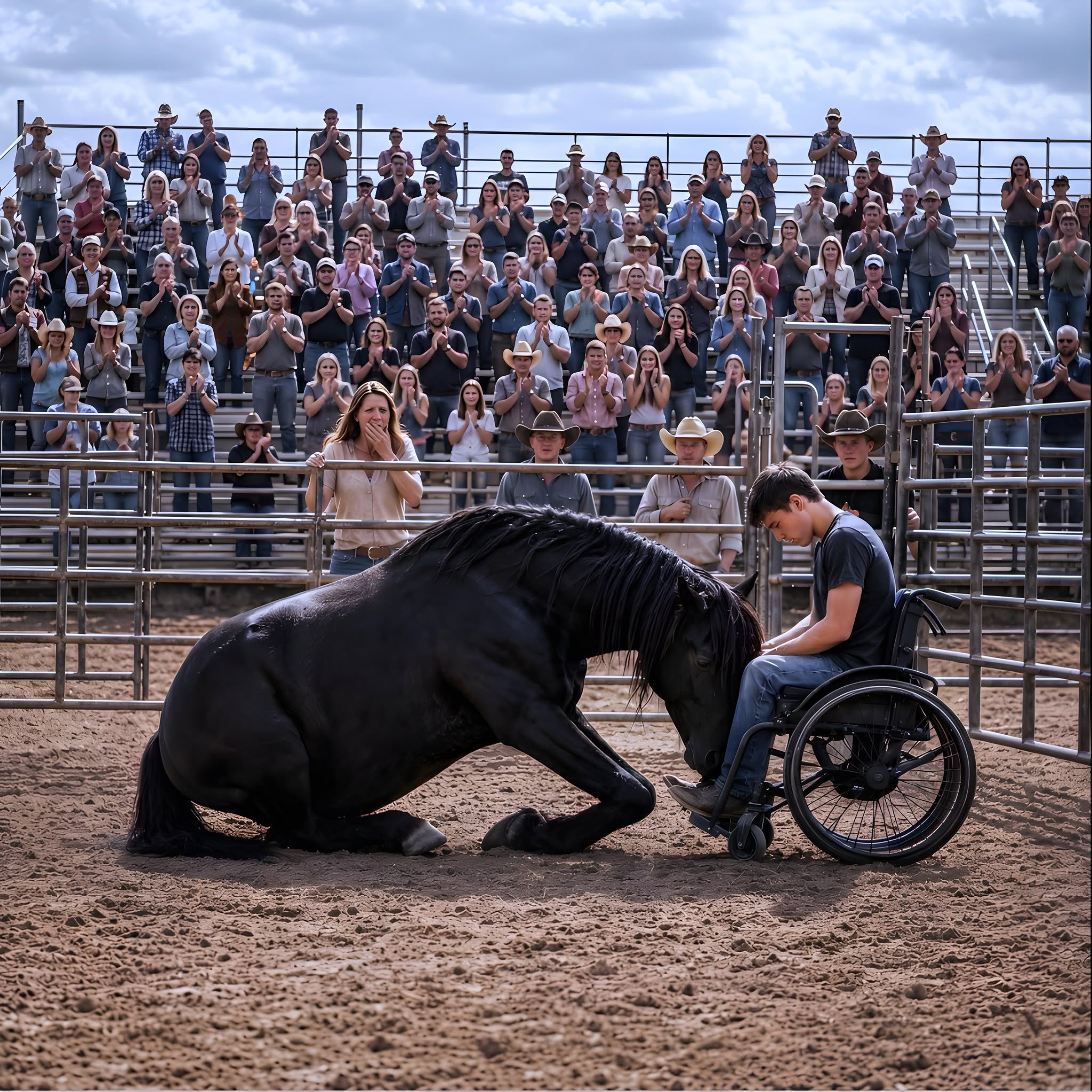
Part 4
Nolan hated the video before he ever watched it.
His phone buzzed until he turned it face down on the motel nightstand. Compliments felt almost as bad as criticism. He did not want to be called inspiring by strangers who would never know what it cost him to get from the bed to the bathroom on bad mornings. He did not want people adding music to the worst and best parts of his life. He did not want his chair turned into a lesson for people scrolling between arguments and dinner photos.
Tessa watched him ignore the phone from the edge of the other bed.
“The event office called,” she said.
Nolan kept his eyes on the muted television. Some cooking show was on. A woman he had never seen was smiling too hard over a bowl of chopped onions. “What do they want?”
“They’re worried.”
“About the horse?”
“About you.” Tessa folded and unfolded the corner of the motel blanket. “About insurance. About waivers. About whether they should’ve let any of it happen.”
“They didn’t let it happen.”
“That’s part of the problem.”
He finally looked at her.
She seemed older than she had that morning. The lines around her mouth had deepened, and her eyes carried the gray exhaustion of someone who had spent years imagining every possible way to lose the person sitting in front of her. “Some of the trainers are angry,” she said. “They think the fairgrounds rewarded a dangerous stunt. They’re saying you got lucky. They’re saying somebody should have stopped you before you got hurt.”
Nolan turned away
Nolan turned away.
The words found the places in him that were already raw. He could picture the men saying it: older riders with good knees, good boots, fast reflexes, men who would look at him and see only what he lacked. He had heard versions of it for two years. Be careful. Let me get that. Are you sure you can? It was all the same sentence wearing different clothes.
Maybe they were right.
The thought stayed with him through breakfast, through the drive back to the fairgrounds, through the slow push along the gravel lane to Cinder’s pen. The horse stood near the water trough, head lowered, ears moving lazily at flies. When Nolan’s wheels crunched closer, Cinder looked up. He did not come to the fence, but he shifted his body so he could see Nolan clearly.
That should have comforted him.
Instead, Nolan heard the strangers in his head. Lucky. Reckless. Liability.
Sam found him there an hour later.
The old trainer came carrying two paper cups of coffee, one balanced dangerously between thick fingers. He handed it down without ceremony. Nolan took it, surprised by the heat against his palms.
“You look like you spent the night arguing with people who weren’t in the room,” Sam said.
Nolan huffed once. “Something like that.”
Sam rested his elbows on the top rail and looked at Cinder
Sam rested his elbows on the top rail and looked at Cinder. “Let me guess. Dangerous kid. Dangerous horse. Dangerous old fool who didn’t stop either one.”
“That close?”
“I’ve been called worse by better horsemen.”
Nolan stared into the coffee. “They think I don’t know what I’m doing.”
“Some of them do.”
The blunt answer scraped at him.
Sam continued before Nolan could retreat into it. “Some of them are also mad because you embarrassed their favorite tools. Ropes, flags, pressure, noise. They threw the whole toolbox at that horse and got nowhere. You sat down and waited, and he picked you. That bruises a man if he thinks horses are supposed to prove his importance.”
Nolan’s throat tightened. “You said yourself it’s a risk.”
“It is.”
“If he spooks, I can’t move.”
“No.”
“If he kicks, I can’t dodge.”
“No.”
“Then maybe they’re not wrong.”
Sam turned from the horse then. His expression did not soften, but his voice did. “Risk doesn’t make a thing false. It just makes it cost something.”
Nolan looked up.
“What you’re doing with him isn’t a party trick,” Sam said. “It isn’t the universe handing you a pretty moment because life was unfair. It’s work. Quiet work, but work all the same. You read him. You make choices. He makes choices. That’s horsemanship.”
Cinder stretched his neck toward a scrap of hay
Cinder stretched his neck toward a scrap of hay and nosed it through the dirt.
Sam pointed at him. “See that? His weight’s settled. His jaw isn’t locked. He’s watching us, but he’s not bracing for a fight. That didn’t happen because he got tired. It happened because someone finally gave him a way to be right without being trapped.”
Nolan swallowed. “I can’t force him.”
“Good.”
“I mean it. I can’t.”
“I know what you mean.” Sam’s gaze held steady. “And I’m telling you, force would ruin him. He doesn’t need stronger hands. He needs better timing. You’ve got that.”
Nolan looked back at the mustang.
The anger in him did not disappear. Neither did the fear. But something beneath both shifted its weight, as if a door inside him had opened just far enough to let in air.
Sam took a slow sip of coffee. “The federal folks are finishing the paperwork today. Cinder’s not going to long-term holding. Not after what they saw. But he needs an approved placement.”
Nolan’s hand tightened around the cup.
“My ranch is outside Dry Creek, ten miles from here,” Sam said. “Good pipe pens. A round pen with packed footing. No crowd. No phones unless I throw mine in a water trough by accident. I’m licensed to hold mustangs for adopters, and I’ve got room.”
Nolan did not breathe for a second
Nolan did not breathe for a second.
Sam went on. “If you and your mother want to adopt him, we can put him at my place while he finishes gentling. You work with him there. I supervise. Your mother gets to tell me when I’m being an idiot, which I’m sure she’ll enjoy.”
Despite himself, Nolan almost smiled.
Then he saw Tessa standing near the feed shed, close enough to have heard. Her arms were folded tight across her chest. She looked at Cinder, then at Nolan, and the fear returned to her face—not sharp this time, but deep and tired.
“This is not a small thing,” she said.
“No, ma’am,” Sam replied.
“He could get hurt.”
“Yes.”
“My son could get hurt.”
“Yes.”
Tessa closed her eyes briefly. When she opened them, they were wet but steady. “And if I say no?”
Nolan looked down.
Sam did not answer for him.
The silence stretched long enough that Nolan had to fill it. “Then we go home,” he said. His voice stayed quiet, but it did not stay flat. “And I go back to my room. And Cinder goes somewhere he disappears.”
Tessa’s face changed.
He had not meant to hurt her. He could see that he had. But it was the first fully honest thing he had said to her in months, maybe years, and once it was out, he could not call it back.
“I don’t know how to keep doing nothing,” he said.
Tessa pressed her fingers to her mouth. She looked toward the black horse, who stood in the sun with dust along his back and a federal tag braided into his mane. Then she looked at the hands Nolan had built his new life around, hands already roughened from only a week of dirt and rims.
Finally she turned to Sam. “I want every safety rule in writing.”
Sam nodded. “You’ll get it.”
“And if I tell you to stop, you stop.”
“I’ll listen.”
“That is not the same sentence.”
For the first time, Sam smiled. “No, ma’am. It isn’t.”
The adoption papers were signed under a shade canopy that smelled of printer ink, dust, and old coffee. Nolan wrote his name slowly, pressing hard because his hand shook. Tessa signed beside him. Sam loaded Cinder himself, taking over an hour to get the mustang into the trailer without force. When the door finally closed, Cinder stood inside trembling but uninjured, and Nolan sat beside the ramp in the hot dirt, exhausted in a way that felt almost clean.
Three months at Sam Carver’s ranch stripped the shine off the idea of a second chance.
There was no music under the work. No crowd leaning forward, no applause, no neat little video ending at the perfect moment. There was only heat, flies, dust that got into the bearings of Nolan’s wheels, and mornings when the muscles between his shoulder blades felt like torn rope. The ranch sat beyond Dry Creek, where the land rolled brown and silver beneath the sky. Sam had packed one lane of the arena hard enough for Nolan’s chair, but the rest of the place still fought him. Sand grabbed the casters. Gravel jarred his spine. Gate latches seemed designed by people who had never sat down in their lives.
Nolan kept coming anyway
Nolan kept coming anyway.
His palms blistered, split, and hardened. The soft skin he had developed during two years indoors gave way to calluses thick enough to catch on cloth. His shoulders filled out. His wrists grew stronger. At night, Tessa rubbed ointment into the places he could not easily reach, and neither of them talked much because talking would have made the tenderness too obvious.
Cinder changed more slowly.
For nearly two weeks, Nolan only worked the fence line. He asked for one step back, then gave space. He rolled away before the horse had to leave. He learned that Cinder could tolerate a rope on the ground before he could tolerate one in a hand. He learned that the mustang hated the sound of Velcro, disliked men moving fast on his left side, and relaxed when Nolan hummed under his breath without realizing it.
The first touch came on a windless morning.
Nolan had been resting near the shade rail with his arm extended but not reaching. Cinder stood close, head low, nostrils moving over Nolan’s sleeve. For days he had sniffed and withdrawn. That morning, he did not withdraw. Nolan lifted his hand by a single inch and pressed his palm against the horse’s neck.
Cinder’s skin twitched.
Nolan removed his hand
Nolan removed his hand.
The horse stayed.
Sam, watching from the gate, looked down at the dirt and hid a smile behind his coffee cup.
The halter took three more weeks. Leading took longer. Nolan could not rely on the movements other handlers used without thinking. He could not step into Cinder’s shoulder or pivot on a heel. He learned to use the angle of the wheelchair, the direction of his chest, the exact weight of the lead rope. He learned when to wait and when waiting had become avoidance. Cinder learned that pressure did not always mean punishment. Sometimes it was only a question, and release was the answer.
By late August, the black mustang had begun to follow Nolan on purpose.
Not always. Never cheaply. But when Nolan rolled into the arena, Cinder often lifted his head and came to the rail. When Nolan parked beneath the shade roof, the horse stood close enough to drop his muzzle near Nolan’s shoulder and doze. More than once, Tessa looked out from Sam’s porch and found the two of them motionless in the afternoon heat, boy and horse sharing a stillness neither had known how to survive alone.
See more on the next page
Advertisement
To see the full cooking instructions, go to the next page or click the Open button (>) and don't forget to SHARE it with your friends on Facebook.