
Part 7
Mason shot him a look.
“I know,” Nolan said. “I hated when people told me that too.”
The corner of Mason’s mouth moved, not quite a smile.
“Now lift,” Nolan said. “Just enough that the rope has an opinion.”
Mason lifted his hand.
For a second, nothing happened. Nolan watched Cinder’s balance, not his feet. The horse’s weight shifted forward by a breath.
“Drop,” Nolan said.
Mason dropped his hand.
Cinder stepped toward him.
The boy’s eyes widened. He looked from the horse to the rope, then to Nolan. “I didn’t pull him.”
“No.”
“He just did it.”
“You asked right.”
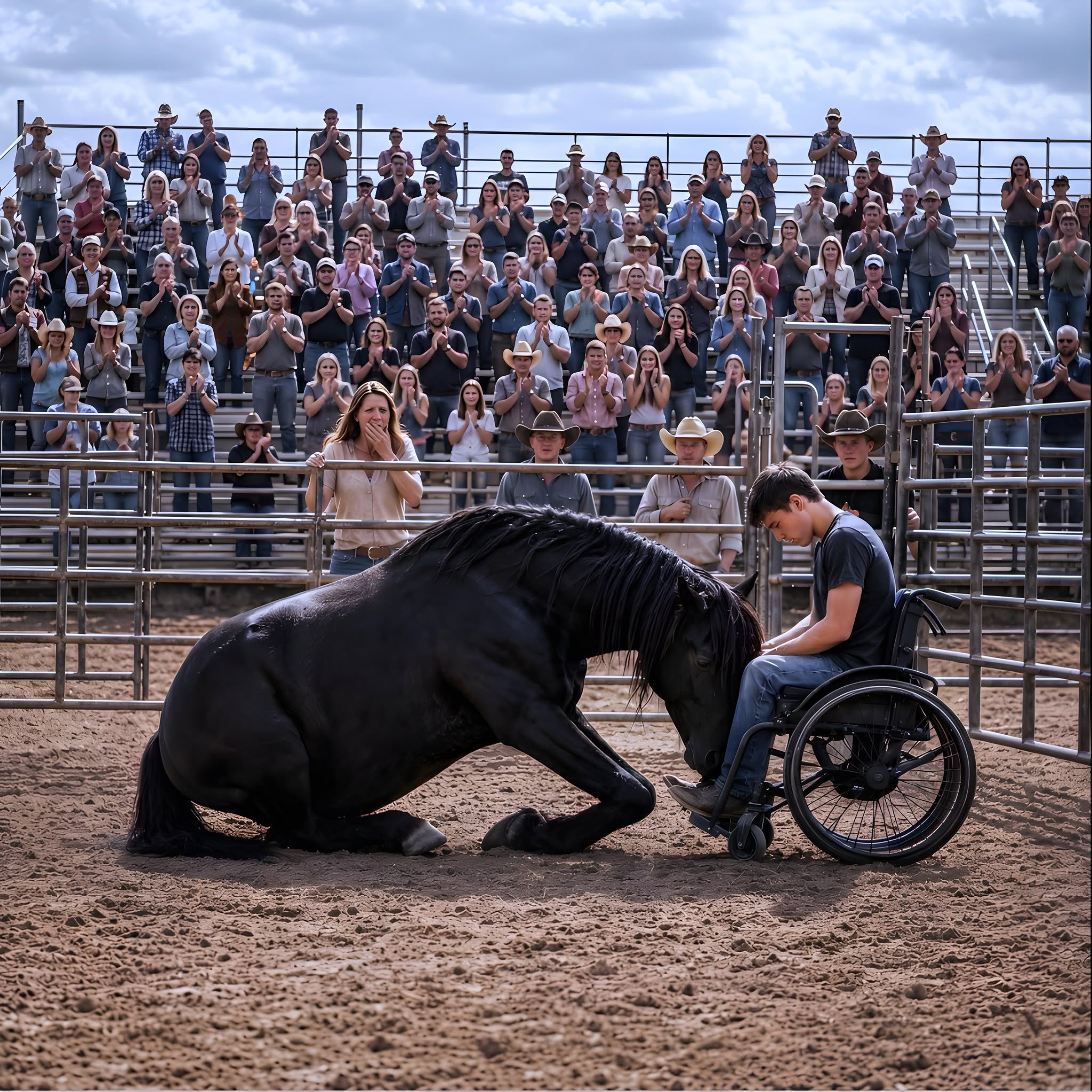
Mason stared at Cinder as if the animal had rewritten a rule he had been living under since the crash. He lifted the rope again, a little more confidently this time, and when Cinder came another step, the mustang lowered his muzzle into the boy’s lap.
Mason froze.
Cinder breathed warm air over his hands.
The anger did not leave the boy’s face all at once. It loosened in pieces. His shoulders dropped first. Then his mouth. Then one hand, still cautious, came up and touched the white star hidden beneath Cinder’s forelock.
Nolan waited.
“What now?” Mason asked, barely above a whisper.
“Now you ask him to back up.”
For the next twenty minutes, Mason moved a thousand-pound mustang with ounces of pressure and the timing of his release. He made mistakes. Cinder forgave most of them. Nolan corrected the rest without making them sound like failure. When the session ended, Mason tried to hand back the rope with a shrug, but his cheeks were flushed and his eyes had changed.
Janelle noticed
Janelle noticed. So did Tessa. So did every volunteer pretending not to stare.
By noon, Nolan was worn out in a way he had not expected. Arena work tired his body. This had reached something deeper. Each child arrived carrying a private weather system—fear, anger, overstimulation, shame—and Cinder responded not by fixing it, but by standing inside it without demanding that it become easier first.
Nolan knew that gift because the horse had given it to him before anyone else.
As they loaded Cinder, Janelle came to the trailer ramp and stopped beside Nolan. She did not clasp her hands or tell him he had changed lives. He appreciated that.
“You understand the kids faster than most visiting trainers,” she said.
Nolan watched Sam secure the divider. “I understand not wanting everyone to make a project out of you.”
Janelle smiled at that, small and tired. “We run Saturday sessions twice a month. I can’t pay much.”
“I didn’t ask.”
“No,” she said. “You didn’t.”
Tessa, standing behind Nolan, reached down and squeezed his shoulder once. He covered her hand with his for a second before letting go.
The visits became part of the rhythm of fall.
Not every session went beautifully. One boy screamed when Cinder sneezed. A girl threw a brush and then sobbed because she thought the horse would hate her. Some days Cinder was too alert, and Nolan ended early while volunteers looked disappointed and Sam looked proud. The work stayed slow, honest, and imperfect. That was why it held.
By late September
By late September, cold began slipping down from the mountains before sunset.
One evening, after chores, Nolan pushed himself through the open gate into Sam’s back pasture. The ground there was rougher than the arena and less forgiving than the lane. Dry clumps of sage grabbed at the wheels. Small rocks jolted through the frame into his spine. He had to choose his path with care, sometimes backing up to find a firmer line, sometimes leaning hard to lift the front casters over a rut.
He went anyway.
Fifty yards from the barn, he stopped and locked his brakes.
The pasture opened around him in layers of gray-green brush and fading gold grass. The sky had turned a deep bruised purple at the horizon. Behind him, the barn lights glowed warm and distant. Ahead, Cinder grazed loose near the fence line, no halter, no rope, no reason to come except the one he chose.
Nolan did not call.
Cinder lifted his head.
The mustang stood with the wind moving through his thickening coat. For a moment he looked like what he had been born to be: a dark horse against open country, free to turn away from every human thing. He could have gone back to grazing. He could have drifted toward the far pasture. He could have kept the whole evening for himself.
Instead, he came
Instead, he came.
His walk was unhurried, loose through the shoulder, head low. He stopped close enough that his chest nearly touched the front of Nolan’s chair, then lowered his muzzle to bump Nolan’s boot. After a breath, he rested his head near Nolan’s knee with the heavy trust of an animal who no longer needed to brace for the hand that came next.
Nolan placed his palm flat against Cinder’s neck.
The horse leaned in.
They stayed like that while the cold gathered.
Nolan looked down at his hands. The boy who had left the rehab hospital would not have recognized them. The palms were hard now, the knuckles scarred from rims and gate latches, the nails permanently rimmed with dirt no brush could fully remove. They were not the hands he had once imagined for himself. They would not lift him into a saddle. They would not make his legs answer.
But they had learned another language.
For two years, Nolan had thought the chair was the end of every sentence about him. People saw it first. He felt it first. Every doorway, every gravel lot, every sympathetic glance had seemed to confirm that his life had narrowed to the size of what he could no longer do.
Cinder shifted his weight and breathed a small cloud into the cold air.
Nolan thought of Lily pressing her helmet against
Nolan thought of Lily pressing her helmet against the mustang’s neck. He thought of Mason holding the rope as if it were proof that his hands still mattered. He thought of his mother at the fence, learning to be afraid and proud at the same time. He thought of Sam, who had never once called him broken and never once pretended he was not in danger.
The grief was still there. It would always be there. Some mornings it still waited at the edge of the bed before Nolan reached for his chair. Some nights he still dreamed he was running and woke with his chest tight and his legs quiet beneath the blankets.
But grief was no longer the only thing that knew his name.
The wind moved across the pasture, rattling dry sage along the fence. Cinder’s ears flicked toward the sound, then back to Nolan. The horse waited, not because he had been trapped, not because he had been conquered, but because he had chosen the boy in the chair and kept choosing him.
Nolan took one slow breath.
Then he patted the dark neck once and dropped his hands to the rims.
“Come on,” he said.
He unlocked the brakes and turned toward the barn lights.
Cinder fell into step beside the right wheel, matching him across the uneven ground. The chair bumped over ruts. The horse adjusted without being asked. Together they moved through the deepening dusk, not quickly, not perfectly, but steadily—two creatures who had learned that freedom did not always mean running away.
Sometimes it meant knowing where to return
Sometimes it meant knowing where to return.
See more on the next page
Advertisement