
That was the closest thing to justice you had seen all night.
After the medical team left, the apartment felt stripped.
No music.
No laughter.
No illusion.
Only papers on the table and people standing in the wreckage of Martín’s different lies.
Elena took Diego’s hand.
“We should go.”
You turned to her.
“Marcia can help you file for updated support if you want.”
Elena looked tired.
“I don’t want his money touching my son.”
Marcia spoke gently.
“It isn’t his money. It’s your son’s legal right.”
Diego looked at his mother.
“I don’t want anything from him.”
You crouched in front of the boy.
“I understand. But sometimes rights are not about wanting someone. They are about making the truth official.”
He considered that with the serious face of a child who had learned too much too early.
“Will it make him my dad?”
You felt your heart crack.
“No,” you said softly. “Only you get to decide who earns that word.”
Diego nodded.
Then he looked at Martín one last time.
“You look like me,” he said. “But I don’t want to look like you.”
No adult in the room could have said it better.
Elena led him out.
Martín watched the door close behind them as if he had lost something.
Maybe he had.
Maybe for the first time, he understood that secrets do not preserve life. They rot it from the inside until even the innocent can smell it.
But understanding came too late to be useful.
Brenda stood next.
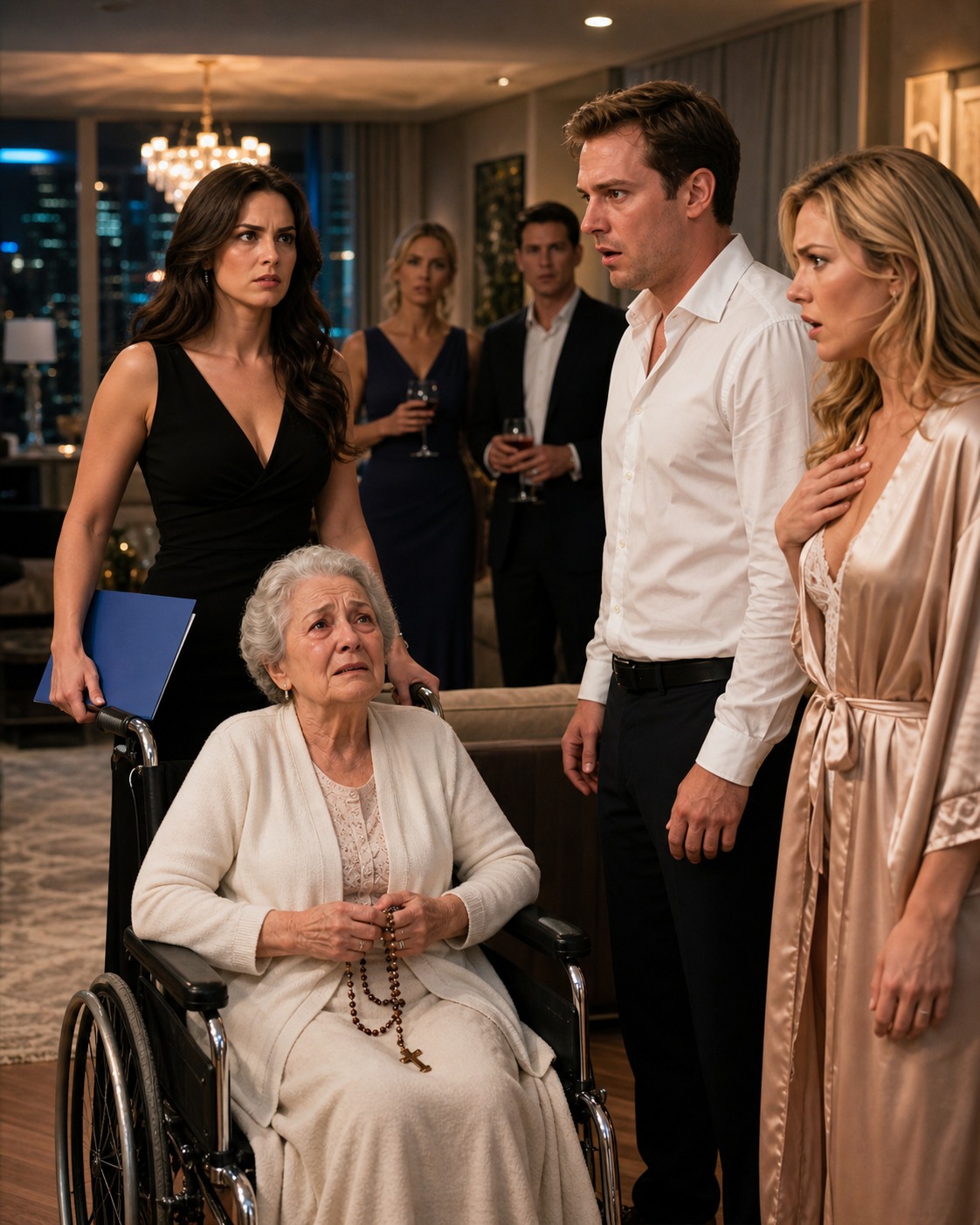
Her face was pale, makeup streaked, your silk robe clutched around her body like a confession.
She looked at you.
“I didn’t know.”
You held her gaze.
“You knew I existed.”
She flinched.
“Yes.”
“That was enough to ask better questions.”
She nodded slowly.
“You’re right.”
You did not expect that.
It softened nothing, but it made the room quieter.
Brenda looked down at the robe.
“I’ll send this back.”
“No,” you said. “Keep it.”
She looked up, startled.
You smiled faintly.
“It looks ruined now.”
She almost laughed, but it turned into a sob.
Then she turned to Martín.
“I want your things out by tomorrow.”
His mouth fell open.
“My things? Brenda, be serious.”
“I am.”
“You’re throwing me out because of a scene my wife created?”
Brenda looked around the room.
“No. I’m throwing you out because this is the first time I’ve met you.”
He stared at her.
She walked to the bedroom and closed the door.
You watched him stand in the middle of the apartment he thought was his new beginning, surrounded by legal papers, abandoned wine glasses, and people who no longer believed him.
For years, Martín had survived by assigning women roles.
You were the caretaker.
Brenda was the escape.
Patricia was the difficult sister.
Elena was the mistake.
His mother was the burden.
Tonight, every role had walked offstage.
And he had no script left.
Marcia touched your elbow.
“Claudia, we should go.”
You nodded.
You picked up your purse.
Martín suddenly stepped toward you.
“Wait.”
You did not stop.
“Claudia.”
His voice changed.
Softer.
The old voice.
The one that used to make you pause in hallways, used to make you hope the man you married was still somewhere under the selfishness.
You turned anyway.
Not because he had power.
Because you wanted to see if he would finally say something true.
He looked awful.
Older.
Smaller.
Almost human.
“I made mistakes,” he said.
You waited.
That was not truth.
That was packaging.
He swallowed.
“I was overwhelmed. My mom’s illness, our marriage, money problems. I didn’t know how to breathe.”
You nodded slowly.
“Interesting.”
Hope flickered in his face.
Then you killed it.
“You couldn’t breathe, so you left your mother drowning and asked me to hold her underwater quietly.”
His face hardened.
“I’m trying to apologize.”
“No,” you said. “You’re trying to reduce the size of what you did until it can fit inside the word mistake.”
He said nothing.
You stepped closer.
“You did not make one mistake. You built a system where every woman in your life carried a piece of your cowardice. And when it got heavy, you blamed us for dropping it.”
For a second, he looked truly wounded.
Good.
Truth should hurt the person it describes.
“I loved you,” he whispered.
You almost believed that he believed it.
That was the saddest part.
“No,” you said. “You loved being cared for.”
Then you walked out.
The elevator ride down felt different from the ride up.
On the way up, your hands had been shaking around a folder and a wheelchair. On the way down, your hands were empty. For the first time in years, empty did not feel like loss.
It felt like release.
Marcia stood beside you.
“You did well.”
You stared at the elevator doors.
“I don’t feel well.”
“You don’t have to.”
Your reflection in the mirrored wall looked exhausted. Hair pulled back, lipstick faded, eyes red, shoulders stiff from years of carrying other people’s emergencies. But beneath all that, there was something you had not seen in a long time.
You.
Not Martín’s wife.
Not Doña Refugio’s nurse.
Not the woman abandoned with instructions.
Just you.
When you reached the lobby, the guard would not meet your eyes.
Good.
Let him remember you.
Let him remember the night a woman arrived with a wheelchair and left with her name back.
Outside, Mexico City moved like nothing had happened.
Cars. Rain on pavement. A couple laughing under one umbrella. A delivery driver arguing into his phone. The world did not pause for your marriage ending.
That comforted you.
Some endings deserve no ceremony.
Only movement.
The weeks that followed were ugly in practical ways.
Divorce was not a dramatic door slam. It was forms, deadlines, account freezes, inventories, passwords, signatures, receipts, screenshots, and the humiliating work of proving what you had lived. Marcia guided you through each step with the calm brutality of a woman who knew the law could be both shield and maze.
Martín tried everything.
First anger.
Then guilt.
Then sudden tenderness.
He sent long messages about memories, about your first apartment, about the dog you almost adopted, about the time you danced barefoot in Veracruz. He attached old photos like evidence that love had once existed and therefore should excuse everything that came after.
You did not answer.
Then he tried his mother.
She misses you.
Patricia sent you a screenshot five minutes later.
He hasn’t visited once.
That one hurt, though you wished it didn’t.
Doña Refugio’s health improved slightly under Patricia’s care. Not magically. Life is not that kind. But her medication schedule became stable, her blood sugar improved, and she started sitting near a sunny window instead of waiting in a dark bedroom for a son who resented her breathing.
Patricia called you one night.
“She asks for you.”
You closed your eyes.
“I don’t know if I can.”
“I understand.”
Silence stretched between you.
Then Patricia said, “She keeps saying she raised him wrong.”
You sat down.
“What do you say?”
“I tell her maybe. Then I tell her the rest is his.”
You liked Patricia more every time she refused to make truth comfortable.
A month later, you visited.
Doña Refugio cried when she saw you. You thought you would feel trapped, pulled back into duty by her weakness. But instead, you felt calm. You brought flowers, not medicine. You stayed one hour, not all day. You kissed her forehead when you left, not because anyone expected it, but because you chose to.
Choice changed everything.
Elena filed the support claim.
Diego refused to attend the first meeting, and nobody forced him. Martín’s lawyer tried to argue uncertainty, until Marcia produced the DNA report, emails, transfers, and proof that Martín had known for years. The judge was not amused.
Diego’s support was ordered.
Elena cried in the hallway afterward.
Not because of the money.
Because the court record finally said her son had not been imagined, exaggerated, or invented out of bitterness.
Some truths need a stamp before the world stops calling them drama.
Brenda moved out of the Polanco apartment before Martín could.
That part made you laugh for the first time in weeks.
Apparently, she read the lease, called her father, and found a lawyer faster than Martín could invent a new victim story. She sent your robe back in a box with no return address. It smelled strongly of expensive detergent and shame.
You donated it.
Not because you were noble.
Because you never wanted to see it again.
Martín ended up in a small furnished studio near his office, though he told people he had “chosen simplicity.” His friends stopped inviting him to dinners after the story spread. Not because they all suddenly gained morals, but because public disgrace makes cowards contagious.
You did not care.
That surprised you most.
For years, you thought his downfall would satisfy you. Instead, it bored you. Watching him lose the audience was less important than realizing you no longer wanted a seat in the theater.
Three months after the night at the apartment, Marcia called.
“The house issue is clear,” she said. “He cannot sell it. Doña Refugio’s care interest is documented, and your contributions to maintenance are part of the marital asset review.”
You looked around your kitchen.
Your kitchen.
Not the marital house.
Not the room where you waited for Martín to come home.
A small rental with peeling paint, a noisy refrigerator, and sunlight that arrived every morning across the table like a promise.
“Good,” you said.
“There’s more,” Marcia added. “Based on the account misuse, we can press for reimbursement.”
You looked at the little plant on your windowsill.
The one you bought the day after leaving.
It was already growing new leaves.
“Do it.”
Your voice did not shake.
The final divorce hearing happened on a rainy Tuesday.
Martín wore a navy suit you had bought him for an anniversary. He looked at you when you entered, expecting something — sadness, anger, maybe nostalgia. You gave him politeness, which offended him more than hatred would have.
Marcia sat beside you.
Martín’s lawyer spoke about emotional strain, marital breakdown, mutual distance.
Mutual.
You almost smiled.
The legal language tried so hard to make abandonment sound symmetrical.
Then Marcia spoke.
She laid out the financial misconduct, the caregiving abandonment, the hidden child support issue, the misuse of joint funds, the messages about waiting for Doña Refugio to die so the house could be sold.
The judge’s face changed at that part.
Martín stared at the table.
For once, he had no note to leave.
When it was your turn to speak, you stood.
You had written a statement. Three pages, revised twice, printed neatly. But when you looked at it, the words felt too polished for the life you had lived.
So you folded the paper.
“I spent years believing loyalty meant endurance,” you said. “I thought being a good wife meant carrying what my husband refused to touch. His mother’s illness. His lies. His loneliness. His anger. His secrets.”
The courtroom was quiet.
You continued.
“But marriage is not a place where one person gets to disappear and leave the other holding all the bodies.”
Martín flinched.
Good.
“I am not asking this court to punish him for failing to love me,” you said. “You cannot legislate decency. I am asking for a fair division of what he misused, recognition of what he abandoned, and the legal freedom to stop being responsible for a man who called selfishness happiness.”
The judge granted the divorce.
The financial claims continued separately, but the marriage ended that day.
No thunder.
No music.
Just a signature.
A stamp.
A life returned.
Outside the courthouse, Martín followed you to the steps.
“Claudia.”
Rain misted between you.
You turned.
He looked thinner. Maybe he was eating badly. Maybe nobody was reminding him to take his vitamins, wash his shirts, pay bills, call his mother, schedule repairs, buy groceries, breathe responsibly.
Maybe he was finally meeting the weight you had carried.
“I miss you,” he said.
You believed him.
That was the strange part.
He probably did miss you.
Not the full person. Not your thoughts, your dreams, your laughter, your exhaustion, your secret tenderness. He missed the function you served. The warm house. The handled details. The mother cared for. The bills remembered. The emotional weather managed before he had to notice it was raining.
“I know,” you said.
His eyes lit with hope.
Then you finished.
“But I don’t miss who I was with you.”
The hope died.
You walked away.
One year later, Doña Refugio passed away in her sleep.
Patricia called you first.
Not Martín.
You went to the funeral.
You stood beside Patricia, not beside your ex-husband. Martín arrived late, wearing sunglasses and grief that looked borrowed. He cried loudly near the coffin. Patricia watched him with a face carved from stone.
You did not judge the tears.
Maybe they were real.
Maybe men like Martín cry hardest when there is no longer anything practical required of them.
Diego came with Elena.
He stood in the back, uncertain. He had met Doña Refugio twice before she died, after Patricia gently asked if he wanted the chance. The old woman had cried when she saw him and said, “You have his eyes, but I hope you keep your own heart.”
Diego did not know what to do with that.
Neither did anyone else.
At the cemetery, Martín tried to approach him.
Diego stepped behind Elena.
Martín stopped.
That was progress, maybe.
Or just witnesses.
After the burial, Patricia invited you for coffee.
You accepted.
The two of you sat in a small café near the cemetery, both too tired for small talk.
“She left you something,” Patricia said.
You frowned.
“No.”
“She did.”
“I don’t want anything.”
Patricia smiled sadly.
“That’s why she wanted you to have it.”
She handed you an envelope.
Inside was a letter written in shaky handwriting.
Claudia, forgive me for letting my son make you the daughter I should have protected. Thank you for washing me when I was ashamed, feeding me when I was afraid, and taking me to the truth when my own blood left me behind. I do not leave you money. I leave you my blessing, and the permission I should have given every woman sooner: go live for yourself.
You read it twice.
Then you pressed the letter to your chest and cried.
Not for Martín.
Not for the marriage.
For the older woman who had learned too late, but still learned.
For yourself.
For all the women trained to prove love by disappearing into service.
Patricia reached across the table and squeezed your hand.
“We’re family, if you want,” she said.
You laughed through tears.
“Without Martín?”
“Especially without Martín.”
Years passed, but not many.
Enough for your hair to grow longer.
Enough for the plant on your windowsill to become too big for its pot.
Enough for you to stop sleeping with your phone under your pillow.
You built a quiet life.
Not glamorous.
Better.
You took a job managing operations for a small home-care agency after realizing you knew more about caregiving systems than half the administrators you had once begged for help. You became frighteningly good at spotting exhausted wives and forgotten mothers. You trained staff to ask the question nobody had asked you soon enough.
“Who is caring for the caregiver?”
Sometimes that question made women cry.
You always kept tissues nearby.
Patricia became your friend.
Elena too, slowly.
Diego grew taller, more serious, and eventually started calling you “Tía Claudia” after you helped him apply for a scholarship. The first time he said it, you pretended not to cry because teenage boys are allergic to visible emotion.
He noticed anyway.
“You’re doing the face,” he said.
“What face?”
“The lady-about-to-cry face.”
You laughed.
“Go do your homework.”
He smiled.
And there it was again.
Proof that blood is not the only thing that makes family.
Martín never fully disappeared.
Men like him rarely do. They send birthday messages to people they ignored, apologies at inconvenient hours, dramatic emails when their lives feel empty. He tried to reconnect with Diego twice. Diego answered once, politely, and said he was not ready.
Martín complained to Elena that she had poisoned him.
Elena hung up.
Growth looked good on her.
On the third anniversary of your divorce, you returned to Polanco for work.
Not to that apartment.
Never again.
But to a nearby building where your agency was pitching a care plan for elderly clients. After the meeting, you walked past the old tower and looked up at the eleventh floor.
For a moment, you saw it all again.
The elevator.
The robe.
The wine.
Doña Refugio’s wheelchair.
Diego’s face.
Martín’s panic.
Your folder in your hand like a match.
You expected pain.
Instead, you felt gratitude for the woman you had been that day.
Not because she was fearless.
She was terrified.
But she had finally understood that leaving quietly would only protect the liar. So she made the truth public enough that no one could fold it back into a note.
Your phone buzzed.
A message from Patricia.
Dinner Sunday? Elena and Diego are coming. Bring that cake you pretend you make from scratch.
You smiled.
It is from scratch. The bakery scratches the receipt.
She sent twelve laughing emojis.
You kept walking.
The city was loud, bright, indifferent.
Your life was not perfect.
No life worth having is.
But it was honest.
And honesty, after years of being married to a man who used lies like furniture, felt like luxury.
That Sunday, your apartment filled with voices.
Patricia brought flowers.
Elena brought tamales.
Diego brought his scholarship acceptance letter and tried to act casual while everyone screamed.
You put the bakery cake on the table and announced it was homemade by professionals.
Everyone laughed.
Halfway through dinner, Diego raised his glass of soda.
“To Tía Claudia,” he said.
You looked up, startled.
He cleared his throat, embarrassed but determined.
“For opening the door.”
The room went quiet.
Patricia smiled.
Elena wiped her eyes.
You looked at this strange, patched-together family created from the wreckage of Martín’s lies.
“What door?” you asked softly.
Diego shrugged.
“All of them.”
You could not speak.
So you lifted your glass.
Years earlier, Martín had left you a note.
Need to be happy. Take care of my mother. You know how to do it better.
For a long time, you hated that sentence.
Then you understood it had been the first honest thing he ever wrote.
You did know how to care better.
You cared better for Doña Refugio.
For Diego.
For Elena.
For Patricia.
And finally, at last, for yourself.
That was the part Martín never expected.
He thought leaving you with his burdens would bury you.
Instead, you carried them straight to his door, exposed every secret he had built his new life on, and walked away lighter than you had arrived.
People later told the story as if it was revenge.
They loved that version.
The wife dragging the sick mother to the mistress’s apartment. The stolen robe. The hidden son. The divorce papers on the table. The coward husband caught barefoot in his luxury lie.
And yes, maybe revenge was in the room.
A little.
You are human.
But the real story was not revenge.
It was return.
You returned his mother to him.
You returned his son to the truth.
You returned his lies to the room where he had been celebrating them.
Then you returned yourself to the life he had interrupted.
One night, long after everyone left, you found Doña Refugio’s letter in your drawer. You read the last line again.
Go live for yourself.
So you did.
You turned off the kitchen light.
Watered the plant.
Locked the door.
And for the first time in a long time, you did not feel abandoned in the silence.
You felt chosen.
By yourself.
And that was the one love Martín could never steal.
See more on the next page
Advertisement