
PART 2: THE FAMILY HE THOUGHT HE COULD THROW AWAY
You opened the door, and Martín stopped breathing.
Standing in the hallway was a boy with a small black backpack, a faded hoodie, and eyes so much like Martín’s that the entire room seemed to understand before anyone spoke. Beside him stood a thin woman in her late thirties, holding a plastic folder against her chest like it contained the last pieces of her dignity.
The boy looked at Martín and whispered one word.
“Papá?”
The room died.
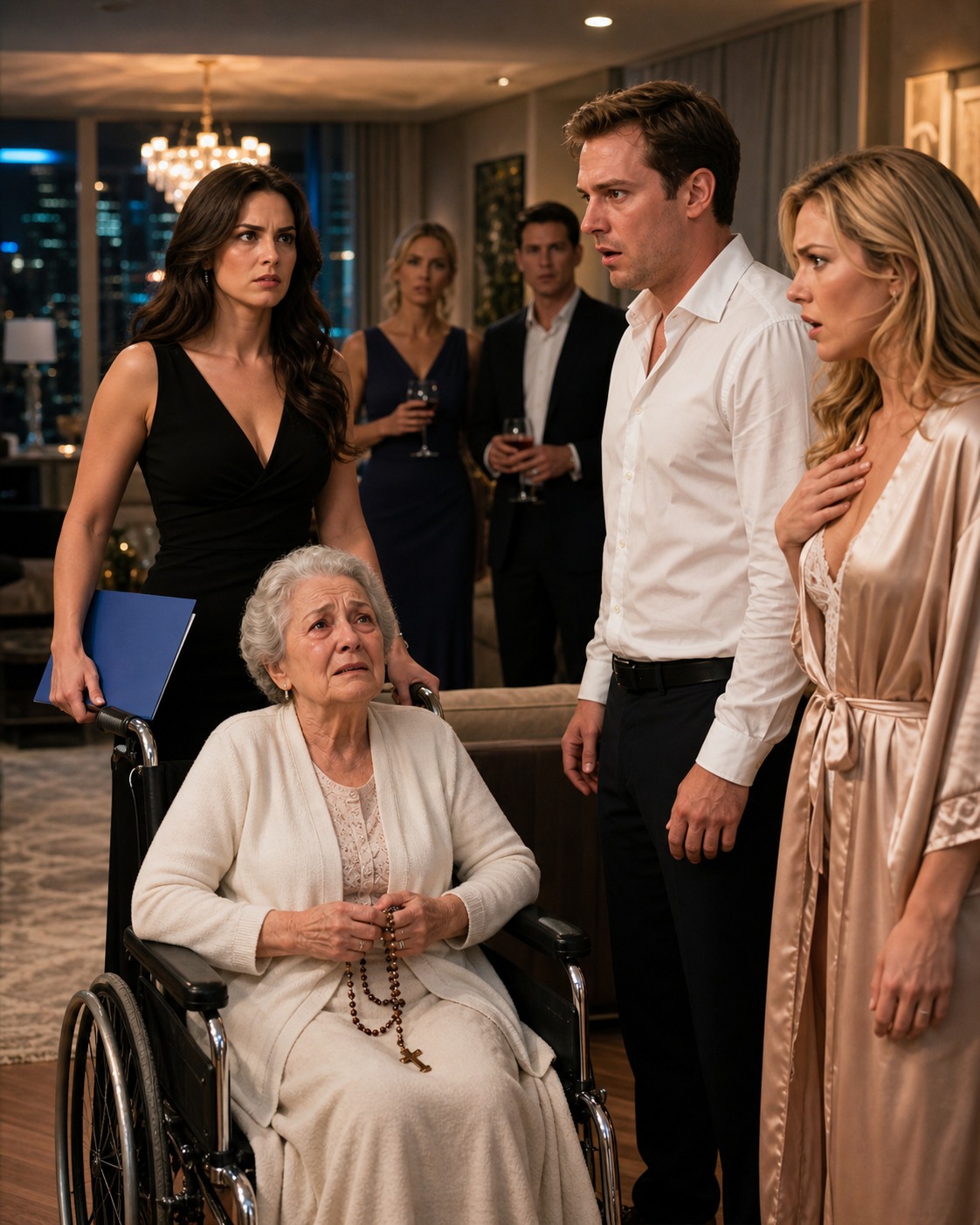
Brenda’s hand flew to her throat. One of Martín’s friends actually set his glass down as if the sound might break something. Doña Refugio stared at the boy from her wheelchair, her lips trembling, her rosary frozen between her fingers.
You stepped aside.
“Come in, Diego,” you said softly.
The boy looked at you first, because children always know who is safe before adults admit who is dangerous. Then he stepped into the luxury apartment with shoes too worn for the marble floor. His mother followed him, face pale but steady.
Martín looked like he wanted to disappear through the window.
“Claudia,” he said, voice cracking, “what the hell is this?”
You laughed once.
Not because anything was funny.
Because after fifteen years of marriage, after caring for his mother, after washing sheets, counting pills, paying bills, swallowing loneliness, and being handed a note like a receipt for abandonment, he still believed he had the right to ask questions as if he were the victim.
“What is this?” you repeated. “This is your son.”
Brenda turned slowly toward him.
“Your what?”
Martín shook his head too fast.
“No. No, this is not—Claudia is doing this to humiliate me.”
The woman beside Diego finally spoke.
Her voice was quiet, but it carried across the room.
“You humiliated yourself, Martín. Ten years ago.”
Doña Refugio made a sound like pain.
“Mijo,” she whispered. “Who is that child?”
Martín would not look at her.
That told her everything.
You watched the truth move through his mother’s face. Confusion first. Then recognition. Then shame so deep it seemed to age her in seconds. The woman he had dumped in your house like old furniture was now watching the son she raised become a stranger in front of witnesses.
You almost felt sorry for him.
Almost.
Then you remembered the messages.
As soon as the old woman dies, we sell the house.
Claudia will take care of everything. She always does.
I deserve a clean life. No diapers, no sick people, no drama.
Clean life.
That was what he had called abandoning everyone who depended on him.
You walked to the coffee table and tapped the blue folder.
“Let me explain, since Martín seems to have forgotten how truth works.”
Martín stepped toward you.
“Don’t.”
You looked at him.
“Don’t what? Speak? You should have asked me that before leaving your mother in my bedroom with a note.”
One of his coworkers muttered, “Man, what is going on?”
You turned toward the room.
“What’s going on is simple. My husband moved into this apartment with his mistress using money from our joint account. He left his sick mother in my care because he considered her inconvenient. And for ten years, he has been hiding a son from his entire family.”
Diego lowered his eyes.
That broke something in you.
This child had not come here to be a weapon. He had come because he had already been treated like a secret for too long.
You placed a hand lightly on his shoulder.
“None of this is your fault,” you told him.
His eyes filled.
Martín’s face twisted.
“Don’t talk to him like you know him.”
You looked at him coldly.
“I know more about him than you ever bothered to.”
The woman beside Diego lifted her folder.
“My name is Elena Vargas,” she said. “I met Martín eleven years ago when he was working in Monterrey. He told me he was separated. He told me he was getting divorced. When I got pregnant, he cried and said he wanted to be a father.”
Her voice wavered, but she did not stop.
“Then he disappeared.”
Doña Refugio covered her mouth.
Elena looked at her gently.
“I tried to find your family. He told me you were dead.”
That sentence hit Doña Refugio like a slap.
“My son told you I was dead?”
Elena nodded.
“I’m sorry.”
Doña Refugio turned to Martín.
“Martín…”
He looked anywhere but at her.
Brenda backed away from him as if his lies had become contagious.
“You told me you didn’t have children,” she said.
Martín snapped.
“I don’t.”
The room froze.
Diego flinched.
You felt rage rise through you so fast your hands went cold.
Elena made a tiny sound, but she did not cry. Maybe she had cried all the tears Martín deserved years ago. Maybe mothers learn to save crying for places where children cannot see.
You stepped in front of Diego.
“You don’t get to say that in front of him.”
Martín laughed bitterly.
“Oh, now you’re defending the kid? You brought him here like a prop.”
“No,” you said. “I brought him here because Elena contacted me after she saw your engagement-style photos with Brenda online. She recognized the man who disappeared from her son’s life and realized you had not died, not divorced, not suffered some tragedy. You had simply moved on to the next woman you planned to use.”
Brenda’s eyes narrowed.
“Engagement-style photos?”
You glanced at her.
“Don’t look surprised. He promised you a ring after his mother died and the house sold, didn’t he?”
Her silence answered.
One of the guests whispered, “This is insane.”
You turned back to Martín.
“It gets better.”
His face darkened.
“Claudia, I swear—”
“No. You don’t get to swear anymore. You have spent years lying on every name that should have mattered to you.”
You opened the folder and pulled out copies.
Bank transfers.
Screenshots.
A birth certificate.
Messages between Martín and Elena from years ago.
And the newest document — a legal notice requesting child support review.
You placed them on the table one by one.
“You used our joint account to pay for this apartment. You drained money meant for your mother’s medicine. You hid income during your previous child support conversations. And now you were planning to sell Doña Refugio’s house after she died, even though half of that property was legally protected for her care.”
Martín stared at you.
For the first time, he looked afraid of your intelligence.
That pleased you more than it should have.
“You were never supposed to see those,” he whispered.
You smiled.
“I know.”
Brenda picked up one screenshot with trembling fingers.
Her face changed as she read.
Then she turned on him.
“You said your wife was cold. You said she hated your mother. You said you were trapped.”
You almost laughed again.
Men like Martín always needed a villain woman to sell themselves as heroes.
First you.
Then his mother.
Then Elena.
Eventually Brenda too.
He raised his hands.
“Baby, listen. She’s manipulating this. Claudia has always been bitter because I wanted more out of life.”
You looked around the luxury apartment.
At the stolen robe.
The wine.
The guests.
The marble.
The sick mother in the wheelchair.
The hidden child by the door.
“More?” you asked. “No, Martín. You didn’t want more out of life. You wanted a life with no consequences.”
Doña Refugio began to cry.
Not loud, not dramatic.
Just quiet tears sliding down the soft, tired face of a woman who had spent her life defending a son who saw her as a burden waiting to die.
You knelt beside her.
“Mamá Recu,” you said softly, “your daughter is on her way. She knows everything. You won’t be alone.”
She looked at you.
“Why are you still kind to me?”
That question nearly broke you.
Because you had asked yourself the same thing all afternoon while washing her hair.
Why be gentle to the mother of the man who shattered you?
But the answer had been clear the moment she asked if you were taking her to an asylum. She was not the one who left the note. She was not the one who stole your robe. She was not the one who planned to sell the house after her death.
“You are not furniture,” you said. “And you are not his trash to leave behind.”
She sobbed then.
Brenda’s face softened for half a second before fear hardened it again.
“No,” Brenda said suddenly. “No, I can’t do this. Martín, tell them to leave.”
You stood.
“You wanted his new life. Here it is.”
She shook her head.
“His mother needs medical care. I don’t know how to do any of that.”
“Neither did I,” you said. “I learned.”
“I have work. I have plans. This apartment isn’t set up for—”
“For reality?” you asked.
Her mouth closed.
You did not hate Brenda as much as you expected to.
She had been cruel, yes. She had worn your robe, smiled in photos, believed the version of him that made you look small and bitter. But now she was standing inside the truth she helped decorate, and the room was beginning to smell rotten to her too.
Martín moved toward her.
“Brenda, don’t listen to them. My mother is Claudia’s responsibility until the divorce is settled. She’s been caring for her for years.”
You turned slowly.
There it was.
The sentence that stripped the final illusion from the room.
Not my mother.
Not our responsibility.
Not I made a mistake.
Just logistics.
You picked up the divorce papers and placed them against his chest.
“No. I was your wife, not your unpaid nursing staff. I cared for her because I loved her more decently than you did.”
He grabbed the papers.
“You think a judge will let you dump my mother here?”
You smiled.
“No. A judge will decide many things. But tonight, everyone in this room knows exactly who left whom.”
The doorbell rang again.
This time, Martín jumped.
You did not.
You had been waiting for this one.
You opened the door.
A woman in her forties stood there with a suitcase, red eyes, and the fury of someone who had spent years being told she was dramatic only to find out she had not been dramatic enough.
“Where is my mother?” she demanded.
Doña Refugio sobbed.
“Patricia.”
The woman rushed past you and knelt at the wheelchair.
“Mamá.”
The two women held each other, crying so hard the entire room looked away.
Patricia had not visited often. You used to resent her for it. Martín always said his sister was selfish, unstable, ungrateful. He said she only called when she wanted money. He said Doña Refugio preferred him because daughters “leave” and sons “stay.”
Another lie.
Patricia looked up at Martín with hatred.
“You told me Claudia didn’t let you take care of Mamá.”
Martín’s mouth opened.
Nothing came out.
“You told me she controlled the house. You told me she wanted the property.”
You crossed your arms.
“I heard a different version. Apparently you abandoned your mother and I was the only one willing to help.”
Patricia looked at you.
For a moment, the two of you understood each other perfectly.
You had both been kept apart by the same man.
Divide the women.
Use the women.
Blame the women.
Then act exhausted when the women stop serving.
Patricia stood.
“You’re done, Martín.”
He laughed, but it sounded weak.
“What are you going to do? Take her to Guadalajara? You couldn’t even call more than twice a month.”
Patricia stepped closer.
“I called every week. You blocked my number on her phone.”
Doña Refugio gasped.
You closed your eyes.
Of course he had.
Control was easier when every caretaker thought she was alone.
Patricia pulled out her own phone.
“I have messages. Bank receipts. Recordings. You told me Mamá was confused and didn’t want visitors. You told Claudia I didn’t care. You told Mamá I was ashamed of her illness.”
Martín looked trapped now.
Not by walls.
By women comparing notes.
It was almost beautiful.
Elena spoke next.
“He told me his family would take my son from me if I came looking.”
Brenda’s voice trembled.
“He told me Claudia was mentally unstable.”
You smiled faintly.
“And he told me he needed space to think.”
Doña Refugio wiped her tears.
“He told me all of you were too busy to love me.”
That sentence destroyed the last bit of noise in the room.
Even the guests looked ashamed, though they had done nothing except arrive for wine and gossip.
Martín looked around, searching for an ally.
There was none.
So he did the only thing men like him do when charm fails.
He became cruel.
“You’re all enjoying this, aren’t you?” he spat. “Poor Martín, the villain. Nobody cares what I’ve carried. My mother’s sickness. Claudia’s coldness. Patricia’s drama. Elena’s mistake. Brenda’s needs. Everyone always wants something from me.”
Diego looked up.
“Did I want something?”
The room shattered again.
Martín froze.
The boy stepped forward, small but brave in the way children become when disappointment has already aged them.
“I wrote you letters,” Diego said. “Mom said maybe you didn’t get them. I drew you a truck. I saved it for two years.”
Elena covered her mouth.
Diego’s voice shook.
“I didn’t want money. I wanted to know if you looked like me.”
Martín stared at him.
For one second, something human flickered in his face.
Then pride killed it.
“I didn’t know if you were mine.”
Elena inhaled sharply.
You reached for the folder and pulled out the DNA report.
“You did.”
You held it up.
“Elena sent it to you eight years ago. I found the email.”
Martín’s face went gray.
Diego looked at his mother.
She nodded through tears.
“You knew?” the boy whispered.
Martín said nothing.
And that silence did what shouting never could.
It told Diego the truth.
The child stepped back as if the floor had moved beneath him.
You wanted to put your arms around him, but Elena reached him first. She knelt, pulled him close, and pressed her face into his hair.
You looked at Martín and felt something inside you go cold forever.
Not heartbreak.
Not jealousy.
Not even anger.
Judgment.
You had loved this man once. You had built meals around his moods, folded his shirts, defended his lateness, explained away his silences, cared for his mother, and prayed your marriage would become gentle again.
But now you saw him clearly.
He was not weak.
Weakness would have been forgivable.
He was empty where responsibility should have lived.
Patricia stood behind Doña Refugio’s wheelchair.
“My mother is coming with me tonight,” she said.
Martín’s eyes snapped to her.
“No, she’s not. She can’t travel.”
“She won’t travel far tonight. I already booked a medical transport service and a short-term care apartment nearby until we decide what’s best for her.”
You nodded.
“I packed her medications and medical history.”
Patricia looked at you, and her face softened.
“Thank you.”
You shrugged because if you accepted the gratitude fully, you might cry.
Martín pointed at you.
“You planned this.”
“Yes,” you said.
“You had no right.”
That made you laugh.
A real laugh this time.
“No right? You left me a human being and a note. You moved in with your mistress using marital money. You hid a son. You lied to your sister, your mother, your lover, and your wife. Martín, if audacity were real estate, you’d own half the city.”
One of the guests coughed to hide a laugh.
Brenda shot him a look.
But even she looked like she wanted to laugh and scream at the same time.
Then your phone rang.
Your lawyer.
You put it on speaker.
“Claudia,” she said, “I’m downstairs with the notary and the financial auditor. Do you want us to come up?”
Martín stared.
“You brought a lawyer?”
You smiled.
“No, Martín. I brought witnesses.”
His anger finally slipped into panic.
“Claudia, wait. We don’t need to make this legal tonight.”
“You made it legal when you used our joint account for your apartment.”
“You don’t understand. That money—”
“Was traceable,” you said. “Yes, I noticed.”
Brenda turned slowly toward him.
“Our rent came from your joint account?”
He swallowed.
“It was temporary.”
Her face hardened.
“My name is on the lease as co-responsible.”
You almost felt bad for her again.
Almost.
Martín had not only used her.
He had made her legally touch the mess.
Your lawyer entered with two people behind her and the calm expression of a woman who billed by the hour and enjoyed precision. Her name was Marcia, and she had been your secret weapon for three weeks, ever since you found the first suspicious transfer and the first message about selling the house.
She looked around the apartment.
“Well,” she said, “this is lively.”
You gestured to the table.
“Everything is there.”
Marcia nodded and began sorting documents like she was arranging knives.
“Mr. Álvarez,” she said to Martín, “you’ve been served notice of divorce proceedings, request for financial disclosure, temporary injunction regarding marital assets, and preservation notice regarding digital and banking records.”
Martín looked at her.
“This is my home.”
Marcia glanced at the apartment.
“Interesting. According to the lease, Ms. Brenda Salas is co-signer, and according to the payment records, funds came from a marital account. So legally, it is complicated. Emotionally, it appears crowded.”
Brenda sank onto the sofa.
“I’m going to be sick.”
You said nothing.
There are moments when the other woman discovers she was not chosen.
She was recruited.
That lesson does not need your commentary.
Patricia’s medical transport arrived twenty minutes later.
Doña Refugio held your hand before they moved her.
Her skin felt thin, warm, fragile.
“Claudia,” she whispered, “I don’t deserve what you did for me.”
You leaned close.
“Maybe not. But I deserved to leave without becoming cruel.”
She cried.
“So did I,” she said.
You understood what she meant.
Somewhere in her life, long before illness and diapers and pills, Doña Refugio had become the kind of mother who believed a son’s comfort mattered more than a daughter’s truth. Maybe she had learned it from her own mother. Maybe from poverty. Maybe from a husband whose ghost still sat at family tables.
But tonight, that chain had snapped in a room full of witnesses.
Patricia touched your shoulder.
“I’ll take care of her.”
“I know.”
“Not because he failed,” she added. “Because she’s my mother too.”
You nodded.
That distinction mattered.
As they wheeled Doña Refugio out, she looked once at Martín.
“Mijo,” she said.
He stepped forward, perhaps expecting forgiveness.
Her voice broke.
“You left me like I was already dead.”
He stopped.
She turned her face away.
See more on the next page
Advertisement
To see the full cooking instructions, go to the next page or click the Open button (>) and don't forget to SHARE it with your friends on Facebook.