
I had loved Ethan—truly, earnestly—but I could no longer ignore the small moments I had stacked neatly in the pantry of my mind, thinking I’d take them out later and deal with them then: the times he’d joked about where I went and who I was with, the way he frowned if I worked late, the sigh he couldn’t hide when I disagreed in public. None of it was monstrous; that’s what had made it easy to file away. But a thousand gentle tilts can still reroute a river.
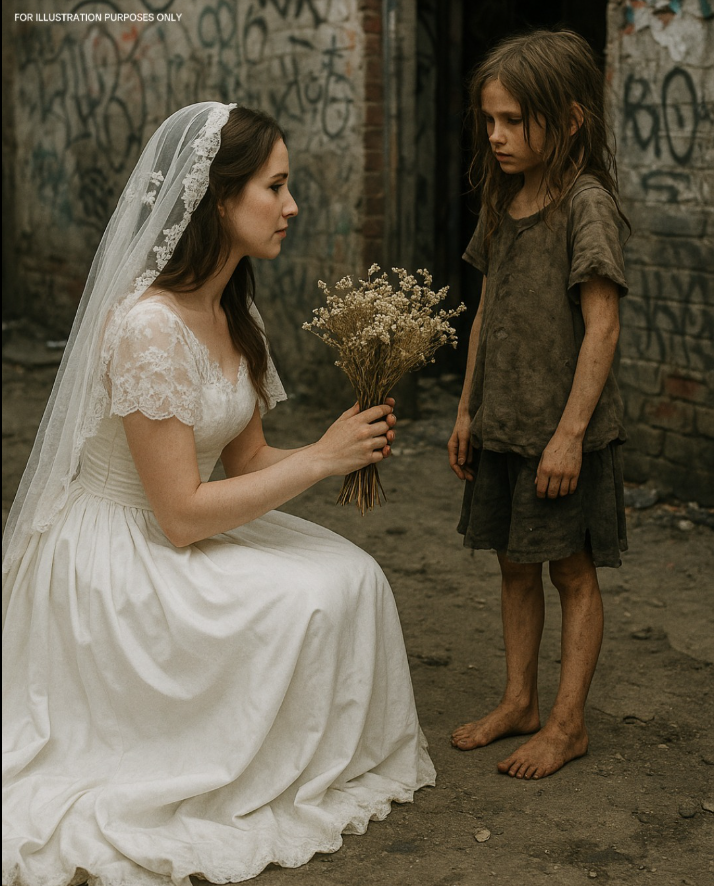
For illustrative purposes only.
I dialed Anna’s number before the second coffee cooled. She answered on the third ring.
“It’s me,” I said.
“Are you all right?” she asked.
“I am,” I said, surprised to find that it was true. “How are you and Polly?”
“We’re okay,” she said. I could hear the smile in her voice when she said Polly’s name. “She’s coloring. She keeps drawing brides.”
“Tell her this bride is grateful,” I said. “I’d like to stop by, if that’s all right.”
When I arrived, Polly showed me a portrait of three figures holding hands under a yellow sun: a tall one with a crown of scribbled flowers, a medium one with a brown ponytail, and a small one with a long, long braid. “That’s you, that’s Mom, and that’s me,” she explained. “We’re at a park picnic. There’s lemonade.”
“I love lemonade,” I said solemnly. “And I love this drawing.”
We had tea at the small kitchen table with its cheerful sunflower tablecloth. We talked about practical things first: work schedules, safety, next steps. My father is an accountant who always seems to know a lawyer; by that afternoon we were at a friendly office on Oak Avenue, where a woman with kind eyes and a steel spine explained options: documented boundaries, formal protections, resources that don’t vanish when someone charming smiles.
We didn’t make a war of it; we made a plan.
In the weeks that followed, I stayed busy—busy helps when your heart is stitching itself in quiet places. The venue agreed to donate most of the food to a neighborhood shelter; my mother and I took the flowers to the rehab center where my grandmother had once learned to dance again with a new hip. I mailed the rings back with a handwritten note that said nothing clever, only what was true: I hope we both learn from this. Then I took the honeymoon refund and, with my parents’ blessing, used a chunk to help Anna with a deposit on a brighter apartment three blocks north, where the light poured in and the windowsills asked politely to be lined with books.
Anna found part-time work at the library—at first at the returns desk, then leading Wednesday story hour, where her voice warmed in ways I had never heard. Polly started first grade and decided she liked numbers “because they always tell the truth.” On Saturdays, we made pancakes in my small kitchen and debated toppings. (“Lemon and sugar,” Anna insisted. “Blueberries,” I said. “Chocolate chips,” Polly declared, ending the argument as completely as a gavel.)
For illustrative purposes only.
Ethan reached out now and then—polite messages that asked how I was, more carefully worded notes that edged close to apology without quite stepping into it. I kept my replies short and kind. You can forgive without returning to the same path. You can wish someone well and still wish yourself better.
Spring arrived with a confident jawline. The city shrugged off its coat and pried open café windows; crocuses popped up in the park like notes at the top of a scale. One afternoon after story hour, we walked to Riverside Green and spread a blanket under an oak tree that had seen enough of people to be patient with us. Polly ran on the grass, plucking “wishes” and blowing seeds until the air glittered.
“I thought love would look like a wedding,” I admitted to Anna, watching Polly make the dandelion clocks spin. “And maybe one day it will again. But right now it looks like… this.” I gestured at the thermos, the sky, the small girl laughing at a ladybug that had chosen her knee as a landing pad.
Anna tucked hair behind her ear. “I thought love had to look a certain way, too,” she said. “Maybe it looks like a door that actually stays open. Or a quiet Tuesday where nobody keeps score.”
We smiled at each other, shy and sure.
Not everything was effortless. Some days memories tugged at me like sleeves—what-ifs, if-onlys, a montage of moments when un-choosing would have been easier than choosing again. But on those days, I would hear Polly’s voice as clearly as if she were standing beside me: I wouldn’t marry a man like that. Not cruel; simply clear. A child’s compass pointing north.
Clarity is a kind of love, I’m learning. It tells the truth without needing to punish. It doesn’t slam; it shuts with a soft click.
By summer, the three of us had created small traditions the way you might string shells after a beach day and discover you’ve made a necklace. On Thursdays we tried a new recipe from a cookbook with watercolor illustrations. On Fridays, if the weather behaved, we walked to the open-air cinema for a classic movie, bringing a blanket big enough for two adults, one child, and a bag of popcorn that never survived the second act. On Sundays, Polly taught me braids—my fingers clumsy at first, then surer, then competent enough to be trusted with “special occasions.”
One late July evening, our building lost power for two hours, and the hallway filled with the soft neighborly murmur of candles being lit. We sat on the stoop with melting bowls of ice cream, trading stories with Mrs. Green from 2B, who had once been a seamstress for a theater troupe and told us about mending wings for Peter Pan. When the lights blinked back, Polly sighed. “I almost liked the dark,” she admitted. “You can see other kinds of things.”
I thought about the winter I used to imagine, the one with a dress and a dance and a door that led to a house with Ethan’s name and mine on the mailbox. Then I looked at the summer I was actually in: a stoop that felt like a front row seat to the ordinary miracle of people being kind to each other, a child leaning her head on my shoulder, a friend who had learned to laugh again in the space where laughter could breathe.
I don’t know if the life I have is braver than the one I almost lived. I only know it’s truer, and truth has a way of making room for joy.
For illustrative purposes only.
One morning in late August, I woke to a gentle tapping. When I opened my door, Polly stood there barefoot, her braid already sleek, holding a drawing board like a messenger.
“I made you something,” she announced, handing over a page thick with color.
On it, she had drawn a house with a blue door and a little heart for a doorknob. In the yard, three figures stood holding lemonades. The tallest had hair like mine; the medium one had Anna’s neat ponytail; the smallest had Polly’s signature braid. Above us, in purple crayon, Polly had printed carefully:
I swallowed around the feeling that rose in my throat like a tide. “It’s perfect,” I said. “Where should we hang it?”
“In the kitchen,” she decided. “Where the pancakes live.”
“Of course,” I said.
We taped it to the wall by the spice rack—between cinnamon and vanilla—and it watched over batter on weekends and quiet weekday dinners and all the tiny conversations people forget to count when they tally up a life. It was there the afternoon Anna came home with a lanyard and a grin and told us the library had offered her a permanent position. It was there the evening I printed flyers for a fundraiser and Polly insisted on sticking glow-in-the-dark stars along the border because “people need light to find things.”
It was there the day a bouquet arrived at our door, daisies and eucalyptus wrapped in brown paper, with a note in neat handwriting that said, I’m glad you chose your own path. I’m choosing mine, too. —E. I placed the flowers on the table and felt the last knot slip loose, grateful for an ending that didn’t need trumpets or thunder, only a sincere wish in both directions.
Months have passed since I walked away from that glowing hall and into the night that had room for a voice like a bell. Sometimes people ask me for the story—quietly, over coffee, in the intimate space that opens when one person says, “I think I might be standing where you stood.” I tell them the truth: that I loved someone, that I wanted to build a life with him, and that a small voice reminded me that love without kindness is just a pose in a mirror.
I tell them that walking away wasn’t a failure; it was a beginning so soft I almost didn’t hear it at first. I tell them that not every door that closes is slammed shut by anger; sometimes you close it gently because you’re going to need your hands to open something else.
What opened for me was a kitchen with a drawing taped to the wall and the sound of crayons on paper and the teaching of braids, the learned pleasure of blueberry pancakes, the rediscovery of laughter on a library carpet. What opened was the understanding that families can be grown like gardens—patiently, deliberately, with kindness for the days that bloom late.
And always, underneath it all, there is that sentence—simple, steady, true—ringing through the fog like a lighthouse:
“I wouldn’t marry a man like that.”
Some people might hear judgment in it. I hear love: love for a mother, love for a stranger in a white dress, love for a world where girls learn early that “no” can be a door you choose because the room beyond it deserves your “yes.”
For illustrative purposes only.
If I ever do walk down an aisle again, it will be toward someone whose kindness shows up when nobody is watching, who thinks ordinary Tuesdays are holy, who doesn’t mind lemon sugar on pancakes and has opinions about braid symmetry only if asked. Maybe that person will arrive. Maybe I will spend my whole life building a different kind of love—toward friends, toward a child who needed a steady hand and offered one back, toward the version of myself who finally believed she did not have to prove she was worth gentle things.
Either way, I know this: the life I chose the night I listened to a small voice is the life I wake into with gratitude. And when I tuck Polly’s blanket under her chin after movie night or watch Anna pause with a book in her lap to smile at a line that catches in her chest, I feel the kind of joy that doesn’t need an audience.
The world will always be loud with music and chandeliers and laughter that sounds like crystal. Those things are beautiful. But somewhere outside, a small truth waits in the quiet, ready to turn our feet just slightly, so that when we move again, we are walking toward ourselves.
I wouldn’t marry a man like that, the little girl said.
And the woman I am now answers her every time: Neither would I.
See more on the next page
Advertisement