
“Not what your parents want. Not what your brother wants. You. If they didn’t exist, what would your life look like?”
The answer came out before I could stop it.
“Quiet,” I whispered. “Safe. Mine.”
She smiled, just a little. “Then that’s what we build. Piece by piece.”
Piece by piece, I did.
I landed a receptionist job at a tiny tech start-up in Seattle because I could type fast and smile on command. The office was three rooms above a coffee shop, the kind of place where the paint still smelled fresh and the founders practically vibrated with caffeine and possibility.
Most people saw it as a stepping stone. I saw it as a classroom. I watched everything. How they talked to investors. How they negotiated leases. How they balanced risk with reality. I took notes on legal pads and on the bus ride home at midnight, after staying late to reset the conference room and wipe down whiteboards, I’d transfer them into a battered notebook I kept hidden under my pillow.
When the start-up folded—as most do—I walked away with more than a severance check. I walked away with patterns. A sense of how money moved. Where people made the same mistakes over and over. How so much of “success” was paying attention to the things everyone else thought were boring.
I took freelance gigs as an operations consultant for any small business that would have me. A florist drowning in invoices. A tattoo shop that hadn’t filed taxes in two years. A vintage store owner who kept her cash in a shoebox under the register. I cleaned up their books, put systems in place, and watched their shoulders loosen when they realized they could breathe again.
One of those clients, a woman named Lena who owned a run-down motel on the Washington coast, changed everything.
“It’s a money pit,” she told me the first day I walked the property with her, the Pacific wind whipping our hair. The paint was peeling, the railings rusted, but the view… God. The view made my chest ache. “My dad bought it for nothing in the eighties. I’ve been trying to keep it afloat ever since.”
By the time I finished with her books, we both saw a different picture. Not a money pit. A gold mine no one had bothered to polish.
We rebranded. We fixed what we could with a shoestring budget and creative favors. I built her a website on my secondhand laptop at two in the morning and taught myself just enough about marketing to make the motel look like the kind of “hidden gem” people drove hours to find.
It worked.
Bookings tripled. Tourists posted sunrise photos from her cracked concrete balconies with captions like “Can’t believe this place is real” and tagged the location. A travel blogger with more followers than I could comprehend featured it in a list, and suddenly Lena had a waitlist.
“You did this,” she said one night, handing me a mug of coffee as we watched the ocean from the lobby. “You see things, Aubrey. Not the way they are, but the way they could be.”
I’d never had an adult say that to me without an edge of expectation attached. I didn’t know what to do with the feeling.
That motel became my blueprint. If I could turn someone else’s crumbling inheritance into a thriving business, what could I do if I owned the ground under my feet?
I saved every spare dollar. I lived like I was still broke long after my bank account told a different story. I took calculated risks—small at first, then bigger. A duplex in a neighborhood no one wanted to touch yet. A storefront in a part of town people said “might” turn around in a few years. I bought what others ignored, fixed what they didn’t understand, and sold or leased when the rest of the world finally caught up.
While my parents whispered lies about me back home—ungrateful, dramatic, disloyal—I built an empire out of forgotten corners and overlooked properties. I learned to trust my own eye more than anyone else’s opinion.
I was twenty-seven when I stood barefoot on the glass balcony of the oceanfront house I’d just closed on, waves slamming into the rocks below like applause.
The place looked like something out of my mother’s vision board—marble floors, high ceilings, walls of glass—but it was mine. Not a promise from a parent. Not a future dangled like a prize I’d never be allowed to win. Mine.
People in the industry started calling me a shark. A genius. A rising star. They wrote profiles about the “girl from nowhere” who turned distressed assets into jewels.
No one wrote about the nights I lay awake, counting the ways my family could still find a way to hurt me if I let them back in. No one wrote about the way my cheek still ached when it rained hard, a ghost of a bruise long gone.
I changed my number. I blocked them on social media. But I still heard things. You always do, in towns like Tacoma and cities like Seattle, where everyone knows someone who knows your mother’s hairstylist.
Caleb had taken over more of the business. Their debts were piling up. There was talk of a bad investment, a lawsuit, a job gone wrong. My parents were “under stress.” People clucked their tongues and shook their heads.
“Family is family,” they’d say when my name came up. “Blood is blood.”
They didn’t know that blood was exactly what had been used to keep me in line for nineteen years.
The Return
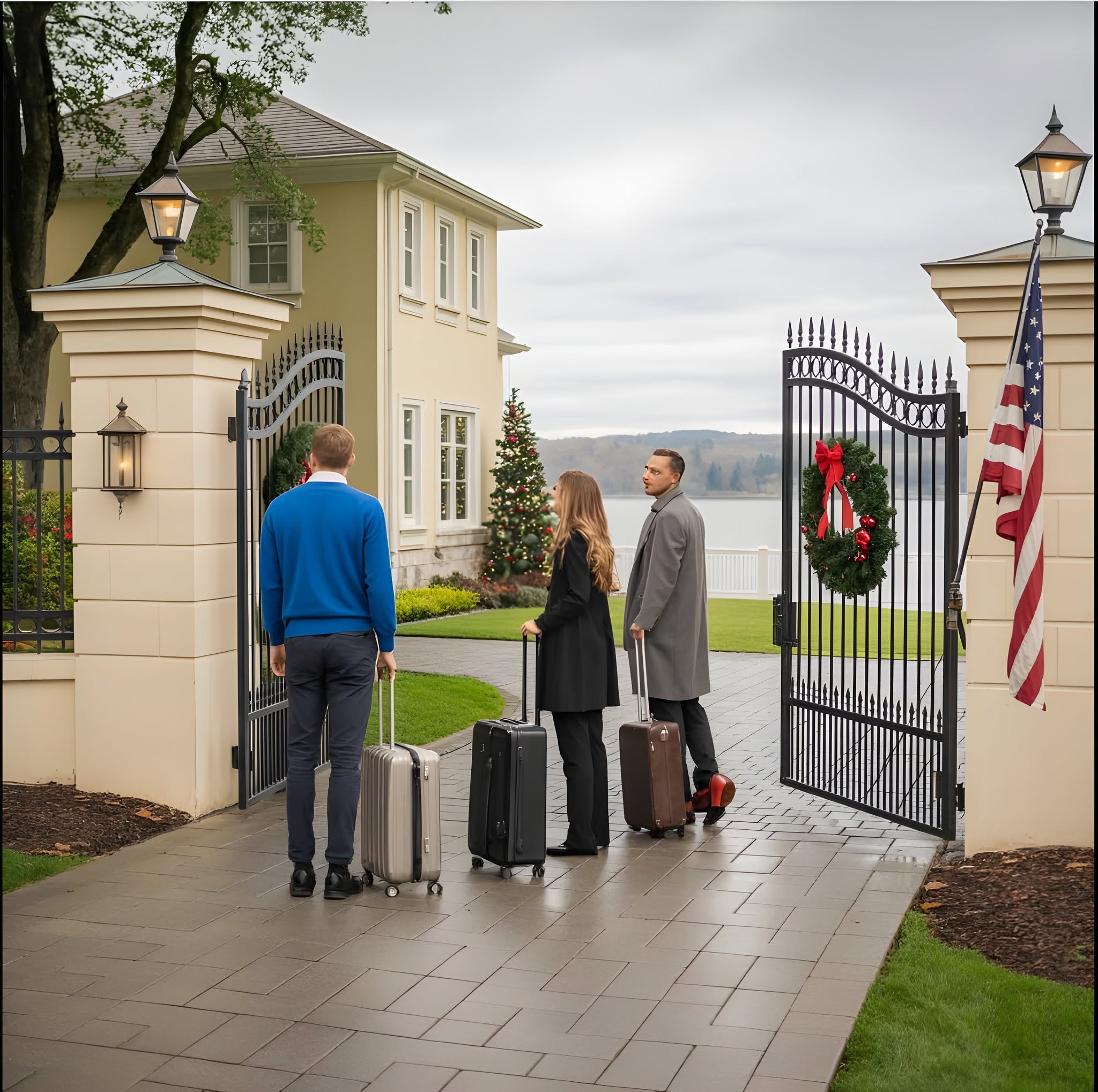
So when the security company called me one gray Monday to say there were three people at my front gate insisting they were “immediate family” and demanding to be let in, I just stood there in my glass-walled living room, phone in my hand, and stared at the grainy image on the screen.
My parents. My brother.
I hadn’t seen their faces in nine years. Time had carved new lines into them, but the expressions were the same—entitlement on my father, calculation on my mother, anger on Caleb. They looked up at my house like it owed them something.
The guard on the line cleared his throat. “Ms. James? Do you want us to send them away?”
I watched my brother pound his fist against the gate, my mother’s mouth forming words I couldn’t hear yet but could guess.
I thought about the kitchen table. The credit cards. The slap of my brother’s fist against my face. The taste of blood and the word trash hanging between us like a verdict.
I thought about the girl who had walked out into the Tacoma night with a duffel bag and a bruise, and the woman standing barefoot on heated marble floors now, holding the phone.
“No,” I said finally. “I’ll handle it.”
Because if there’s one thing I’d learned in nine years of rebuilding a life from ashes, it was this: some doors you don’t slam in a fit of rage. Some doors you close carefully, deliberately, knowing you are never going to open them again.
The knock on the gate didn’t stop. It grew louder, angrier, like they thought persistence could bend me. I stood inside my glass-walled living room, watching them through the cameras on my phone. My brother’s face had aged hard, lines of arrogance carved deep. My parents, though, looked smaller, weaker than I remembered, but their voices still sharp, still commanding.
“Aubrey, open this gate. We’re family. We have a right.” My mom barked.
Family. That word stung like salt in an open wound. Nine years ago, I begged them to see me, to hear me, to love me even half as much as they loved him. Instead, they let him strike me. They let his wife spit on me. They let their silence crush me.
And now, now they wanted entry.
I pressed the intercom button, my voice steady as glass. “You cut me off. You erased me. Remember? What right do you think you have now?”
Silence. Then my dad coughed, his pride cracking just enough for desperation to slip through. “We… we lost the house. The business is gone. Your brother’s in debt. We need somewhere to stay.”
A laugh almost escaped me, bitter and sharp. They had traded me for him, and he had led them into ruin.
“I have space,” I said finally, letting hope flicker in their eyes for half a second. Then I leaned in close to the mic. “But not for you.”
My brother’s fist slammed against the gate. “You ungrateful little—”
I cut the feed.
Because here’s the truth. I wasn’t that girl with a bruised face anymore. I wasn’t the shadow they cast out. I was Aubrey James, the woman who built a kingdom from the ashes they left behind.
And I wasn’t done teaching them what it felt like to lose everything.
The Lesson Begins
The gate stayed locked, but the real lesson was still coming.
That night, the ocean wind howled against my windows, but it was nothing compared to the noise in my chest. Memories collided. Me at nineteen standing in the driveway with a swollen cheek. My parents refusing to meet my eyes. My brother’s smirk burning into me like a scar.
And now they were outside my gates, begging for shelter like orphans.
I should have slept. Instead, I poured a glass of wine, pulled up my laptop, and opened a folder I hadn’t touched in years.
Receipts.
Because while they erased me, I collected every debt, every lawsuit, every shady transaction my brother had pulled under our family’s name. He thought he was invincible with dad’s support, but banks don’t forget. Neither do courts. And I documented it all.
The next morning, I strolled down my marble steps, heels clicking, and unlocked the gate—not to let them in, but to watch them squirm up close.
My mom rushed forward, fake tears clinging to her lashes. “Aubrey, please. We didn’t mean it. You know, blood is thicker than water.”
Blood. I remembered her words clear as glass. You’re nothing but shame to this family.
I tilted my head, studying them like strangers. “You want a place here? Fine. Let’s make it fair. Why don’t you sign this?”
I held out a document. One that stripped my brother of power of attorney over dad’s ruined company. One that transferred their remaining assets under my oversight.
Their faces drained.
My brother lunged for the paper, snarling. “What game are you playing?”
I stepped back, calm, sipping my coffee. “The kind where I finally win.”
He laughed, mocking, but his eyes betrayed him. He needed me. They all did.
And in that moment, I saw it. Fear. Not for me. Not for what I might do, but fear of losing the last shred of control they clung to.
The gate closed again. Metal bars slicing their faces into fractured reflections.
And I whispered to myself, “Let them sweat.”
Because poetic justice doesn’t strike all at once. It drips slow, merciless, and their storm had only just begun.
The Truth Unveiled
By the third day, their begging turned to threats. I watched from my balcony as my brother paced outside the gate, his voice sharp enough to pierce the morning air.
“You think that house makes you better than us? You wouldn’t have anything if it weren’t for this family.”
I almost laughed. This family? The same one that threw me out like spoiled leftovers. The same brother who bloodied my face and called me worthless because his wife said so.
I leaned over the railing, letting the sun catch my hair, my voice cutting through the ocean breeze. “You’re right. I wouldn’t have anything if I had stayed under your roof. If I had believed your lies. If I had remained small so you could feel big.”
My mom tried her old weapon. Guilt. “Aubrey, you can’t erase us. We’re your parents.”
I smiled faintly. “And yet you erased me first.”
They didn’t know the calls I’d been making, the quiet arrangements, the invitations sent to certain old friends of theirs who’d be very interested in seeing the truth.
That evening, I hosted a private dinner at my mansion. Investors, bankers, a few society names who once adored my parents. The dining hall glittered with candlelight and glass, laughter echoing against stone walls.
And right on cue, I projected a slideshow on the wall.
The Legacy of the James Family.
But it wasn’t the legacy they expected.
It was documents. Transactions showing how they funneled my savings into my brother’s failing ventures. Loan defaults. Properties foreclosed. Lies they’d spun about me to cover their tracks.
The room fell silent. Forks froze midair. Gasps spread like wildfire.
And then laughter. Not mine. Theirs. The same people who once praised my parents now whispering, mocking, shaking their heads at the empire of fraud.
My parents stood at the back, pale as ghosts. My brother’s fists clenched so tight I thought he’d break his own bones.
I raised my glass, smiling. “To family—the ones who teach us the hardest lessons.”
The applause was thunder. Not for them. For me.
That night, I didn’t just lock them out of my gate. I locked them out of their own reputations.
And for the first time, I felt at peace. Not because I destroyed them, but because I’d finally told the truth.
The Collapse
The fallout was faster than even I imagined. By sunrise, the whispers from my dinner spread like wildfire through town. The same people who once bowed to my parents now avoided their calls. Bankers demanded meetings. Business partners pulled out. Even my brother’s wife, so smug the day she called me trash, packed her things and fled.
I sipped coffee by the ocean, the waves crashing steady as a heartbeat. My phone buzzed relentlessly. Desperate voicemails. Frantic apologies. Tear-soaked pleas.
I let them pile up.
By noon, my parents stood outside the gate again, but this time, no arrogance. Just collapse.
My father, once the man who controlled every room he entered, now leaned on the fence like it was the only thing holding him upright. My mother’s makeup streaked down her face, her voice cracking.
“Aubrey, we don’t have anywhere else to go. Please, just let us in.”
For a moment, I almost felt it. The old tug of guilt, the reflex to be their savior. But then the scar on my cheek ached. The memory of fists. The humiliation. The years alone.
I shook my head slow. “You made your choice when you chose him over me. You all did.”
My brother exploded, pounding the gate. “You think you’ve won? You’ll regret this.”
But even his threats sounded hollow because the truth was he had nothing left. His businesses were ash. His wife was gone. His parents had no funds to back him anymore.
I walked down the steps, my heels sharp against stone until I stood inches from the gate. I could smell their desperation.
“You spent nine years treating me like a burden,” I said softly. “Now look at you clawing for scraps at my door.”
My mom dropped to her knees. “Please, Aubrey. Just one chance.”
I let the silence stretch, the ocean roaring behind me.
Then I leaned close, voice like glass. “One chance. That’s all I ever asked for.”
And with that, I turned away. The lock clicked behind me like a gavel.
Because revenge doesn’t always scream. Sometimes it whispers.
The Final Lesson
The next move came sooner than I thought. Three days later, while I was away at a charity gala, I got an alert on my phone. Motion sensors. Gate breach.
My pulse didn’t rise. I’d been expecting it.
When I pulled up the live feed for my cameras, there they were. My brother, red-faced and frantic, hauling bags through the gate. My parents shuffling behind him like shadows. They thought they could just move in, claim my home as if it were still theirs.
I didn’t rush home. I let them unpack. I let them believe for a few hours that they’d won.
By morning, I walked through my own front door with the police at my side.
My brother appeared first, bleary-eyed, wearing one of my silk robes like a crown. He froze.
“What the hell are they doing here?”
The officer answered for me. “You’re trespassing, sir. This property is legally owned by Miss Aubrey James.”
My parents stumbled out of the kitchen, clutching mugs of my coffee, faces drained of color.
“Aubrey, wait—”
But I didn’t wait. I pointed to the documents the officers carried. Proof of ownership. Security footage of the break-in. Restraining orders I’d filed weeks ago.
“This isn’t your home,” I said coldly. “It never was.”
My mother’s cup slipped, shattering against the marble. My father’s shoulders sagged like a puppet with cut strings. And my brother, furious, cornered, lunged toward me.
The officer’s hand was on his holster in an instant. “Step back, sir.”
He stopped, chest heaving. Hatred in his eyes, but nothing left in his hands.
The officers escorted them out, their bags dumped onto the driveway. Neighbors peeked from windows, phones out, recording every humiliating second.
By the time the gates slammed shut again, the world knew. The family who called me worthless now had nowhere to stand.
I poured myself a glass of wine. The house finally quiet again.
Not a victory dance. Not gloating. Just release.
Because revenge isn’t about making them bleed. It’s about making them see.
And they saw.
The Aftermath
The silence after their eviction didn’t last. By the end of the week, the tabloids had the story.
Local Millionaire Rejects Family, Parents and Brother Kicked to the Curb.
But the article didn’t paint me as the villain.
No, it told the truth. The bank foreclosures. The unpaid debts. The trail of wreckage my brother had left in his wake.
Calls poured in. Reporters. Former business partners. Even the so-called friends who once mocked me as the family embarrassment. Now, they wanted to hear my side.
And I gave it to them. Measured. Calm. Undeniable.
Within days, my brother’s empire collapsed for good. Investors fled. His accounts froze. He was nothing but smoke and memory.
My parents tried to cling to their old allies, but doors shut in their faces. Their reputation, once polished gold, was reduced to dust.
People whispered about them at every dinner party. How they betrayed their own daughter, only to end up begging at her gate.
And then came the knock.
I opened the door to find them all standing there again. No bags this time. No entitlement. Just ruin.
My brother’s eyes were bloodshot, his voice broken. “Please, Aubrey. I can’t… I can’t keep sleeping in the car. Just help me get back on my feet. One loan. I’ll pay it back.”
My father’s voice cracked for the first time in my life. “We were wrong about everything. Please don’t let us go down like this.”
And my mother, who once spat the word useless at me, was sobbing so hard she could barely speak.
I watched them crumble on my doorstep. And for a moment, the girl they abandoned nine years ago stirred inside me, whispering that this was the apology I’d craved.
But I wasn’t that girl anymore.
I stood tall, steady as the tide behind me. “You all made sure I knew where I stood in this family. Now the world knows where you stand.”
Their faces collapsed. Hope drained away.
And I shut the door.
This time it wasn’t the lock that sealed it. It was finality.
The Peace I Built
I didn’t celebrate when I closed the door. No champagne. No laughter. Just quiet. The kind of quiet I had longed for since the day my brother’s fist split my lip and my parents called it discipline.
I walked through my oceanfront mansion, sunlight spilling through the glass, waves crashing against the rocks like applause I never asked for but finally deserved.
They thought they broke me. Calling me trash. Erasing me from holidays. Pretending my existence was nothing but a stain.
Yet here I was, standing on marble floors, building legacies they could never touch.
And them? Stripped of reputation, money, and pride. Drifting from couch to couch, whispers following them like shadows. The same people they once impressed now shook their heads in pity.
The sweetest part wasn’t their collapse. It was my peace.
I started funding scholarships in my name. I supported shelters. I built a future where every dollar I earned created safety for someone who once felt powerless—just like me.
Because revenge isn’t about destroying others. It’s about refusing to be destroyed yourself.
And still, when I stand on my balcony at night, the wind carrying the scent of salt and freedom, I remember that last moment on my doorstep. My parents’ hollow eyes. My brother’s trembling voice.
The family who once called me worthless now knows the truth.
I was never the stain.
I was the fire.
See more on the next page
Advertisement
To see the full cooking instructions, go to the next page or click the Open button (>) and don't forget to SHARE it with your friends on Facebook.