
He did call later. We talked for a long time about things that had nothing to do with the beach house and everything to do with it.
He cried at one point, which was something I had not seen him do in probably twenty years. I didn’t find it satisfying. I found it sad, and human, and something I was glad I stayed on the phone for.
The charges against Paige moved through the legal system slowly.
That part wasn’t satisfying either.
I want to be clear about that, because people who hear this story often assume there was a moment of triumph, some clean feeling of vindication when the police arrived.
There wasn’t.
What I felt sitting at the kitchen counter while it all happened on the camera feed was something much quieter and more complicated. Something like the feeling after surgery that went well but was never routine.
Relief, yes.
But also exhaustion. Also grief. Also the particular sadness of being right about something you wished you had been wrong about.
The only thing that felt purely and cleanly right was Milo falling asleep against my shoulder an hour later while Ethan made pasta and put on something easy to watch.
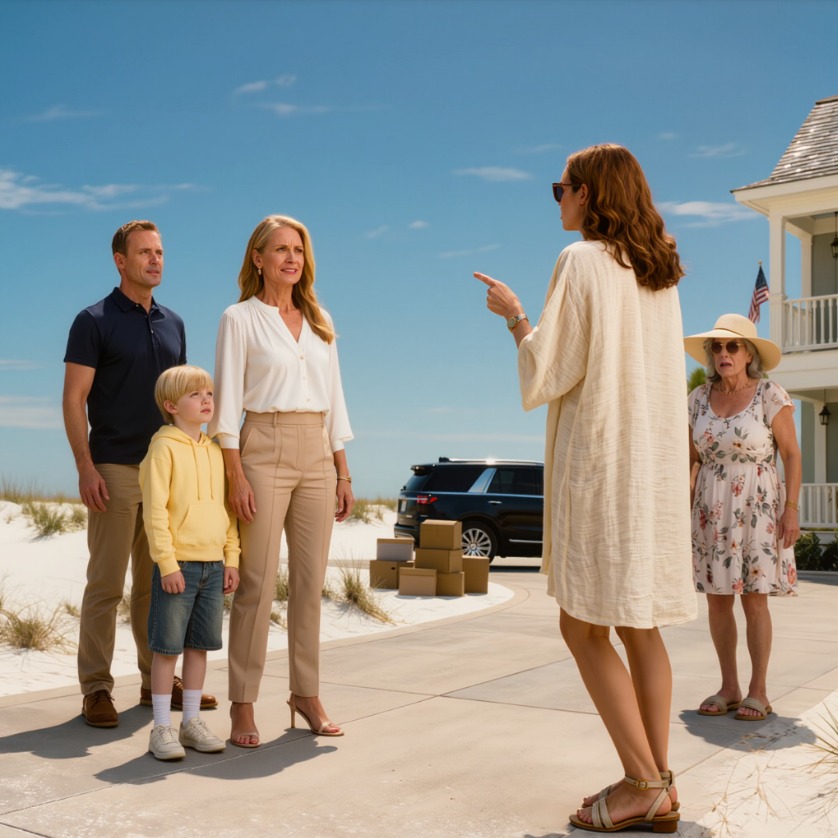
Me sitting in my own house on a Friday night without forty-seven people telling me how to be in it.
The particular peace of a space that belongs to you when you are finally willing to protect it.
My mother took three weeks to call.
Not out of anger, I think. Out of something closer to shame.
That was new for her.
When she finally called, she didn’t begin with Paige or the reunion or the gate or the money.
She began by asking how Milo was doing in school.
I told her.
Then she asked if she could come visit sometime. Not at the beach house. Just here, in Jacksonville.
Just the four of us, she said.
If that would be all right.
I told her I would think about it.
She didn’t push.
That was also new.
Whether something permanent shifted between us, I genuinely cannot say.
I have learned to stop needing to know the ending before I am willing to begin the conversation.
What I know is that I told the truth at the gate that day, the truth about Milo and about what had been allowed to go on for years, and that truth did not destroy everything.
It removed the comfortable layer of pretense everyone had been using to avoid the harder one underneath.
About a month after the weekend that was never a reunion, Milo came home from school and told me her class was doing a project on heroes.
Not fictional ones. Real ones, everyday people from your actual life.
She had to write one page about someone she admired and explain why.
She showed me the draft at dinner.
She had written about Ethan first, about how he had never made her feel like an accident or an afterthought, about how he had shown her that you could be tired and still be present, which she said was the hardest kind of love and also the most important one.
Then in the last paragraph, she had written about me.
She said I was the kind of person who did hard things quietly and did not need people to witness them. She said I had taught her that saying no was not the same as saying you did not love someone. She said that sometimes it was the opposite.
I read the draft twice, told her it was very good, and handed it back.
Then I went into the bathroom and stood at the sink for approximately four minutes until I was reasonably confident I could return to the dinner table without embarrassing both of us.
I don’t know if that is the kind of thing that shows up in the official record of a person’s life.
The four minutes at the bathroom sink. The moment you realize your child has understood something you spent years trying to demonstrate without being able to name.
But it is one of the things I think about most.
The beach house is still mine.
We went the following month, just the three of us, for a long weekend.
Milo brought her sketchbooks and three different kinds of sunscreen and her noise-canceling headphones. Ethan brought the good coffee and the paperback novels he never quite finishes. I brought nothing except the willingness to be somewhere without anything being required of me.
We sat on the back deck in the morning while pelicans moved in slow arcs over the water. Milo drew things. Ethan read. I watched the light change over the Atlantic and thought about all the years I had let guilt about what I had make me unable to simply have it.
On the last morning, Milo looked up from her sketchbook and said, “I like it better when it’s just us.”
I looked at her.
“Do you think that makes me a bad person?” she asked.
It was a serious question. Eleven-year-olds ask the most serious questions.
“No,” I said. “It makes you honest.”
She went back to drawing.
“Okay,” she said.
Just: okay.
As if that settled it.
And somehow, sitting there in the early light with the ocean doing its patient, indifferent work in front of us, it did.
Some doors need to close before you understand what they were keeping out.
I had spent years propping mine open out of guilt, out of habit, out of the particular fear that belongs to women who were raised to believe that loving people means never making them uncomfortable.
I had called it generosity. I had called it family. I had called it keeping the peace, as though peace were something you could manufacture by sacrificing the person who most needed protecting.
Milo needed me to close the door.
So I closed it.
And on the other side of it, finally, was exactly what I had been working for all along.
The house. The light. The coffee. My daughter drawing pelicans while her father reads a book he will probably not finish.
Mine.
Ours.
Enough.
If you came here from Facebook because this story stayed with you, please consider going back to the post and leaving a like, a short thought, a kind note about the writing, or a few words of support for Bella and Milo. One small gesture can mean so much to the writer and helps us know this story reached someone’s heart.
See more on the next page