
“Last Christmas? Mason, I need you to be sure. This matters more than you know.”
“She made me promise not to say anything. I thought maybe they’d wait. I thought—they were going to wait, you know? After things settled. I didn’t think it would happen like this. I didn’t think she’d…”
He didn’t finish the sentence. He didn’t need to.
My mother had still been alive. Last Christmas, my mother had been alive—baking sugar cookies in that very kitchen, wrapping presents in the living room, hanging stockings on the mantle with the careful attention she brought to every holiday tradition. And while she was doing those things, my father was buying a ring for her sister.
“Where did they get it?”
“Ridgeway Jewelers. On Fifth Street. I took a picture of the card inside the box—the one that came with the receipt. The order number’s on it. I’ll text it to you right now.” He pulled out his phone, his fingers trembling as he navigated to the photo. “There was a handwritten note. Tucked inside the box. It said: ‘For our real beginning.’”
Our real beginning. Four words that contained an entire hidden history—a history that existed alongside my parents’ marriage like a shadow, invisible until the light hit it from the right angle.
I didn’t scream. I didn’t cry. I walked inside, grabbed my keys from the hook by the door, and left.
Chapter Five: The Receipt
At Ridgeway Jewelers, the woman behind the counter smiled at me with the professional warmth of someone who spends her days selling happiness to people who can afford it.
“Looking for a wedding set, sweetie? I’ll show you the best ones we have!”
“I’m looking for a receipt.”
The smile flickered—not disappearing entirely, but dimming, shifting from welcoming to wary. “I’m not sure I can help with that. Receipts are typically—”
“White gold ring with a diamond halo. Bought in December. By a man named Charles.” I gave her the order number Mason had texted me. “I have the reference number. I just need to see the date.”
She typed slowly, her nails clicking against the keyboard, her expression carefully neutral. Then she turned the screen toward me.
There it was.
Charles. December 18. White gold diamond halo. Paid in full.
December 18. My mother had been alive—baking sugar cookies, wrapping presents, humming along to the Christmas music she played on the ancient radio in the kitchen—while he bought that ring. While he wrote “For our real beginning” on a card and tucked it into a velvet box and gave it to her sister. While he sat across from my mother at the dinner table and asked her what she wanted for Christmas and smiled and kissed her goodnight and lived a lie so seamless that the woman who knew him best never saw a single thread loose.
I took a photo of the screen.
When I returned, the reception was in full swing—champagne flowing, music playing, laughter bouncing off the walls of the house like the whole thing was normal, like there wasn’t a freshly dug grave eight days old and a daughter who had been told to fix her mood. Someone handed me a glass and asked if I’d like to say a few words about the happy couple. I could see the expectation in their eyes—the hope for a gracious speech, a moment of unity, a display of the kind of forgiveness that makes everyone comfortable.
I stepped into the center of the yard. The grass was soft under my shoes—the same grass my mother had mowed, the same grass where my tulips had been pulled out that morning to make room for white chairs and flower arrangements.
“Eight days ago, I buried my mother.”
The yard fell silent. Not gradually—immediately, like someone had pressed a mute button on the entire world. Hands froze holding glasses. Conversations died mid-sentence. The wind even seemed to stop, as though nature itself was listening.
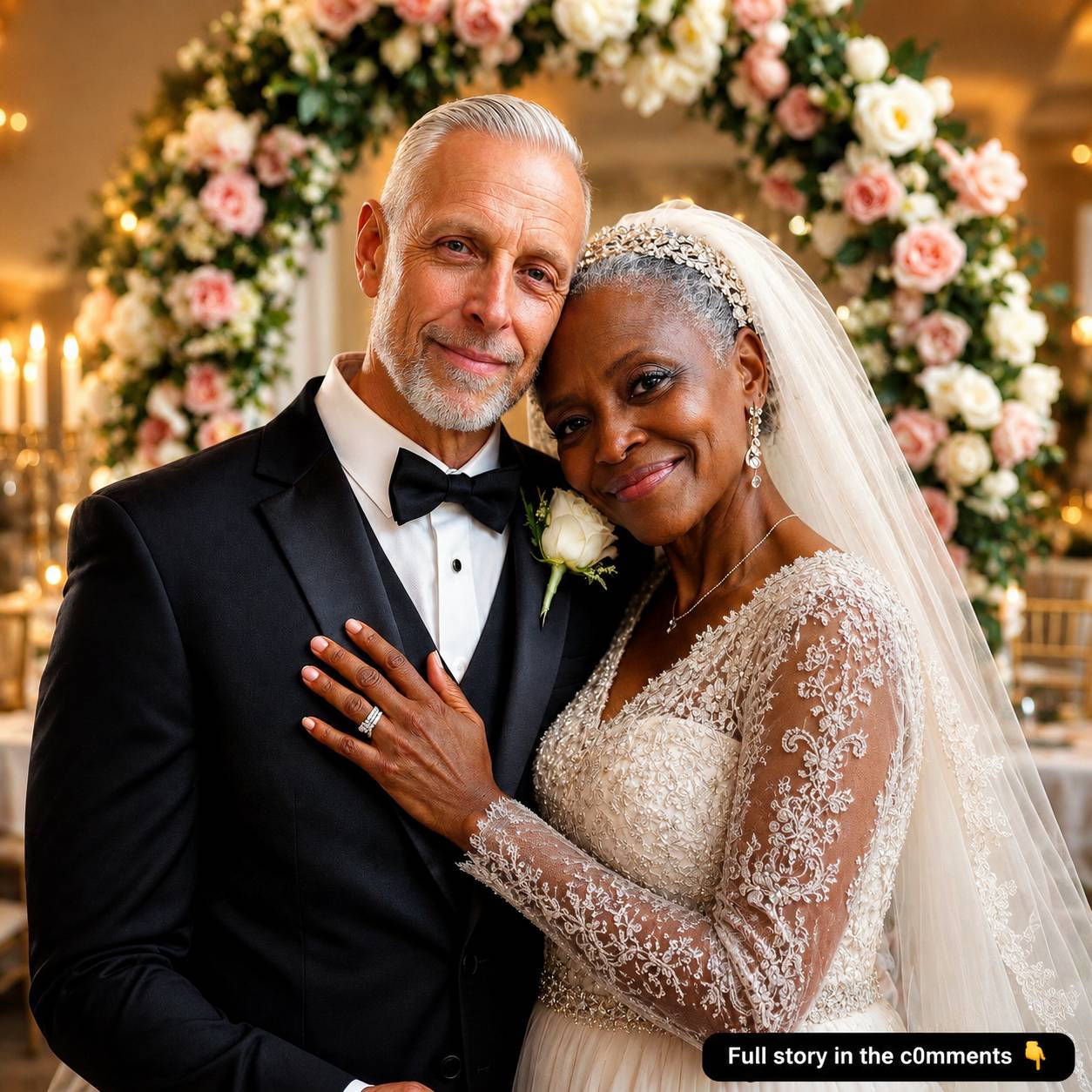
“Today, I’m standing in her backyard, watching her sister wear a ring my dad bought while my mother was still alive.”
A fork clattered against a plate. The sound was sharp, almost theatrical, like a sound effect in a movie—the kind of detail that seems too perfect to be real but that happens sometimes, when reality decides to be dramatic.
“Tessa, that’s enough,” my father snapped, his voice carrying the authority he used to use when I was a teenager and had stayed out too late—the voice of a man who expected to be obeyed without question. “You’re grieving. You don’t know what you’re saying.”
“I know exactly when and where you bought that ring. December 18, at Ridgeway Jewelers. I have the receipt. This affair didn’t begin in grief. It’s been going on for a long time.”
Corrine’s smile cracked. Not slowly—all at once, like glass hit by a stone, the pleasant facade shattering to reveal something hard and ugly underneath.
“How dare you embarrass us. This was supposed to be a day of healing.”
“You embarrassed the memory of my mother. I’m just stating the timeline.”
“She’s not herself,” Corrine said, turning to the guests, her voice shifting into the soothing, reasonable tone of someone trying to manage a public relations crisis. “Grief makes people… confused. She doesn’t know what she’s saying.”
I set the glass down on the nearest table—gently, deliberately, the way you set something down when you want the act of setting it down to be its own statement—and walked away.
Chapter Six: The Aftermath
The next morning, the church group chat exploded. Screenshots circulated—the receipt photo, the timeline, the details that I had laid out in the yard like evidence at a trial. Even the sweet woman from Bible study—the one who always brought extra cookies and asked about my prayer life—commented under Corrine’s wedding photo:
“Shame on you. That poor child deserved more time to grieve her momma.”
The comment stayed up for twelve hours before it was deleted, but by then, everyone had seen it. Everyone had screenshotted it. Everyone had talked about it. The secret was out, and no amount of deleting could put it back.
Two days later, my father found me packing my mother’s dresses into boxes—the same dresses that had been hanging in the closet Corrine was already “reorganizing,” the same dresses my mother had worn to church and to birthday parties and to the grocery store, each one carrying a memory that no amount of reorganizing could erase.
“You humiliated us, Tessa.”
“No. I revealed what you buried. There’s a difference. You could have divorced Mom if you weren’t happy. You could have let her keep her dignity. You could have been honest with her, with me, with yourself. Instead, you chose deception.”
“We were going to tell you.”
“After the wedding photos? After the cake was eaten? After the thank-you notes were written? When, exactly, was the right moment? When it was convenient for you?”
Silence. The kind of silence that isn’t empty but full—the kind that contains all the things a person could say but won’t, all the defenses that crumble under the weight of their own inadequacy.
“She knew, didn’t she?” I asked. “Mom knew about the affair.”
“We were separated.”
“You were not separated. You were living in the same house, sleeping in the same bed, eating her food, letting her take care of you while you were buying rings for her sister. You should have done better by her. My mother was the best part of you. Now that she’s gone, we have nothing.”
He said nothing. He stood in the doorway of the bedroom—his bedroom now, their bedroom, the room where my mother had slept for thirty years and where Corrine’s things were already replacing hers—and he said nothing. No defense, no explanation, no apology. Just silence.
That was answer enough.
I salvaged a few tulips from the pile by the shed—the ones Corrine’s helper had missed, the ones that had been pulled up but not disposed of, lying in the dirt with their roots exposed and their leaves wilting. They weren’t perfect. They were damaged, uprooted, half-dead. But they were alive, and they were my mother’s, and that was enough.
I drove to the cemetery and knelt beside her grave—the fresh earth still dark and unsettled, the headstone not yet installed, the space marked only by a temporary metal marker with her name printed on it in a font that seemed too small for a woman who had filled so much space in the world. I pressed the tulips into the soft dirt, packing the soil around their roots with my bare hands, not knowing if they would take hold but needing to do something with my hands that wasn’t packing boxes or holding receipts or gripping a steering wheel.
Mason followed.
“I didn’t want you to find out later, Tess,” he said, standing behind me, his voice quiet. “I couldn’t keep carrying it. It was eating me alive.”
“They thought they’d won,” I said, not turning around, still pressing dirt around the tulip roots. “They thought they could bury it all—the affair, the ring, the timeline—under a wedding cake and a champagne toast, and no one would dig it up.”
“But they didn’t. The reality will hit soon enough. It always does.”
There was no neat lesson. No tidy forgiveness. No moment where I understood their side and found peace through compassion. Sometimes the truth is just the truth, and it doesn’t come with a bow on it, and it doesn’t heal you, and it doesn’t set you free in the way that motivational quotes promise. Sometimes the truth just is—a sharp, hard thing that you hold in your hands and look at and then set down because there’s nothing else to do with it.
Just tulip bulbs in the ground, dirt under my nails, and silence that didn’t need fixing.
I didn’t get my mother back. No revelation, no confrontation, no amount of truth-telling could bring her back. That was the irreducible fact at the center of all of this—the thing that couldn’t be changed or undone or mitigated by exposure or justice or closure.
But I didn’t let them bury the truth with her.
The tulips would bloom again in spring. I didn’t know if they would bloom in the cemetery soil, in this unfamiliar ground, in this place that wasn’t the backyard where my mother had planted them. But bulbs are stubborn—they hold life inside them through dark seasons, through cold and silence, and they wait. And sometimes they come back.
I wasn’t going to stay in that house. I couldn’t—not with them in it, not with my mother’s things being replaced and my mother’s garden being “fixed” and my mother’s memory being erased one renovation at a time. Let them keep the ring. Let them keep the house. Let them keep the version of reality they had constructed, the one where they were victims of circumstance and grief brought them together and anyone who disagreed was just being “sour.”
I had her dresses, carefully folded in boxes. I had her recipes, copied from the stained index cards in her handwriting. I had her tulips, planted in the ground above her grave, where no one could pull them out. I had everything she gave me that they could never take—not money, not property, not things that could be boxed up or reorganized or “fixed”—but the intangible inheritance of a woman who had loved me completely and without condition, who had baked me cookies and planted me flowers and taught me what it meant to be a person worth knowing.
For the first time since the funeral, I wasn’t angry.
I was done.
See more on the next page
Advertisement