
No Copper.
No blanket.
Just the shape of where love had been.
Rachel came up beside me.
“Are we selling the house?” she asked.
I knew the question was coming.
It still hurt.
“I don’t know.”
“I don’t either.”
“We don’t have to decide today.”
“No.”
She rubbed her arms.
“But we should decide something.”
“What?”
She pointed toward the window.
“Copper’s spot.”
Outside, near the side of the porch, was the patch of dirt where Copper used to roll in sun.
Even in his last year, he dragged himself there on warm afternoons.
Dad had put an old chair cushion beside it.
For the cat.
Not for guests.
For Copper.
Rachel said, “When his ashes come back…”
I nodded.
“We’ll put them there.”
“Together?”
“Yes.”
She looked relieved.
“And if we sell someday?”
“We can take the box.”
She shook her head.
“No. I mean, maybe we don’t sell to someone who would tear everything out.”
That surprised me.
“Rachel.”
“I know we can’t control everything. I just…”
She looked out the window.
“I don’t want their whole life turned into a renovation project by June.”
There it was.
The second controversy.
Not the cat.
The house.
What do adult children owe the dead?
Do you preserve the home like a museum?
Do you sell because bills are real?
Do you keep objects because they meant something?
Or let go because the dead do not need furniture?
There is no clean answer.
Anyone who says there is has not stood in a parent’s kitchen holding a chipped mug they used every morning.
Rachel looked at me.
“Mark thinks we should sell quickly.”
“I figured.”
“He’s not being cruel.”
“I know.”
“He’s thinking about taxes, insurance, repairs.”
“I know.”
“But I keep seeing Dad at that window.”
I nodded.
“Me too.”
She laughed weakly.
“Now I’m the sentimental one.”
“Welcome. It’s exhausting.”
We stood there until the sky went dark.
That night, I stayed at Dad’s house alone.
Rachel wanted me to come home with her family.
I said no.
Not because I wanted to be brave.
Because leaving felt like betrayal.
I slept on the couch.
Or tried to.
Every creak sounded like Copper jumping down.
Every shadow looked like Dad passing the hallway.
At 2:13 in the morning, I woke up reaching for a sound that wasn’t there.
The house was black except for the streetlight coming through the blinds.
I sat up.
“Copper?” I whispered.
Then I remembered.
Grief is remembering over and over.
It is the mind opening the same empty door.
I walked to the kitchen.
On the counter was Dad’s coffee mug.
Blue.
Cracked handle.
I had washed it after the funeral gathering and set it upside down to dry.
That simple object broke me.
Not the casket.
Not the cemetery.
A mug.
Because Dad would never drink bad coffee from it again.
Copper would never sit at his feet waiting for toast crust.
The morning routine was gone.
The ordinary world had ended.
I sat at the table and opened Dad’s shoebox again.
I looked through every photo.
On the back of some, Dad had written dates.
First day he let me touch him.
First snow he hated with his whole soul.
Fell asleep during the game. Traitor.
Copper stole my chair again.
I laughed.
Then cried.
Then laughed again.
That is grief too.
A mind that cannot decide which way the knife is turned.
At the bottom of the box was a small notebook.
I had missed it before.
The cover was bent.
Inside were little notes.
Not a diary exactly.
More like fragments.
Dad had written them on random days.
Copper ate half my sandwich. Acted innocent.
Dreamed of Marianne last night. Woke up crying. Copper on my chest before I turned on lamp.
Rachel called. I told her I was fine. Should have said I missed her.
I stopped there.
The sentence sat on the page like a hand on my shoulder.
Should have said I missed her.
I took a picture of it and sent it to Rachel.
Then I saw the time.
2:41 a.m.
Too late.
But the reply came in less than a minute.
I’m awake.
Then another.
Can you send me that again?
I did.
She called.
Neither of us said hello.
She was crying.
I was crying.
For a long time, we just breathed into the phone like two children hiding under the same blanket.
Finally she said, “He missed me.”
“Yes.”
“I needed to know that.”
“I know.”
“I kept thinking he didn’t.”
“He did.”
She cried harder.
“I should have asked.”
“He should have said it.”
“We all should have done better.”
“Yes.”
There was no comfort in pretending otherwise.
But there was comfort in saying it together.
The next day, I posted the photo.
Not for attention.
At least, I told myself that.
Maybe all grief posts are partly a flare in the dark.
The picture was simple.
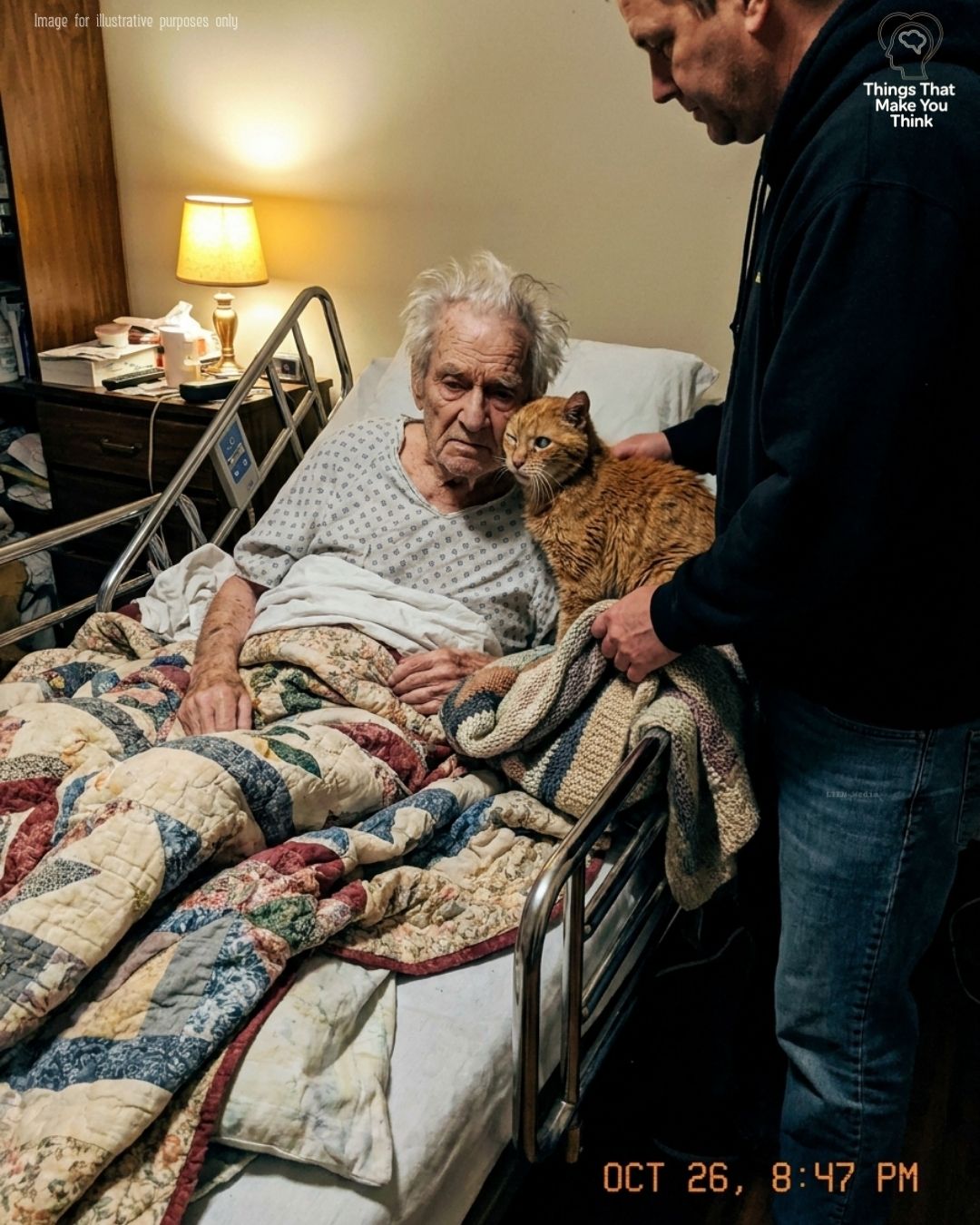
Dad’s hand on Copper’s back.
My hand over Dad’s.
Taken in the gray light before dawn.
I did not even remember taking it.
Maybe I needed proof.
The caption was short.
My father asked for his old cat before he died. Copper stayed all night. Dad passed first. Copper followed at sunrise. Please check on the people who say they’re fine. And please don’t make fun of the little comforts that keep someone alive.
I posted it.
Then I put the phone face down.
By noon, Rachel called.
“Have you seen the comments?”
“No.”
“You might want to.”
My stomach tightened.
“Bad?”
“Both.”
That was how she put it.
Both.
The post had spread through our town first.
Then beyond it.
Friends shared it.
Strangers shared it.
People wrote stories about dogs, cats, birds, horses, old rabbits, one stubborn goat.
People wrote about fathers.
Mothers.
Widows.
Veterans of grief.
Divorced men in apartments.
Grandmothers with parakeets.
Nurses who had seen pets brought to windows.
Men who said they had never told anyone their cat was the reason they got out of bed.
Women who said their children thought the dog was “too much” after their husband died.
The beautiful comments could have carried me for years.
But then came the others.
This is unhealthy. People shouldn’t replace family with animals.
A cat is not a child.
This is why people are too sentimental now.
Your father needed more human contact, not a pet.
Maybe the family should have shown up instead of praising the cat.
That one hurt because it was not entirely wrong.
Rachel texted me after reading it.
Don’t answer that one.
I didn’t.
But I wanted to.
I wanted to say, yes, we should have shown up more.
I wanted to say, that is the whole point.
I wanted to say, sometimes the truth is not clean enough for people who only like grief when it flatters them.
Instead, I wrote one comment.
Just one.
Copper did not replace us. He revealed where we had left empty space. That is why this hurts.
Then I closed the app.
That comment became the one people argued under.
Of course it did.
Some agreed.
Some got angry.
Some said guilt was useless.
Some said guilt was necessary.
Some said pets were family.
Some said pets were not people.
Some said adult children were doing their best.
Some said “doing your best” can still leave someone lonely.
The argument grew.
But underneath it, something else happened.
People started tagging siblings.
Calling parents.
Sharing photos.
Writing, “I’m coming by this weekend.”
Writing, “Dad, do you need anything?”
Writing, “Mom, I know you say you’re fine, but I’m calling tonight.”
That mattered more than the argument.
Maybe that is what viral really means when it is not just noise.
Not millions of strangers gasping at pain.
But a few people changing what they do after seeing it.
Three days after the funeral, Copper’s ashes came back.
A small wooden box.
A paw print.
A little card with his name.
Copper.
No last name.
He never needed one.
Rachel drove over with Caleb.
He brought Copper’s blanket.
Not because we needed it.
Because he insisted.
We stood beside the sunny patch near the porch.
The ground was cold but not frozen.
I had bought a small stone from a local garden shop.
Nothing fancy.
Just river rock with a flat face.
I wrote on it with outdoor paint.
COPPER
Under that, I wrote:
HE STAYED
Rachel saw it and covered her mouth.
Caleb asked, “Is Grandpa under here too?”
Rachel knelt.
“No, sweetheart. Grandpa is at the cemetery.”
Caleb frowned.
“Then Copper will be lonely.”
That question went right through me.
Rachel looked at me, unsure.
I crouched beside him.
“Copper spent a lot of years watching this porch,” I said. “And Grandpa’s collar has Copper’s collar with him.”
Caleb thought about that.
“So they each have something?”
“Yes.”
He nodded.
“That’s fair.”
Children understand symbols better than adults sometimes.
Adults need rules.
Children need meaning.
We placed the box in a weatherproof container beneath the rosebush Dad had planted for Mom.
Not hidden.
Not dramatic.
Just near the porch, where sunlight came in the afternoon.
Rachel let Caleb set the stone.
Then she took Copper’s blanket and folded it carefully.
“What are you doing?” I asked.
She placed it on the porch chair.
“For now,” she said.
I didn’t argue.
The wind moved the edge of it.
For one second, I expected orange fur to appear in the doorway.
Nothing did.
But the porch looked less empty.
That evening, Rachel and I sat on the steps with coffee.
Bad coffee.
Dad would have approved.
She said, “I keep thinking about the comment you wrote.”
“Which one?”
“That Copper revealed the empty space.”
I nodded.
She stared at the yard.
“I don’t want my kids to say that about me someday.”
“They won’t.”
“You don’t know that.”
“No.”
She took a sip.
“I’m serious. I keep telling myself I’m doing everything for them. Working. Planning. Driving. Paying. Scheduling.”
“That is a lot.”
“It is. But what if I’m around them all day and still not really with them?”
I did not answer quickly.
Because that question deserved respect.
Finally I said, “Then change one thing.”
“One?”
“Start with one.”
She looked at me.
“Like what?”
“Sit on the couch without your phone.”
She laughed.
“That sounds harder than grief.”
“Probably is.”
She smiled.
Then her face softened.
“Dad used to sit with us.”
“Yes.”
“Before Mom died.”
“He did.”
“He’d pretend he didn’t care about our shows.”
“But he knew all the characters.”
Rachel laughed.
“He did.”
The porch went quiet.
Then she said, “Maybe that’s what I miss most. Not big advice. Just him being in the room.”
That became the thing I could not stop thinking about.
Just being in the room.
Copper’s greatest gift was not heroic.
He did not rescue Dad from a burning building.
He did not bring medicine.
He did not bark at danger.
He sat in the room.
Again and again.
Day after day.
Maybe love is not proven by intensity.
Maybe it is proven by return.
The next week, I went back to my own apartment.
It felt too clean.
Too quiet.
No Dad smell.
No medicine bottles.
No orange hair.
I had spent years thinking I liked quiet.
Now I understood there are different kinds.
Peaceful quiet.
Lonely quiet.
Final quiet.
I started calling Rachel every night.
Not long.
Sometimes five minutes.
Sometimes two.
At first, it was awkward.
We had spent years communicating through logistics.
Now we had no logistics.
Just ourselves.
“How are you?” I would ask.
“Fine,” she would say.
Then we would both go silent.
Because the word had become suspicious.
Finally she started saying, “I’m not fine, but I made dinner.”
I started saying, “I’m not fine, but I went to work.”
That became enough.
Not everything had to be fixed.
Some things just had to be witnessed.
Two weeks after Dad died, Mrs. Hanley knocked on his front door while I was sorting books.
She was holding a tin of cookies.
She always held food like an apology.
“I saw your post,” she said.
“Oh.”
“My niece sent it to me. Imagine that. My own neighbor goes around the internet before I see him online.”
I smiled.
“Sorry.”
She waved that away.
“I wanted to tell you something.”
I invited her in.
She stood in the living room and looked at the recliner.
Her eyes softened.
“Your dad used to talk to Copper on the porch.”
“I know.”
“No,” she said. “I mean really talk.”
I waited.
“He told him stories about your mother. About you children. About things he wished he’d said.”
My throat tightened.
“He thought no one could hear?”
She gave me a look.
“Men on porches think fences are walls.”
I almost laughed.
She looked toward the window.
“One evening, I heard him tell Copper he was proud of you.”
I went still.
“Me?”
“You and Rachel both. But that night, you.”
I swallowed.
“What did he say?”
Mrs. Hanley set the cookie tin on the table.
“He said, ‘That boy feels things too deep, Copper. World’s going to bruise him if he doesn’t learn to let some of it pass.’”
I looked down.
She smiled sadly.
“Then he said, ‘But I hope he never gets hard.’”
That did it.
I sat on the arm of the couch.
Mrs. Hanley touched my shoulder.
“He loved you. Quiet men are still loud in some places.”
That sentence felt like something Dad could have written.
After she left, I added it to the notebook.
Quiet men are still loud in some places.
I did not know what I would do with Dad’s house.
But I knew I could not let all his little truths disappear.
So I started writing them down.
Stories about him.
Stories about Copper.
Things Rachel remembered.
Things neighbors told us.
Tiny pieces.
The way Dad ate peanuts one at a time.
The way he warmed Copper’s food in winter because “nobody likes cold supper.”
The way he kept Mom’s garden gloves in the shed and never used them.
The way he said “drive careful” instead of “I love you.”
The way Copper slapped his hand if he stopped petting too soon.
I wrote them all.
Not because they were important to history.
Because they were important to us.
A month later, Rachel and I returned to the cemetery.
The grass had settled.
The flowers were gone.
Dad’s temporary marker stood small and plain.
Rachel brought coffee.
I brought a can of the cheap cat food Copper had loved.
We did not open it.
That felt wrong.
We just set it beside the marker for a minute.
Then Rachel laughed.
“This is ridiculous.”
“Yes.”
“People would talk.”
“People are already talking.”
She smiled.
Then her eyes filled.
“I’m glad they’re together somehow.”
“Me too.”
She touched the ground.
“I still hate that Dad was lonely.”
“I do too.”
“I hate that a cat knew more than we did.”
“Maybe he didn’t know more.”
She looked at me.
“Maybe he just stayed close enough to notice.”
Rachel nodded.
“That’s worse.”
“Yes.”
We stood there in the cold.
Then Rachel said, “I’m going to visit Mrs. Hanley next week.”
“Why?”
“She’s alone.”
I smiled.
Rachel shrugged.
“Don’t make that face.”
“What face?”
“The face like Copper turned me into a better person.”
“Did he?”
She looked at Dad’s marker.
“Maybe.”
Then she whispered, “Good cat.”
The wind moved through the cemetery trees.
For a second, I could almost hear Dad’s voice.
There’s my boy.
Six weeks after Dad died, I got a message from a stranger.
I almost deleted it.
There had been too many messages.
Too many people telling me their pain.
Some nights, I could not hold it all.
But this one was short.
I read your story about your father and Copper. I called my dad for the first time in three months. He said he was fine. I went over anyway. Thank you.
I sat with that message for a long time.
Then I wrote back.
I’m glad you went.
That was all.
What else could I say?
I was not a counselor.
Not a preacher.
Not a man with answers.
I was just a son who had learned too late that “fine” can be a locked door.
After that, I stopped reading most of the arguments.
People could debate whether pets were family.
They could debate whether adult children owed more.
They could debate grief and boundaries and loneliness and responsibility.
But I knew what I had seen.
I had seen an old man breathe easier when his cat touched his cheek.
I had seen a dying hand calm under orange fur.
I had seen an old cat use the last of his strength to keep a promise no human had asked him to make.
Nobody in a comment section could edit that.
Nobody could reduce it.
Nobody could make it silly.
On the first warm day of spring, Rachel brought her kids to Dad’s house.
We opened the windows.
Dust moved in the light.
Caleb ran straight to Copper’s stone.
He had brought a toy mouse.
A new one.
Bright gray.
He set it beside the rock.
Rachel said, “That’s sweet.”
Caleb shrugged.
“He might need it.”
His older sister rolled her eyes.
“He’s not actually playing, Caleb.”
Caleb looked at her.
“Maybe not. But Grandpa will know we remembered.”
That shut her up.
Rachel looked at me over his head.
There it was again.
Children carrying matches.
We spent the afternoon going through Dad’s garage.
Not everything was sacred.
Some of it was junk.
Bent nails.
Paint cans.
A toaster from 1987.
Three broken radios he had sworn he would fix.
Rachel held up a box of tangled cords.
“Do we honor these too?”
“No,” I said. “Those can go to the great beyond.”
She laughed.
It felt good.
Not because grief was gone.
Because laughter had found a crack to come through.
In the back corner, behind a stack of old lawn chairs, I found a wooden sign.
Dad had made it by hand.
The letters were uneven.
Painted in blue.
SIT A WHILE
I remembered it then.
Mom had hung it on the porch years ago.
After she died, Dad took it down.
Maybe it hurt too much.
I carried it outside.
Rachel saw it and stopped.
“Oh.”
“Should we put it back?”
She nodded.
We found the old hooks.
They were still there above the porch rail.
I climbed on a chair and hung the sign.
It looked weathered.
Imperfect.
Right.
That evening, we sat under it.
Rachel.
Mark.
The kids.
Me.
No phones for a while.
Not because we were noble.
Because Rachel made a basket and said everyone had to drop theirs in.
Her children complained like she had outlawed breathing.
Then, after ten minutes, they survived.
We ordered pizza from a local place.
We drank lemonade.
We told stories about Dad.
Mark admitted he had been afraid of Copper.
“Everyone was afraid of Copper,” I said.
Caleb said, “I wasn’t.”
“You only knew old Copper.”
“He still looked like a pirate.”
“He was a pirate.”
The kids laughed.
Rachel looked toward Copper’s stone.
Then toward Dad’s empty recliner visible through the window.
“I wish he could see this,” she said.
I looked up at the sign.
SIT A WHILE
“Maybe this is what he wanted.”
“What?”
“For us to stop rushing through rooms where people are waiting.”
She nodded.
The sky turned pink.
The porch light clicked on.
For the first time since Dad died, the house did not feel abandoned.
It felt like it was exhaling.
Later, when everyone left, I stayed behind to lock up.
I stood in the living room one last time.
The recliner was still there.
We had decided to keep it.
Not forever maybe.
But for now.
Some people would call that unhealthy.
Some would say move on.
Some would say furniture is furniture.
Let them.
I had learned that people who rush you through grief are usually trying to escape their own.
I placed Dad’s notebook on the side table.
Beside it, I placed the photo of him and Copper.
Then I sat in the recliner.
Just once.
It creaked under me.
The cushion sank into Dad’s shape.
For a moment, I felt like I was sitting inside his absence.
I looked toward the window where Copper used to wait.
The glass reflected the room back at me.
A middle-aged man in his father’s chair.
Tired eyes.
Unshaven face.
Holding a grief that had nowhere useful to go.
I thought about all the times I had said, “I’ll call tomorrow.”
I thought about all the people sitting in houses across the country, saying they were fine.
I thought about old dogs at apartment doors.
Cats in windows.
Birds in cages.
Neighbors behind curtains.
Fathers in recliners.
Mothers at kitchen tables.
People who do not need saving in a dramatic way.
Just noticing.
Just someone to say, “I’m coming by.”
Just someone to sit a while.
I touched the arm of Dad’s chair.
“I’m sorry,” I said.
Not loudly.
Not for performance.
Just into the room.
Then I added, “I’m learning.”
Outside, the porch was quiet.
Copper’s stone sat in the last blue light of evening.
The blanket Rachel had left on the porch chair moved slightly in the breeze.
For half a second, my heart did what hearts do.
It hoped for the impossible.
An orange tail.
A torn ear.
A tiny meow.
Nothing came.
But the ache that followed was not empty.
It was full of everything that had been there.
Dad.
Mom.
Copper.
Rachel’s hand in mine.
Caleb’s question.
The old man with the toothless dog.
Mrs. Hanley at the door.
A thousand strangers promising to call someone.
Maybe that is what staying means after death.
Not the body.
Not the breath.
The proof.
The pressure love leaves behind.
The way it changes what you do next.
I locked the door.
Then I stopped.
I turned around, opened it again, and went back inside.
On the kitchen counter, I found Dad’s grocery pad.
The same one I had used for Copper’s note.
I tore off a page and wrote in big letters.
CHECK TWICE. SIT LONGER. DON’T MOCK WHAT KEEPS SOMEONE GOING.
I taped it to the inside of the front door.
Maybe it was for me.
Maybe for Rachel.
Maybe for whoever came into that house next.
Then I turned off the light.
This time, when I locked the door, I did not feel like I was leaving Dad behind.
I felt like I was carrying instructions.
And I have tried to follow them.
Not perfectly.
I still get busy.
I still miss calls.
I still say “we should get together soon” and then let soon become a month.
But I am different now.
When someone says they are fine, I listen to the space after it.
When an older neighbor waves from a porch, I wave back and sometimes walk over.
When Rachel calls, I answer if I can.
When I cannot, I call back.
Not two weeks later.
Not when life slows down.
Life does not slow down unless something stops it.
And when someone tells me their pet is “all they have,” I do not smile politely anymore.
I believe them.
Because I knew an old orange cat named Copper.
Cloudy-eyed.
Bad-hipped.
Torn-eared.
Half-wild until love made him brave.
He could not speak.
He could not fix grief.
He could not make my father young again.
But when my father reached the last room of his life, Copper walked in after him.
No fear.
No complaint.
No need to understand the whole mystery.
He just pressed his small body against a dying man and stayed.
Some people will still say, “It was just a cat.”
Let them.
Some people need love to look a certain way before they respect it.
But I saw what I saw.
I saw my father leave this world with one hand on the creature that helped him survive it.
I saw Copper wait until Dad was gone before he let himself rest.
And I learned something I wish I had learned earlier.
Family is not always the person with your last name.
Comfort is not always loud enough for others to respect.
And love does not become small just because it comes on four tired legs.
Sometimes the holiest thing in a room is not a speech.
Not a prayer.
Not a perfect goodbye.
Sometimes it is an old orange cat, purring softly under a dying man’s hand.
Sometimes it is a sister finally saying, “He was not just a cat.”
Sometimes it is a son taping a note to a door because he never wants to forget again.
Check twice.
Sit longer.
Don’t mock what keeps someone going.
Because one day, the thing you almost dismissed may turn out to be the very thing that helped someone stay.
See more on the next page
Advertisement