
Eight years had passed since Elena last saw her daughter, yet the memory of that afternoon in Puerto Vallarta remained as sharp as a fresh wound. Time had not dulled it; it had only preserved it, like salt on skin. She could still hear the boardwalk pulsing with music and laughter, vendors calling out, waves rolling in with deceptive calm.
The air had smelled of sunscreen and fried dough, bright with sunlight and carelessness. Sofía had been ten years old, radiant in a yellow embroidered dress Elena had bought from a street stall that morning. Her hair was parted carefully, braided tight the way Sofía liked, so it wouldn’t tangle in the wind. Elena had turned away for just a moment—no more than a breath—to look for her hat, which had slipped from her arm. When she turned back, the space beside her was empty.
At first, denial stepped in gently, like a friend trying to help. Sofía must be nearby. Children darted everywhere along the beach, slipping between strangers, laughing, running. Elena called her name once, then again, louder. Minutes passed. The noise of the boardwalk seemed to swell, swallowing her voice.
Panic rose fast and merciless. Lifeguards were alerted. Loudspeakers crackled with Sofía’s description. Police arrived, asking questions that blurred together. The sea was searched again and again, though it had been calm that day, almost innocent in its stillness. Nothing surfaced. Not a sandal. Not the small cloth doll Sofía carried everywhere, its fabric worn soft by years of love.
The days that followed dissolved into a haze of posters taped to walls, whispered tips that led nowhere, and nights Elena spent awake, staring at the ceiling, replaying that single moment until it felt carved into her bones. Some said Sofía must have wandered into the water. Others spoke in hushed voices of things far worse. Security cameras revealed nothing useful—only crowds, motion, indifference. Eventually, with no answers and no body to bury, Elena returned to Mexico City carrying a grief so heavy it felt like a second skeleton inside her. Her husband unraveled quietly. He stopped sleeping, stopped speaking much at all. Three years later, he followed their daughter into absence, leaving Elena alone with unanswered prayers.
She survived by force of will, not hope. Each morning she opened her small bakery in Roma Norte, kneading dough with hands that still remembered braiding a child’s hair, buttoning a yellow dress. Regulars called her strong. She never corrected them. Strength had nothing to do with it. She simply refused—stubbornly, irrationally—to believe her daughter was gone.
Eight years later, on a suffocating April morning, Elena sat in the doorway of her bakery, watching the street slowly wake. The smell of fresh bread drifted into the heat. A battered pickup truck pulled to the curb, and a group of young men stepped inside, asking for water and bolillos. Elena barely looked up—until her eyes caught something that made the world tilt.
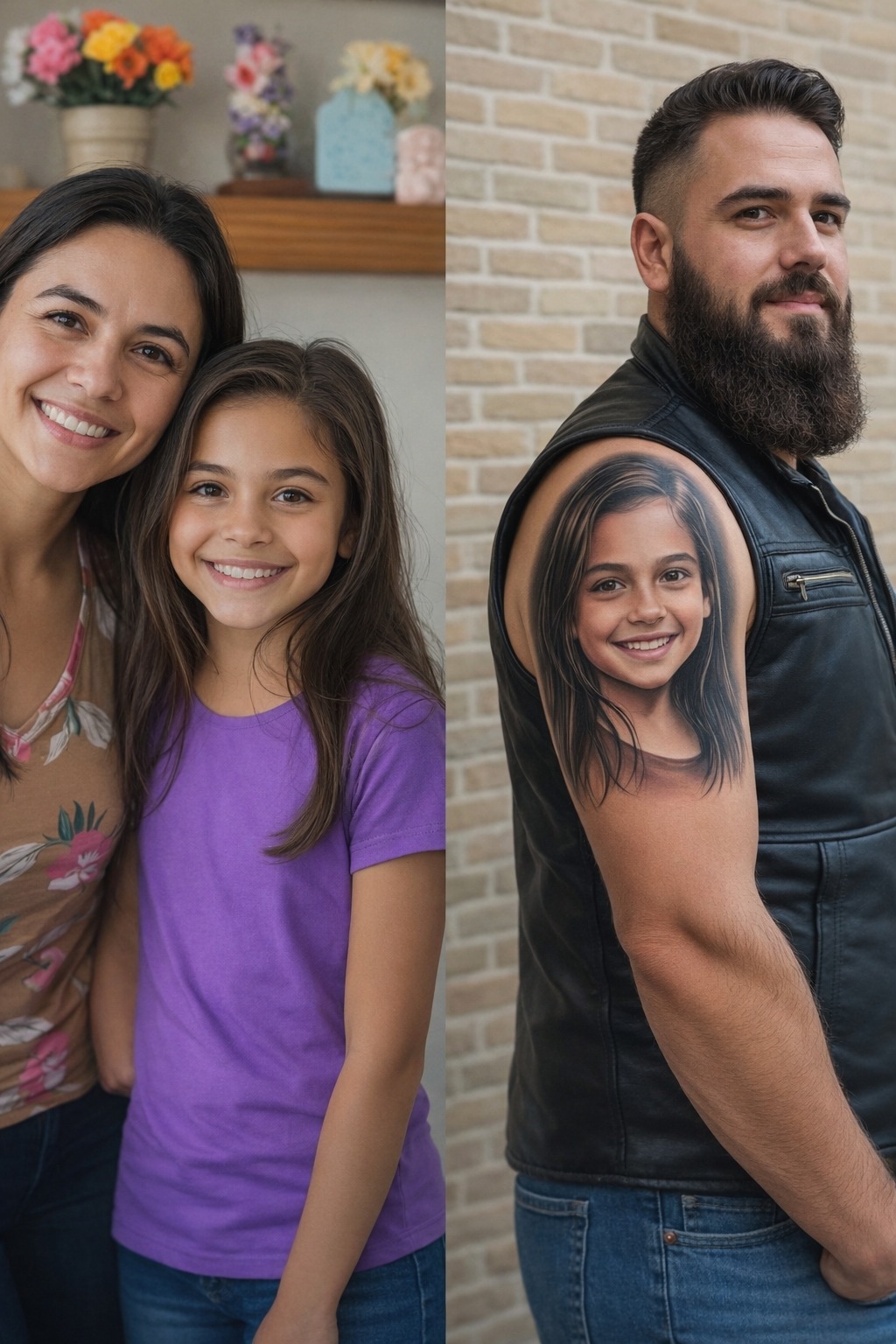
On one man’s arm was a tattoo of a young girl’s face. Simple lines, but unmistakable. Round cheeks. Bright eyes. Braids.
The glass in Elena’s hand slipped and shattered against the floor. Her heart slammed so violently she thought she might faint. She stared, unable to blink, unable to breathe. She knew that face. She had kissed that forehead a thousand times in a life that felt impossibly far away.
Summoning a courage she did not know she still possessed, she whispered, “My son… that tattoo. Who is she?”
The young man froze. Slowly, he lowered his arm, as if the image had suddenly become too heavy to carry. His friends shifted, exchanging uncertain looks.
“My name is Daniel,” he said finally. “It’s my sister.”
Elena’s fingers dug into the doorframe. “What… what is her name?”
He swallowed. “Sofía.”
The world collapsed inward. Eight years of guilt, prayers, and longing folded into that single word.
“Where is she?” Elena asked, her voice barely sound.
They sat together inside the bakery, the air thick with heat and disbelief. Daniel spoke slowly, his voice heavy with regret. When he was seventeen, his mother had come home one evening with a frightened little girl she said she’d found alone near a rural road outside the city. She claimed no one was looking for her. Daniel had known something was wrong—children did not simply appear—but he was young, dependent, and his mother told him not to ask questions.
Sofía spoke little at first. Over time, fragments emerged: a beach, a yellow dress, a doll she’d lost. Daniel’s mother, Teresa, decided to keep her. Fear ruled her choices—fear of losing the child she had come to love, fear of authorities, fear of consequences.
See more on the next page
Advertisement
To see the full cooking instructions, go to the next page or click the Open button (>) and don't forget to SHARE it with your friends on Facebook.