
I Found My Daughter In A Locked Cage While Someone Watched Upstairs-Quieen
The Friday Michael was supposed to pick up Emily, he arrived five minutes early.
That was how he did things.
Every other Friday, he drove to the school side of town before he needed to be there, parked with the engine running, and let a paper cup of coffee go cold in the console.
Emily always came out with her backpack half-open and one shoelace untied.
She would climb into the car, toss her sweatshirt into the back seat, and ask the same impossible question.
“Pizza or grilled cheese?”
She was ten years old.
At ten, the world should still fit inside small choices like that.
Pizza or grilled cheese.
Movie or board game.
Blue blanket or old quilt.
After the divorce, those weekends became the way Michael measured his life.
He had work, bills, custody dates, grocery runs, and a mortgage payment still tied to a house he no longer lived in.
But every other Friday, none of it mattered as much as seeing Emily’s face in the passenger-side mirror.
She had a laugh that filled a kitchen.
She also had a quietness that worried him.
Every Sunday evening, when it was time to take her back to Sarah’s house, Emily changed.
Sometimes she sat on the edge of the couch with her sneakers on, staring at nothing.
Sometimes she asked if they had time for one more episode of a show they both pretended was better than it was.
Sometimes, when he turned onto Sarah’s street, she looked at him and said, “Dad, can I stay just a little longer?”
Michael always told himself that was normal.
Divorce was hard.
Transitions were hard.
Two homes could make any child feel like she belonged nowhere and everywhere at once.
Sarah told him the same thing whenever he brought it up.
“She’s fine,” Sarah said.
“She just knows you’ll baby her.”
Then she would accuse him of trying to make her look bad, and the conversation would turn into the same fight wearing different clothes.
So Michael learned to choose his battles.
That phrase sounds responsible when adults say it.
Sometimes it is only exhaustion trying to sound wise.
Sometimes it is the sentence that lets danger stay hidden.
Sarah had remarried a year earlier.
Jason was not loud in public.
That was the thing Michael kept trying to explain to himself later.
Jason did not act like a monster at school events.
He did not curse on the sidewalk when neighbors were nearby.
He smiled with half his mouth, wore clean work shirts, and spoke to Michael like every word had been rehearsed.
But Emily changed when Jason’s name entered a room.
Not dramatically.
Not in a way that would make anyone call emergency services on the spot.
She stopped swinging her feet under the table.
She answered “I don’t know” where she used to tell stories.
Once, while helping Michael put groceries away, she asked whether grown-ups could get mad forever.
Michael asked what she meant.
Emily shrugged so fast he felt the door closing.
He should have paid attention to the door.
That Friday, Michael called Emily’s phone at 3:42 p.m.
It went straight to voicemail.
At first, he told himself her battery was dead.
She had left that phone everywhere.
Under pillows.
Inside dance bags.
Once in the freezer because she had helped him put away popsicles and gotten distracted.
He called again at 4:15.
Voicemail.
He texted Sarah.
No answer.
By 6:10, he had left two messages and was sitting outside a grocery store, staring at his phone while people pushed carts past his windshield.
He remembered the smell of rotisserie chicken from the automatic doors.
He remembered the squeal of a bad cart wheel.
He remembered the wet shine of the parking lot after a brief rain.
Worry can feel silly right up until it becomes the only honest thing in your body.
That evening, Michael drove by Sarah’s house.
The front curtains were drawn.
Jason’s black SUV was in the driveway.
He rang once.
No one came.
A porch light glowed though the sun had not fully gone down.
He called Sarah from the steps.
He heard nothing inside.
He told himself not to start a scene.
That was another sentence that failed his daughter.
He went home because the custody schedule said Sarah had that weekend.
He went home because lawyers, relatives, and fatigue had trained him to act reasonable even when his gut was screaming.
Saturday came.
No call.
No text.
No picture from Emily.
No complaint about how her mom never bought the cereal she liked.
Michael sent Sarah a message through the custody app so there would be a record.
Please have Emily call me.
The message showed delivered.
No reply.
By Sunday night, he had checked his phone so many times his thumb hurt.
He listened to old voicemails just to hear Emily’s voice.
One was from three weeks earlier, asking whether she had left her blue hoodie at his apartment.
Another was only laughter because she had pocket-dialed him from the school pickup line.
He sat at his kitchen table beneath the hum of the overhead light.
For the first time, he said aloud what he had been trying not to think.
“Something is wrong.”
On Monday morning, he drove back to the house he and Sarah had bought when Emily was born.
It sat in a quiet subdivision with trimmed lawns, porch flags, basketball hoops, and matching mailboxes.
Michael had painted that mailbox himself when Emily was a baby.
He remembered standing in the driveway with blue paint on his hands while Sarah held Emily on the porch.
Back then, he believed a house could keep a family safe if you paid the bills and fixed the leaks quickly enough.
After the divorce, Sarah stayed in the house.
Michael kept helping with the mortgage because he did not want Emily moved from the only bedroom she had ever known.
Her room had once been full of glow-in-the-dark stars and stuffed animals lined against the wall like a tiny audience.
When Michael pulled up that morning, the gate was chained shut.
That was new.
He parked in front and got out.
The air already felt hot.
The neighborhood was too quiet for a weekday.
No mower.
No kids.
No dog barking behind a fence.
He rang the bell.
Nothing.
He rang again and knocked hard enough to hurt his knuckles.
Jason’s SUV sat black and polished in the driveway.
The curtains were drawn across every front window.
The flower beds Sarah once fussed over were dry and tangled with weeds.
Near the front steps, a faded chalk heart Emily had drawn months earlier was still on the concrete, washed pale by weather until it looked bruised into the ground.
Then Mrs. Harris came out next door.
She wore a robe over her clothes and had a rosary wrapped around one hand.
Her face looked gray.
“Michael,” she said.
His name sounded like relief and fear at the same time.
He walked toward the low hedge.
“What’s going on?”
She looked toward Sarah’s house before answering.
“I’m so glad you came. I didn’t know what else to do.”
Her words came in pieces.
She had heard shouting for weeks.
Not one argument.
Not one bad night.
Weeks.
She had called the police twice, she said, but by the time anyone came, the house was quiet.
No one opened the door.
No one made a statement.
One officer left a card.
Another said that without someone inside reporting a crime, there was only so much they could do from the sidewalk.
Mrs. Harris said Emily used to wave from the backyard.
Then she stopped coming outside.
Jason put tall privacy panels along the fence.
After that, Mrs. Harris only had sounds.
A slammed door.
A man’s voice.
A child crying once, then going silent fast.
Michael felt his body trying to reject every word.
There is a particular horror in hearing proof that your fear was not sudden.
It had been growing without you.
Mrs. Harris lowered her voice.
“Last night, I saw him carrying black trash bags into the backyard.”
Michael’s mouth went dry.
“What bags?”
“I don’t know. Big ones. Heavy.”
Her eyes filled.
“He threw them into the pool.”
For a moment, Michael heard nothing.
Not traffic.
Not birds.
Not the soft rattle of the porch flag.
The world narrowed to the chained gate, the drawn curtains, and the fact that his daughter had not called him in three days.
He asked Mrs. Harris to let him through her side yard.
She did not hesitate.
She opened the gate beside her garage with shaking hands and led him around back.
Her yard smelled like damp soil and old leaves.
The wall between the properties was lower near a storage shed, but still high enough that Michael had to climb.
He put one foot on a stack of bricks.
Hot wood scraped his forearm.
A rusty edge cut his palm as he pulled himself over.
Pain flashed bright, then vanished beneath the louder thing inside him.
He dropped into Sarah’s backyard and landed hard in tall grass.
For one second, he stayed crouched and listened.
The yard looked abandoned.
The lawn had grown wild.
A broken plastic planter lay on its side near the patio.
The pool water was green and still, filmed with something oily.
At the far side of the yard, near the fence, a torn blue tarp sagged over a shape he did not understand at first.
Then the shape moved.
Michael stood.
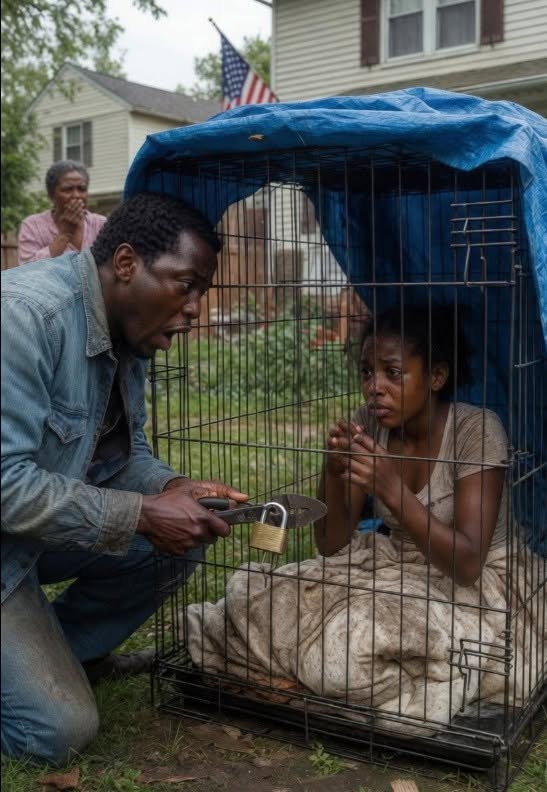
Under the tarp was a large dog cage.
Inside was Emily.
His daughter sat on a filthy blanket with her knees tucked against her chest.
Her hair was matted against one side of her face.
Her cheeks looked hollow.
Her hoodie was wrinkled and dirty.
Her lower lip was split at the corner, dry and swollen in a way that made his vision blur.
She did not scream when she saw him.
She did not reach for him at first.
That was the part that terrified him most.
She looked at him like she did not trust her own eyes.
“Daddy?” she whispered.
Michael ran to the cage.
The door was locked with a heavy padlock.
Not a twist latch.
Not something a child could push open.
A padlock.
For one second, rage rose so fast he thought it would make him useless.
He wanted to kick the cage apart.
He wanted to run inside the house and drag the truth out by its throat.
Instead, he forced himself to look around.
Anger can break things.
Love has to get the lock open.
Gardening pliers lay in the weeds near the fence.
He grabbed them and dropped to his knees.
His hands shook so badly that the metal slipped the first time.
Emily flinched at the sound.
“I’m sorry, baby,” he said. “I’m here. I’m getting you out.”
The second attempt scraped and failed.
He heard movement somewhere inside the house.
Maybe a floorboard.
Maybe imagination.
Maybe someone finally realizing he was in the yard.
He braced one knee in the dirt, pressed the pliers around the shackle, and pulled with everything he had.
His cut palm burned.
The metal groaned.
Then the lock snapped.
Emily moved like a child falling forward in a dream.
She threw herself against him.
He caught her through the open door, one arm under her back, the other around her shoulders.
She weighed less than she should have.
That was not poetic.
It was the thing his arms knew before his mind could accept it.
She wrapped her arms around his neck and held on hard enough to hurt.
He stood with her against his chest and started toward the gate.
Then she stiffened.
Her whole body changed.
He followed her eyes before he could stop himself.
She was looking at the pool.
The water did not move.
It was green, cloudy, wrong.
Near the deep end, beneath the dirty film on the surface, dark shapes rested below.
The black bags.
Emily pressed her face into his neck.
“Daddy, please,” she whispered. “Don’t look at the pool. Let’s go. Just let’s go.”
He did what she asked.
Not because he did not want to know.
Because in that moment, his only job was to get his daughter beyond the fence.
He carried her through Mrs. Harris’s yard and ran to his car.
Mrs. Harris was crying by then.
Michael put Emily in the back seat, shut the door, locked it, and handed her an unopened water bottle.
Her fingers could barely twist the cap.
He opened it.
She took two small sips and held the bottle against her chest.
Then he called 911.
The dispatcher asked for the address.
He gave it.
She asked if Emily was conscious.
“Yes.”
Breathing normally?
“I think so.”
Visible injuries?
He looked at Emily in the rearview mirror.
Her eyes were fixed on the house.
“Yes,” he said.
His voice broke on the word.
The dispatcher told him officers and paramedics were on the way.
She told him to stay where he was if safe.
Safe had become a strange word.
Michael looked at the house again.
That was when the upstairs curtain moved.
Second floor.
Front window.
A slight pullback and release.
Someone was watching.
Someone had watched him ring the bell.
Someone had watched him climb the wall.
Someone had watched him break the padlock and carry Emily out.
Someone had not opened the door.
Emily spoke from the back seat.
Her voice was small and flat.
“Jason said little liars live like dogs.”
Michael turned slowly.
She stared at the water bottle.
“But I didn’t lie, Dad. I just wanted you to come earlier.”
There are sentences a child says that split time in half.
Before them, you are a man trying to understand what happened.
After them, understanding can wait.
Michael told her she was safe.
He told her he was sorry.
He told her she had done nothing wrong.
She listened like she wanted to believe him but did not know whether belief was still allowed.
A siren began in the distance.
Thin at first.
Then louder.
Mrs. Harris stood near her mailbox, one hand over her mouth, the other gripping the post.
The curtain upstairs moved again.
Michael lifted his phone higher.
“There is someone inside the house,” he told the dispatcher. “They’re watching us from the second floor.”
The siren grew closer.
Emily slid lower in the back seat.
Then, from behind the house, came a heavy splash.
Not a child jumping into water.
Not a pool toy falling in.
A slow, deep sound, like something under the surface had shifted.
Mrs. Harris turned toward the backyard fence.
All the color drained from her face.
“Oh my God,” she said.
Her knees gave out.
She caught the mailbox with both hands before she hit the ground.
The dispatcher was still talking in Michael’s ear.
The first flash of emergency lights appeared at the end of the street.
Red and blue flickered across the windows of the house where Emily had been held.
Then the front door opened.
Jason stepped onto the porch.
He looked calm.
Too calm.
See more on the next page
Advertisement
To see the full cooking instructions, go to the next page or click the Open button (>) and don't forget to SHARE it with your friends on Facebook.