
I Only Came to Watch My Son Graduate—Then His Lieutenant Colonel Saw My Old Tattoo and Went Pale
My son asked me to sit in the back.
Not because he was ashamed of me, he said. Not exactly.
He stood in my kitchen three weeks before graduation with his dress uniform hanging from one hand and a pressed white shirt from the other, looking bigger than the boy I had raised and younger than the man the Army was trying to make him.
“Mom,” Caleb said, rubbing the back of his neck, “Dad’s going to be there. And Marissa. And probably Grandpa Dale. They’re making a whole thing out of it.”
I kept my hands in the dishwater longer than I needed to. Outside the window, the Ohio rain came down in thin gray lines, turning the alley behind my duplex into a ribbon of mud.
“A whole thing,” I repeated.
He heard the edge in my voice and winced. “I just mean… they invited some people. Dad knows the battalion commander from some veterans’ charity thing. It’s political. You know how he is.”
I did know how his father was.
Frank Whitaker had never entered a room without first checking who might applaud. He had spent four years in uniform, twenty years telling stories about it, and the rest of his life polishing those stories until they shined brighter than the truth.
I dried my hands on a towel. “Caleb, do you want me there?”
His eyes snapped up. “Of course I do.”
“Then I’ll be there.”
He nodded, but the tension did not leave his jaw. “Just… maybe don’t engage with Dad if he starts.”
I smiled a little. “When have I ever engaged with your father?”
He almost smiled back. Almost.
Then his eyes dropped to my left forearm.
The sleeve of my work shirt had slipped up. There, above the inside of my wrist, black ink peeked through: part of a wing, part of a blade, part of a number nobody in my current life was supposed to recognize.
Caleb had seen the tattoo before. He had asked about it when he was eight. I told him it was from a bad year and a worse decision. When he was fourteen, he asked again, after Frank told him I had “run with some dangerous people” before motherhood cleaned me up. I told him some stories were mine to keep.
By nineteen, Caleb had stopped asking.
Now, twenty-three and graduating from Army Officer Candidate School, he looked at that tattoo like it was one more complication he wished I would keep covered.
“I bought a dress,” I said gently. “Long sleeves.”
His face flushed. “I didn’t mean—”
“I know what you meant.”
But I did.
I knew exactly what everyone in Frank’s orbit thought of me.
Evelyn Hart. Evie. The broke single mother. The woman who fixed lawn mowers out of a garage behind a bait shop. The woman who wore thrift-store boots to church and had a scar cutting through one eyebrow. The woman Frank had left because, as he told people, “Some folks just can’t handle a decent life.”
I did not correct him.
Correcting Frank would have meant opening doors I had spent twenty years nailing shut.
So when Caleb left that night, hugging me too quickly, I stood alone in my kitchen and pulled my sleeve down over the tattoo.
Then I looked at the graduation invitation on the refrigerator.
Fort Redstone Training Center
Officer Candidate Graduation Ceremony
Class 26-04
My boy had made it.
I should have felt only pride.
Instead, I felt the old warning in my bones.
The kind you get before a storm.
Fort Redstone sat under a Georgia sun so bright it made everything look freshly painted.
The parade field stretched wide and green, framed by flags, bleachers, and rows of young officers in crisp uniforms. Families moved everywhere—mothers with cameras, fathers with stiff handshakes, little kids waving tiny American flags.
I parked my twelve-year-old Ford two lots away because the closer spaces were already full of shiny SUVs and rental cars. I sat for a moment with both hands on the steering wheel, listening to the engine tick.
My dress was navy blue, simple, with sleeves to my wrists. My hair, usually twisted up with a pencil while I worked, was pinned at the back of my head. I had even put on earrings, small silver ones Caleb gave me for Christmas when he was sixteen.
“You’re just here to watch your son graduate,” I told myself.
That should have been easy.
But nothing involving Frank Whitaker was ever easy.
I found him near the front bleachers before he saw me.
He wore a tan summer suit and a veteran pin on his lapel, standing with one hand on Caleb’s shoulder like a proud senator. Beside him was Marissa, his second wife, blonde and polished in a cream dress that looked expensive enough to pay my electric bill for three months.
Grandpa Dale stood behind them in a Navy cap, though he had served eighteen months stateside and somehow stretched it into a lifetime of authority.
Caleb looked handsome.
That was the first thing that hit me hard enough to stop my feet.
My son stood straight in his uniform, shoulders squared, chin lifted, the morning light catching the brass on his chest. For one second, I saw him at six years old, saluting me with a wooden spoon and a colander on his head. Then I saw him at twelve, trying not to cry when Frank forgot his birthday. Then at seventeen, asleep at the kitchen table with college brochures under his cheek.
And now there he was.
A man.
My man.
I took a breath and walked toward them.
Marissa noticed me first. Her smile arrived a second late.
“Evie,” she said, as if we were old friends and not two women who had spent fifteen years pretending the other did not exist.
“Marissa.”
Frank turned.
His smile widened, but his eyes sharpened. “Well, look who made it.”
“I said I would.”
“Long drive in that old Ford?”
“Long enough.”
Caleb stepped forward quickly. “Mom.”
He hugged me, and for a moment the noise of the crowd disappeared. His uniform smelled like starch and sun-warmed fabric.
“I’m proud of you,” I whispered.
His arms tightened once. “Thanks, Mom.”
Then Frank clapped him on the back. “We’re all proud. This boy’s carrying on a tradition.”
I let that pass.
Grandpa Dale leaned in, squinting at me. “Didn’t expect you to come all this way.”
“I wouldn’t miss it.”
“No,” Frank said smoothly. “Wouldn’t look good.”
Caleb’s eyes flicked toward him. “Dad.”
Frank held up both hands. “I’m kidding.”
He was not.
A group of officers passed near us. Frank straightened immediately, shifting into his public voice.
“Lieutenant Colonel Reeves!” he called.
A tall man in dress uniform turned. He was maybe fifty, square-jawed, with silver at his temples and the controlled expression of someone used to being watched.
Frank stepped forward eagerly. “Sir, Frank Whitaker. We met at the Veterans Leadership Dinner in Atlanta last spring.”
The lieutenant colonel paused, searched his memory, then offered a polite nod. “Mr. Whitaker.”
Frank beamed as if they were brothers. “This is my son, Caleb Whitaker. Fine young officer. And this is my wife, Marissa.”
Caleb’s jaw tightened at the name.
Whitaker.
He had enlisted under his father’s last name at eighteen after Frank insisted it would “open doors.” Legally, Caleb’s last name was Whitaker-Hart, but Frank had always hated the second half.
Lieutenant Colonel Reeves shook Caleb’s hand. “Congratulations, candidate.”
“Thank you, sir.”
Then Frank gestured toward me, almost carelessly. “And this is Caleb’s mother, Evelyn Hart.”
The lieutenant colonel turned to me.
I expected the usual quick glance—the one people gave women like me when they were trying to place us in a hierarchy and had already decided we belonged near the bottom.
Instead, he froze.
Not completely. Not dramatically. But enough that I noticed.
His eyes dropped to my left wrist.
My sleeve had shifted when I hugged Caleb.
Only an inch of tattoo showed.
A black wing.
A broken spear.
The number 17.
The lieutenant colonel’s face changed.
The color drained from it so quickly Marissa actually stepped back.
He looked at my face, then back at the tattoo, then at my face again.
And in a voice so low only those closest could hear, he said, “Ma’am… where did you get that mark?”
Every old instinct in me came awake.
My heartbeat slowed.
My shoulders loosened.
My eyes measured exits, uniforms, shadows, hands.
Frank laughed, too loudly. “Probably from a biker bar, knowing Evie.”
No one else laughed.
Lieutenant Colonel Reeves did not look away from me.
I gently pulled my sleeve down.
“A long time ago,” I said.
His throat moved. “Were you attached to Task Force Blackwing?”
The name hit the air like a gunshot.
Frank’s smile faltered. “What?”
I stared at Reeves.
Twenty-two years.
Twenty-two years since I had heard anyone say that name in daylight.
“Sir,” I said quietly, “this is my son’s graduation.”
Reeves’ posture shifted. His heels came together.
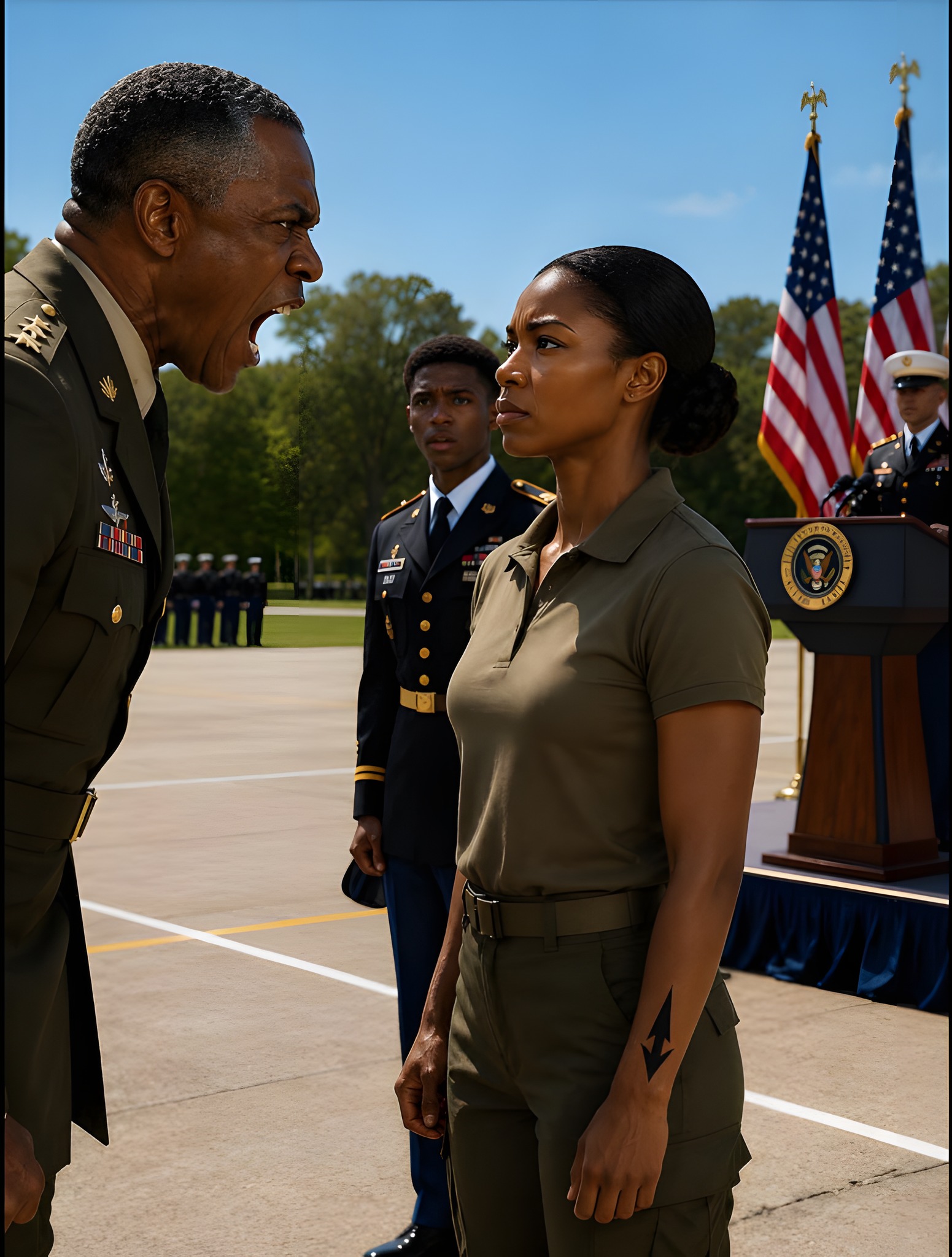
Then, in front of my ex-husband, his polished wife, my son, and half the front row of families, the lieutenant colonel raised his right hand and saluted me.
Not casually.
Not politely.
Formally.
Hard.
Like I outranked the whole morning.
Caleb went still.
Frank stared.
Marissa’s mouth opened.
Grandpa Dale whispered, “What the hell?”
I did not return the salute.
I could not.
Not there.
Not with cameras, families, children, and the past pressing its cold fingers against my throat.
“Please don’t,” I said.
Reeves lowered his hand slowly, but his eyes had gone wet.
“I’m sorry,” he said. “I thought you were dead.”
The ceremony began seven minutes later.
I remember because I checked my watch three times, not because I cared about the time, but because I needed something ordinary to look at.
The candidates marched onto the field in perfect formation. The band played. Families cheered. Flags snapped in the hot wind.
I sat in the third row because Frank, despite everything, had saved seats near the front. I wanted to move to the back, but Caleb looked over once from formation, found me, and held my gaze.
So I stayed.
Lieutenant Colonel Reeves stood at the podium.
His voice was steady when he welcomed families and honored the graduating class. He spoke about duty, service, sacrifice, and leadership. All the right words. Good words. Words that meant something when lived and nothing when performed.
But twice, his eyes moved toward me.
And every time, Frank noticed.
By the time the names were called, Frank’s face had tightened into something ugly.
“Caleb James Whitaker-Hart.”
The announcer used the full name.
My son crossed the stage.
For a moment, everything else vanished again.
He saluted. He shook hands. He received his certificate. His face stayed controlled, but I could see the boy inside him fighting a smile.
That was when I cried.
Not much.
Just enough that I had to press my fingers under my eyes.
Marissa noticed and handed me a tissue. It surprised me enough that I took it.
“Thank you,” I said.
She nodded, looking uncomfortable.
After the ceremony, chaos erupted beautifully. Families rushed the field. Cameras clicked. Graduates hugged mothers, fathers, siblings, girlfriends, grandparents.
Caleb found me before Frank could intercept him.
“Mom,” he said, voice low, “what just happened?”
I touched his cheek before I could stop myself. “You graduated.”
His eyes narrowed. “The lieutenant colonel saluted you.”
“He made a mistake.”
“No, he didn’t.”
Frank appeared at Caleb’s shoulder. “I’d like an explanation too.”
“That’s new,” I said.
His eyes flashed. “Don’t do that. Not today.”
“Then don’t start.”
“I’m starting?” He gave a bitter laugh. “A lieutenant colonel just saluted my ex-wife like she was some war hero. I think I’m allowed to ask a question.”
I looked at Caleb. He deserved the truth.
But not here.
Not with Frank circling like a dog that smelled meat.
“Caleb,” I said, “we can talk later.”
Frank stepped closer. “No. We can talk now.”
My son turned sharply. “Dad, back off.”
The words surprised all of us.
Frank recovered quickly. “Son, I’m trying to protect you.”
“From Mom?”
“From whatever she’s dragged into your big day.”
That landed.
I saw it hit Caleb in the face—the same old poison, served in the same silver cup.
I had swallowed it for years so he would not have to.
Maybe that had been my mistake.
Before I could answer, a young captain approached.
“Ms. Hart?”
I turned.
“Lieutenant Colonel Reeves requests a private word, ma’am.”
Frank snorted. “Of course he does.”
Caleb looked at me. “I’m coming.”
The captain hesitated.
I said, “He’s my son.”
“Yes, ma’am.”
Frank tried to follow.
The captain blocked him with a polite step. “Immediate family only, sir.”
“I’m his father.”
The captain looked at me.
I looked at Caleb.
Caleb looked at Frank. “Dad, wait here.”
Frank’s face turned red. “Caleb—”
“Please.”
That please did not soften the order.
Frank stayed.
And for the first time that day, I walked away from him without feeling his shadow on my back.
Lieutenant Colonel Reeves waited inside a small administrative building near the parade field. The air conditioning hit my skin like winter.
He stood when we entered.
So did two other officers: a major with kind eyes and a command sergeant major whose face looked carved from old oak.
On the table sat a manila folder.
I hated that folder immediately.
Reeves dismissed the captain, then looked at Caleb. “Lieutenant Whitaker-Hart, before we go any further, I need to ask your mother’s permission to speak.”
Caleb blinked.
No one in his father’s world had ever asked my permission for anything.
I folded my hands in front of me. “What exactly do you think you know?”
Reeves’ eyes moved to my covered wrist. “I was a first lieutenant at Outpost Kestrel.”
The room seemed to shrink.
Caleb looked between us. “Outpost what?”
Reeves swallowed. “Northern Iraq. 2004. Classified joint recovery operation.”
I closed my eyes.
For twenty-two years, I had kept that door sealed.
Not because I was ashamed.
Because the room behind it was full of ghosts.
When I opened my eyes, Reeves was no longer a lieutenant colonel at a graduation. He was twenty-six again, bleeding through his uniform, trapped under burning concrete while the radio screamed and the sky cracked apart.
“You were under the west wall,” I said.
His face broke.
“Yes, ma’am.”
The command sergeant major looked down.
Caleb stared at me like he had never seen me before.
Reeves touched the folder but did not open it. “I owe you my life.”
“No,” I said.
“Yes.”
“No,” I repeated, sharper. “You owed me nothing then, and you owe me nothing now. You got your people out. That’s what mattered.”
“I got them out because you carried three of us through a kill zone after your own team was compromised.”
Caleb’s breath caught.
I turned toward him. “Caleb—”
“No,” he said softly. “Please don’t stop.”
The major spoke carefully. “Ms. Hart, Lieutenant Colonel Reeves contacted records immediately after the ceremony. Some portions remain sealed, but your service status is verifiable.”
I laughed once, without humor. “My service status?”
Reeves opened the folder.
Inside was a photocopy of a younger woman with my eyes, my hair cut short, and a uniform I had not touched in decades.
HART, EVELYN M.
Chief Warrant Officer Two
Special Mission Aviation Detachment
Attached Task Force Blackwing
Caleb stepped closer to the table.
I watched him read my name.
Then the decorations.
Then the medical retirement.
Then the line that had followed me like a shadow:
Public record restricted by order of command authority.
His voice was barely audible. “You were in the Army.”
I nodded.
“You told me you worked logistics overseas.”
“I did.”
“You flew helicopters?”
“Sometimes.”
Reeves said, “Your mother was one of the best extraction pilots in theater.”
I gave him a look.
He corrected himself. “One of the best I ever saw.”
Caleb touched the edge of the paper but did not pick it up. “Dad said you quit basic training.”
There it was.
The ugly little lie, finally standing in the room where everyone could see it.
I felt something old and tired move through me.
“Your father never knew what I did,” I said.
“He said—”
“I know what he said.”
“Why didn’t you tell me?”
That question hurt more than Frank’s lies ever had.
Because it was fair.
I had imagined answering it a thousand times. In every version, I sounded noble. Strong. Wise. A mother protecting her child from darkness.
But standing in front of my son, I felt none of those things.
“I wanted you to have a childhood that didn’t belong to war,” I said. “And later… I thought if I told you, it would sound like I was trying to compete with your father. Then after enough years, silence became easier than truth.”
Caleb’s eyes shone. “You let me believe him.”
“I let you believe a version of me that kept you from asking questions I wasn’t ready to answer.”
“That’s not the same thing.”
“No,” I said. “It isn’t.”
Reeves stepped back, giving us space.
Caleb looked at the tattoo hidden under my sleeve. “What does it mean?”
I slowly pushed the fabric up.
The whole mark showed now.
A black wing curved around a broken spear. Beneath it, the number 17. Under that, so small most people never noticed, were six dots in a half-circle.
“Blackwing was the task force,” I said. “The spear meant recovery under fire. Seventeen was our detachment number.”
“And the dots?”
My throat tightened.
“Those were people who didn’t come home.”
No one spoke.
The air conditioner hummed.
Outside, faintly, families laughed and called names across the parade field.
Caleb stared at those six dots.
Then he looked at my eyebrow scar. My left hand, where two fingers did not bend all the way. The way I stood with my weight slightly off my right hip.
All the evidence had always been there.
He just had not known what he was seeing.
Reeves said quietly, “Your mother disappeared after the Kestrel report. Most of us were told she died during evacuation.”
“That was easier,” I said.
“For whom?”
“For everybody who needed the story clean.”
The command sergeant major finally spoke. “Ma’am, with respect, nothing about that story was clean.”
I looked at him.
His name tape read BARNES.
Recognition stirred.
“You were with convoy security,” I said.
He nodded once. “Sergeant Barnes back then. You landed on a road that wasn’t wide enough for a pickup, under fire, with your tail rotor three feet from a wall.”
“You were yelling at me.”
“You were ignoring me.”
“I remember that.”
His mouth twitched. “I remember thinking you were crazy.”
“I probably was.”
“No, ma’am,” Barnes said. “You were the reason some of us got old.”
That nearly did it.
I looked away.
Caleb saw.
The anger in his face shifted into something softer, more painful.
“Mom,” he whispered.
I pulled my sleeve back down. “I need some air.”
Frank was waiting outside like a prosecutor.
He had gathered an audience too—Marissa, Grandpa Dale, two of his veteran charity friends, and a couple of Caleb’s classmates who looked like they regretted standing close.
“Well?” Frank demanded. “What did the colonel want?”
Caleb came out behind me, holding the folder.
Frank saw it.
“What’s that?”
“Records,” Caleb said.
Frank smiled, but it twitched. “Records of what?”
“My mother’s service.”
The words changed the temperature.
Frank laughed. “Her what?”
Caleb did not laugh.
Marissa looked at me, then at Frank. Something like suspicion crossed her face.
Frank pointed at the folder. “Son, whatever she told you in there—”
“She didn’t tell me. Lieutenant Colonel Reeves did.”
Frank’s eyes flicked over my shoulder.
Reeves had followed us out.
So had Barnes.
The audience grew quiet.
Frank straightened. He was good at this part—looking wronged, dignified, reasonable.
“Colonel,” he said, using the wrong title with confidence, “I’m sure there’s some confusion here.”
“Lieutenant Colonel,” Reeves said. “And there is no confusion.”
Frank’s smile hardened. “With respect, sir, I knew Evie back then. She was no officer. She was a dropout with a duffel bag and a temper.”
I should have felt angry.
Instead, I felt tired.
Caleb looked at his father like he was seeing him through clear glass for the first time.
Reeves’ voice became very calm. “Mr. Whitaker, Evelyn Hart served with distinction in operations you were never cleared to know existed.”
Frank’s face reddened. “That’s convenient.”
Barnes stepped forward.
He did not raise his voice. He did not need to.
“Careful.”
One word.
Frank shut his mouth.
Grandpa Dale tried to rescue him. “Now, hold on. Nobody’s disrespecting anybody. We’re just saying there’s been a lot of stories over the years.”
“Yes,” Caleb said. “There have.”
He opened the folder.
His hands shook, but his voice did not.
“Chief Warrant Officer Evelyn M. Hart. Medical retirement. Commendations. Classified attachment. Restricted record.”
Frank looked at the paper like it might bite him.
Marissa whispered, “Frank, did you know?”
He snapped, “No, I didn’t know, because it isn’t true.”
Reeves said, “It is.”
Frank jabbed a finger toward me. “Then why hide it? Why spend twenty years pretending to be some poor little mechanic if you were this great hero?”
That question was not entirely unfair.
But coming from him, it was not a question.
It was an accusation.
I looked at him for a long moment.
Then I said, “Because after I came home, I had a baby who needed diapers, not medals.”
Caleb’s face crumpled.
I had not meant to say it like that.
But once truth starts moving, it rarely asks permission.
“I had nightmares,” I continued, quieter. “I had a hip that barely worked, a hearing problem, a stack of nondisclosure papers, and a son who cried every time a truck backfired. I had no family money. No clean record the civilian world could understand. No patience for men who wanted to turn pain into speeches.”
Frank flinched.
Good.
“So I fixed engines. I cleaned houses. I packed lunches. I went to parent-teacher conferences in clothes that smelled like motor oil. I did what needed doing.”
Caleb covered his mouth with one hand.
Frank looked around, realizing the crowd was no longer his.
“You always did love making yourself the martyr,” he muttered.
Before I could answer, Caleb stepped between us.
“No.”
Frank blinked. “Excuse me?”
Caleb’s voice broke, but he held it. “No. You don’t get to do that today.”
“I am your father.”
“And she is my mother.”
The words rang across the sidewalk.
A few people nearby turned.
Caleb did not care.
“You told me she was nothing,” he said. “You told me she quit. You told me she embarrassed you.”
Frank’s face darkened. “I raised you to respect—”
“She raised me.”
Silence.
Even the Georgia wind seemed to pause.
Caleb’s eyes filled, but he did not look away from his father.
“She worked nights and still made breakfast. She missed meals so I could play baseball. She drove eight hours once because I forgot my inhaler at camp. You sent a check and called it parenting.”
Marissa stared at Frank.
Grandpa Dale looked at the ground.
Frank’s mouth opened, but no sound came out.
I whispered, “Caleb.”
He turned toward me. “No, Mom. I should’ve said this years ago.”
Then he faced Frank again.
“I’m grateful you came today. But if you disrespect her again, you can leave.”
Frank’s pride fought his fear.
For a second, I thought he would explode.
Instead, he adjusted his suit jacket, gave a cold little smile, and said, “You’ll understand when you’re older.”
Caleb nodded once. “I understand enough.”
Frank walked away.
Marissa hesitated.
Then, quietly, she said to me, “I’m sorry.”
It was not much.
But it was more than I expected.
She followed him.
Grandpa Dale went too.
Just like that, the world rearranged itself.
Not completely.
Not perfectly.
But enough.
The official reception was held in a hall decorated with flags, folding tables, sheet cake, and coffee strong enough to strip paint.
Caleb did not leave my side for nearly twenty minutes.
He kept looking at me, then looking away, like he was trying to match the woman who had raised him with the woman in the folder.
Finally, I nudged him. “Go be with your classmates.”
“I don’t want to leave you alone.”
That made me smile. “I survived your teenage years. I can survive a reception.”
He almost laughed.
Almost.
Reeves approached with two paper cups of coffee. He offered one to me.
I took it.
“Still drink it black?” he asked.
“Still tastes like punishment?”
“Some Army traditions endure.”
We stood near the wall while families celebrated around us.
Caleb was pulled into a group photo. He glanced back at me. I nodded for him to go.
Reeves watched him with a strange expression. “He has your eyes.”
“He has my stubbornness too. Unfortunately.”
“Fortunately,” Reeves said.
I sipped the coffee. It was terrible. Familiar.
“You shouldn’t have saluted me,” I said.
“I know.”
“Then why did you?”
He looked at his cup. “Because for twenty-two years, I thought the person who dragged me out of hell was buried in a classified footnote. Then she showed up in a navy dress at her son’s graduation.”
I said nothing.
He cleared his throat. “You vanished, Hart.”
“I was ordered quiet.”
“We all were. But quiet isn’t the same as gone.”
“For me, it had to be.”
He studied me. “Because of the report?”
There it was.
The deeper door.
Outpost Kestrel had not been only a rescue. It had been a mistake buried under patriotism. Bad intelligence. Worse leadership. A mission greenlit by men far from the blast radius. When everything went wrong, people like us were supposed to bleed quietly so people like them could keep their careers clean.
But six dots on my wrist said quiet had a cost.
“I signed papers,” I said.
“So did I.”
“And yet here we are.”
His expression darkened. “Some of the seal orders expired last year.”
I looked at him sharply.
He nodded. “Not everything. But enough.”
“Enough for what?”
“Enough for a recognition packet.”
I laughed under my breath. “No.”
“Hart—”
“No.”
“Hear me out.”
“I said no.”
A family nearby quieted, then wisely moved away.
Reeves lowered his voice. “The men who died at Kestrel deserve clean records. So do the people who brought survivors home.”
My hand tightened around the coffee cup. “Don’t use them.”
“I’m not.”
“Yes, you are.”
His face tightened, but he accepted the hit.
I softened my voice. “Michael, I know what you’re trying to do.”
He looked startled when I used his first name.
“You were a good lieutenant,” I said. “You probably became a good commander. But don’t mistake public recognition for justice.”
“Then what is justice?”
I looked at Caleb laughing awkwardly while one of his classmates threw an arm around his shoulders.
“That,” I said.
Reeves followed my gaze.
“My son standing in sunlight,” I said. “Not knowing the sound a person makes when they realize help isn’t coming. Not spending his childhood learning which parts of his mother were broken by men with maps.”
Reeves’ eyes lowered. “He knows now.”
“Some. Not all.”
“He may ask.”
“I know.”
“And if he does?”
I watched Caleb smile for a camera.
This time, it reached his eyes.
“If he does,” I said, “I’ll tell him enough to understand. Not enough to inherit.”
Reeves nodded slowly.
Then Barnes appeared at my other side with a piece of cake on a napkin.
“Ma’am,” he said. “Reception cake. Government-grade.”
I took it. “Is that a warning?”
“Yes, ma’am.”
I tasted it.
Dry vanilla. Too much frosting.
Perfect.
Barnes looked toward Caleb. “Fine young man.”
“He is.”
“He know what branch he wants?”
“Military intelligence.”
Both men looked at me.
I sighed. “I know.”
Barnes coughed into his fist. “That’s one way for the universe to tell jokes.”
For the first time that day, I laughed.
Really laughed.
Caleb heard it from across the room.
His face changed.
Later, he told me he could not remember the last time he heard me laugh like that.
I could.
It had been before Kestrel.
That evening, Caleb and I went to a diner off the highway instead of the fancy steakhouse Frank had reserved.
The place had cracked red booths, chrome trim, and a waitress named Sandy who called everyone “hon.” A baseball game played silently on a TV over the counter. Outside, the Georgia sky turned purple behind a row of gas pumps.
Caleb sat across from me, still in uniform jacket, though he had loosened his collar.
Between us were two plates of meatloaf, mashed potatoes, and green beans cooked to surrender.
For ten minutes, we talked about nothing.
Traffic.
The heat.
How bad the reception cake had been.
Then Caleb set down his fork.
“Mom.”
See more on the next page
Advertisement
To see the full cooking instructions, go to the next page or click the Open button (>) and don't forget to SHARE it with your friends on Facebook.