
The first time my father mocked my service in public, he did it with a smile so polished that half the room laughed before they understood what he had said.
It happened inside the American Legion Hall in Hartwell, Virginia, on a cold November evening when the windows had fogged from the heat of too many bodies, too much coffee, and too many old stories. The place smelled like waxed floors, barbecue sauce, wool coats, and black coffee burned down to bitterness in silver urns. Flags hung from every corner. Framed photographs of young men in uniforms lined the paneled walls, their faces frozen in decades when they still believed coming home would make them whole.
My father stood near the microphone beneath the largest flag in the room, one hand tucked into the pocket of his dress slacks, the other wrapped around a paper cup he had not drunk from. Colonel Thomas Whitaker, retired United States Marine Corps, knew how to own a room without raising his voice. He had been doing it my entire life.
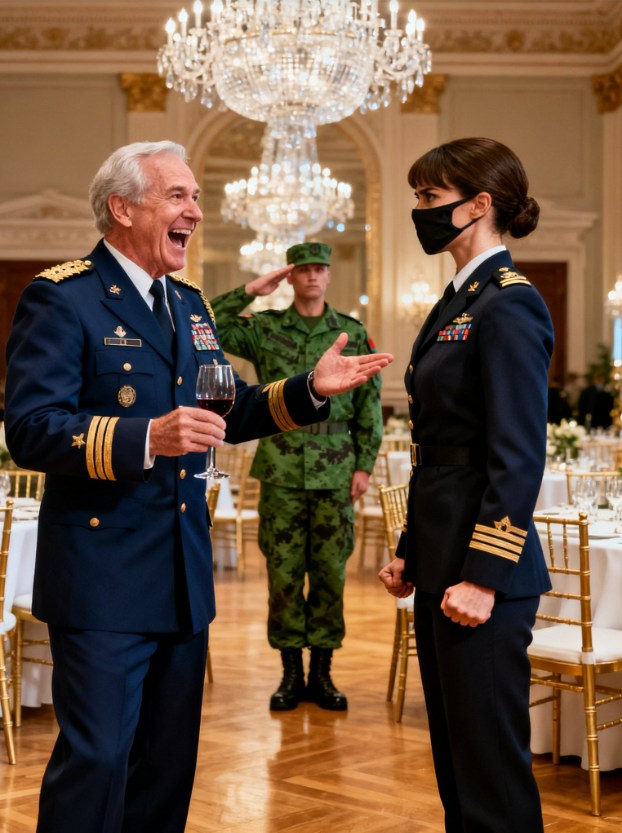
He had broad shoulders still, even at sixty-eight. Silver hair combed back. Chin lifted. Dress blues tailored with the care of a man who believed wrinkles were a moral failing. His medals gleamed under the fluorescent lights like little arguments no one dared challenge.
I stood near the back door with my hands folded in front of me, wearing a plain dark suit instead of my uniform because I had learned long ago that uniforms were invitations in my father’s world.
Invitations to compare.
Invitations to question.
Invitations to shame.
My younger brother, Caleb, stood beside him in his Army captain’s uniform, smiling like a prince being introduced to his kingdom. Caleb had always been exactly what my father wanted in a child: loud when confidence was required, quiet when obedience was demanded, and loyal to the family story above all else.
Then there was me.
Mara Whitaker.
Thirty-six years old.
Former Navy.
Divorced.
No children.
No hometown reputation worth protecting.
At least, that was how my father preferred to introduce me.
The event was supposed to be a Veterans Appreciation Dinner. Every year, Hartwell’s veterans gathered at the Legion Hall the Saturday before Veterans Day. Every year, my father gave a speech. Every year, my brother stood beside him. Every year, I found some reason not to attend.
That year, I had run out of excuses.
My aunt Linda had called three times.
“Mara, your dad’s health hasn’t been great.”
“Mara, Caleb’s coming in from Fort Liberty.”
“Mara, it would mean something if you showed up.”
I almost told her the truth.
That my father didn’t want me there.
That Caleb didn’t want me there.
That I had spent half my life trying to stop wanting to be wanted by either of them.
But Aunt Linda had been kind to me when kindness in our house came with conditions, so I said yes.
Now, I stood under a framed photo of my father at twenty-five, fresh-faced and fierce in Vietnam-era greens, and watched him perform love of country for men who believed him.
“And of course,” he said into the microphone, his voice warm with false humility, “I’m proud to have both my children here tonight.”
The room turned toward us. Caleb straightened. I felt my spine tighten.
“My son, Captain Caleb Whitaker, has carried on the family tradition with honor,” Dad continued. “Three deployments, Bronze Star, and still humble enough to let his old man brag on him.”
The room applauded. Caleb lowered his head with practiced modesty.
Dad waited until the applause softened.
“And my daughter, Mara, also served.”
He paused just long enough.
The pause was the knife.
“She did her time in the Navy,” he said. “Mostly behind computers and coffee mugs, from what I understand. But hey, somebody had to keep the printers running while the rest of us got shot at.”
A ripple of laughter moved through the hall.
Not cruel laughter from everyone.
Some of it was uncertain.
Some of it was automatic.
Some of it came from people who had laughed with my father for too many years to know when to stop.
Caleb looked at the floor and smiled.
My aunt Linda froze near the dessert table.
My father chuckled as if he had said nothing worse than a gentle family joke.
I looked at the flag behind him.
I did not look at the old men laughing.
I did not look at the young veterans sitting with folded arms, some watching me with curiosity, some with discomfort.
I did not look at my brother.
And I did not leave.
Leaving would have made my father right.
So I stood there and let the room decide what version of me it preferred.
For most of my life, Hartwell preferred my father’s version.
In that version, I was difficult.
Cold.
Ungrateful.
A little too secretive.
The daughter who left for the Navy because she couldn’t handle discipline at home, then came back years later with no husband, no children, no stories, and no proof of anything impressive.
My father had built that version carefully.
He had begun when I was ten and cried during a thunderstorm.
“Marines don’t cry,” he told Caleb, who was six and watching from the hallway. “And Whitakers don’t raise cowards.”
He had continued when I was fifteen and wanted to join the debate team instead of running track.
“Your brother has grit,” Dad told me. “You have opinions.”
He refined it when I enlisted at nineteen against his advice.
“The Navy?” he said, laughing without humor. “Well, I suppose not everyone can handle the Corps.”
By the time I came home after twelve years with the kind of silence that makes people uncomfortable, the story was complete.
Mara had served, technically.
Mara didn’t talk about it because there wasn’t much to talk about.
Mara let people assume things because assumptions were kinder than facts.
That was the part my father never understood.
I didn’t stay quiet because I had done nothing.
I stayed quiet because some things followed you home if you spoke their names too loudly.
Dad kept talking.
He moved on from me as easily as a man steps over a crack in the sidewalk.
He spoke about sacrifice. Duty. Brotherhood. The sacred obligation to remember those who didn’t make it back.
He was good at those words.
Men like my father always are.
I had just decided I could survive another hour when the double doors opened at the back of the hall and the room changed.
Not loudly.
Not dramatically.
The doors simply opened, and cold air slipped in with three men wearing dark suits and the kind of stillness that makes noise seem childish.
The first man was tall and lean, with a shaved head, a gray beard trimmed close, and eyes that moved once across the room and missed nothing. He walked with the slight stiffness of old injuries, but not weakness. Never weakness.
The second man, younger, maybe early forties, had a scar at his jaw and wore a Navy lapel pin.
The third was broad, dark-skinned, with a cane in his left hand and a smile that did not soften his gaze.
I knew all three.
My breath stopped.
For one foolish second, I thought I had imagined them.
Then the tall man’s eyes found mine.
Master Chief Elias Boone.
United States Navy SEAL, retired.
A man my father had spoken about for twenty years with the reverence some people reserve for saints.
Boone had served with my father on a joint advisory mission near the end of my father’s active career. At least, that was how Dad told it. Their paths had crossed in Central America during one of those operations everyone in Hartwell pretended to understand and no one asked about after the second drink.
To my father, Boone was proof that his own legend touched greatness.
To me, Boone was the man I had last seen bleeding through a poncho in a dust-choked courtyard halfway across the world while I screamed coordinates into a radio and lied to six dying men that rescue was thirty seconds closer than it was.
He had aged.
So had I.
But when he looked at me, I was twenty-nine again, kneeling behind a blown-out wall with my cheek split open, my left ear ringing with silence, and my call sign crackling through three channels at once.
Boone did not smile.
He crossed the hall.
The room began to quiet.
My father turned from the microphone and saw him.
For the first time that night, Colonel Thomas Whitaker looked genuinely surprised.
“Eli?” Dad said, his voice brightening. “I’ll be damned. Elias Boone.”
Several veterans murmured.
Caleb’s eyebrows lifted. He had heard the Boone stories all his life too.
My father stepped away from the microphone, arms opening, ready to claim the moment.
But Boone did not go to him.
He walked past my father.
Past Caleb.
Past the men reaching to shake his hand.
Straight to me.
The silence became heavy enough to hear the ice machine clunk behind the kitchen door.
Boone stopped three feet away.
His eyes moved over my face as if confirming what memory had kept.
Then he did something that turned the room to stone.
He stood at attention.
Not the loose respect of an old veteran acknowledging another.
Real attention.
Sharp.
Measured.
Alive with meaning.
Then he saluted me.
“Raven Actual,” he said quietly. “It’s been a long time.”
The hall went so silent that my father’s paper cup crackled in his hand.
I stared at Boone’s salute.
For five years after leaving the Navy, I had believed I would never see that gesture again.
Not from him.
Not from anyone who knew.
My throat tightened.
I returned the salute because my body remembered before my heart could object.
“Master Chief,” I said. “You’re late.”
His mouth twitched.
“Would’ve been here sooner,” he said, dropping his hand. “But some of us still know how to make an entrance.”
A few people gave uncertain laughs, not because it was funny, but because the human body sometimes laughs when fear has no place to go.
My father’s face had changed.
The polished smile remained, but the skin around it had gone pale.
“Eli,” he said, stepping toward us. “You know Mara?”
Boone turned slowly.
The younger man beside him looked at my father the way sailors look at a storm line.
Boone said, “Colonel Whitaker.”
No warmth.
No old-buddy grin.
No reunion.
My father noticed.
Everyone noticed.
“Yes,” Boone continued. “I know Commander Whitaker.”
The word hit the room like a dropped glass.
Commander.
Someone near the coffee urn whispered, “Commander?”
Caleb looked at me.
My father blinked.
“She left as a lieutenant commander,” he said quickly, as if correcting a minor detail might stop the earth from shifting. “Administrative track, wasn’t it?”
Boone stared at him.
Then he glanced at the microphone, still live beside the flag.
“I heard your joke,” Boone said.
My father’s smile hardened.
“Oh, come on, Eli. Family ribbing. You know how it is.”
“No,” Boone said. “I don’t.”
The room breathed in.
Aunt Linda covered her mouth with one hand.
I wanted to stop him.
I wanted to tell Boone that this was not why he had come, that I had survived my father’s contempt this long and did not need rescuing in a room full of old men and casserole trays.
But some rescues arrive years after the battle and still matter.
Boone turned toward the audience.
“For those who don’t know me,” he said, his voice calm, “I’m Elias Boone, retired Navy SEAL. Thirty-one years. I’ve buried better men than me and been carried by better women than most of you will ever meet.”
No one moved.
“I came tonight because I was told Hartwell was honoring veterans,” he continued. “I didn’t expect to hear one of the finest officers I ever served with mocked by her own father before a room full of people who should know better.”
My father’s jaw tightened.
“Eli,” he said sharply.
Boone did not look at him.
“Raven Actual was not a printer jockey,” Boone said. “She was not a mascot, not a secretary, not a coffee runner, and not whatever story made small men comfortable. She ran intelligence fusion for Task Force Meridian. She coordinated extractions under fire. She carried a rifle when the perimeter failed. She dragged my sorry carcass out of a kill box after three rounds went through my side, and she stayed on comms with a concussion until the last bird lifted.”
A sound moved through the hall.
Not applause.
Not yet.
Something closer to shame finding its way into air.
My father looked at me as if I had become a stranger in his house.
Caleb whispered, “Mara?”
I did not answer.
Boone reached inside his suit jacket.
My stomach dropped.
“Master Chief,” I said quietly.
He heard the warning.
He ignored it.
He pulled out a small black velvet case, worn at the edges.
“I also came,” he said, “because a correction is overdue.”
The younger man with the jaw scar stepped forward and handed Boone a folded document.
Boone opened the case.
Inside lay a medal I had only seen once before, in a military office with bad coffee and blinds drawn against reporters.
A Navy Cross.
My father stopped breathing.
The room understood before it knew the details. Every veteran in that hall knew the shape of extraordinary when it appeared in a little black case.
Boone held it without flourish.
“Five years ago,” he said, “Commander Mara Whitaker refused public recognition for actions that saved twenty-three American and allied lives during Operation Night Harbor. At the time, parts of the record were sealed. Some still are. This week, the citation was cleared for family notification and public acknowledgment. The Navy requested a formal ceremony. Commander Whitaker declined.”
His eyes cut briefly to me.
“She has always hated attention.”
That got one real laugh, low and knowing, from the man with the cane.
Boone looked back at the room.
“So we brought the truth to where the lie had been living.”
My father sat down.
Not dramatically.
His knees simply seemed to forget their duty.
The chair behind him scraped against the floor as he dropped into it, still holding that crushed paper cup.
Boone read from the citation.
He did not read everything.
He could not.
But he read enough.
Enough for the room to hear about an ambushed convoy outside a provincial medical compound.
Enough to hear about communications lost, command elements pinned, and an intelligence officer assuming tactical control after senior leadership was wounded.
Enough to hear that I had crossed open ground three times under direct fire to retrieve radios, medical supplies, and classified equipment.
Enough to hear that I had refused evacuation until every wounded service member and civilian interpreter had been loaded.
Enough to hear the phrase “extraordinary heroism.”
Enough to hear my name attached to it.
Mara Elizabeth Whitaker.
The name sounded wrong in Boone’s voice.
Too formal.
Too clean.
It did not smell like smoke, copper, diesel, and dust.
It did not include Petty Officer Lane screaming for his mother.
It did not include Hamid, our interpreter, pressing a photograph of his daughters into my hand because he thought he was about to die.
It did not include me throwing up behind a helicopter after we lifted off because I had been holding myself together with rage, caffeine, and one cracked rib.
It did not include the months after.
The nightmares.
The divorce.
The way grocery store fireworks made me abandon a cart full of food and sit in my car shaking until midnight.
The way my father looked at me when I came home and said, “You seem jumpy for someone who never left the wire.”
Boone closed the document.
No one spoke.
Then the oldest man in the room stood.
Mr. Aldridge, ninety-two, former Army infantry, who had lost two fingers in Korea and still helped set up chairs every year.
He saluted.
One by one, others stood.
Chairs scraped.
Canes tapped.
Boots shifted.
Men and women rose across the hall and saluted me.
Some had tears in their eyes.
Some looked ashamed.
Some looked confused but followed because respect has a language older than explanation.
Caleb stood last.
My father did not stand.
He just stared.
And I, who had survived mortar fire, classified briefings, divorce court, and five years of being treated like a disappointment at Thanksgiving, nearly broke apart beneath the weight of being seen.
Boone stepped closer.
“This belongs to you,” he said.
I looked at the medal.
“I told them I didn’t want it.”
“I know.”
“I still don’t.”
“I know that too.”
“Then why bring it here?”
His eyes softened, but only slightly.
“Because you can refuse a ceremony,” he said. “You don’t get to keep letting people who love lies bury the truth.”
That was when my father finally spoke.
His voice was low and rough.
“Why didn’t you tell me?”
Everyone turned toward him.
He looked smaller sitting there beneath the flag.
For one second, I saw not Colonel Whitaker, not the man who had measured childhood by toughness and love by obedience, but an old father staring at a daughter he had never bothered to know.
I wanted to say something merciful.
I wanted to be the kind of woman who could hand him grace like a folded flag.
Instead, the truth came out flat.
“You never asked.”
He flinched.
The room heard it.
Maybe that was cruel.
Maybe it was overdue.
Maybe both.
Boone put the medal case into my hands.
The velvet felt heavier than metal should.
Aunt Linda began crying quietly by the dessert table.
My father stood then, slowly, pride dragging him upward by the collar.
“This isn’t the place,” he said.
“No,” I answered. “It wasn’t the place when you humiliated me either.”
His eyes flashed.
There he was.
My father.
Wounded pride first. Love somewhere behind it, if it existed at all.
“I made a joke,” he said.
“You made a habit.”
Caleb stepped between us slightly.
“Mara, come on.”
I looked at him.
“Don’t.”
He swallowed.
For once, my brother listened.
Boone’s gaze stayed fixed on my father.
“Tom,” he said, and the use of my father’s first name felt like a demotion, “you and I need to talk.”
Dad’s face tightened.
“About what?”
Boone looked around the hall.
“Not here.”
My father’s eyes flickered.
A small thing.
Almost nothing.
But I saw it.
So did Boone.
For the first time that night, a question rose inside me stronger than humiliation.
Why was my father afraid of Elias Boone?
I thought the worst part of the evening had already happened.
I was wrong.
The medal, the salute, the silence of the hall—those were only the match.
The fire had been waiting for years.
After Boone’s announcement, the dinner dissolved into clusters of whispers. People moved carefully around me, as if I had become both honored guest and unexploded ordnance. Some came to apologize. Some thanked me for my service in tones too solemn to be natural. Some avoided my eyes entirely.
Mrs. Langley, who ran the town bakery and had once told me my father “worried because daughters need softer lives,” squeezed my hand and said, “We didn’t know.”
I almost said, “You didn’t want to.”
Instead, I said, “Thank you.”
A Vietnam vet named Carl Dennison approached with tears standing in his eyes.
“Commander,” he said, “I laughed when he said it. I’m ashamed of that.”
That one landed.
Because he did not excuse himself.
He did not say he misunderstood.
He simply named what he had done.
I nodded.
“We’ve all laughed at things we shouldn’t have.”
He wiped his face.
“Doesn’t make it right.”
“No.”
He saluted.
I returned it.
Across the hall, Caleb stood near the punch bowl, surrounded by younger veterans who had suddenly found him less interesting. My brother looked stunned, embarrassed, and angry in a way he had not yet decided where to aim.
My father was gone.
So was Boone.
I found them outside behind the hall, where the dumpsters sat near a row of bare maple trees and cigarette smoke usually gathered during events. The cold hit my face. Frost silvered the grass beyond the parking lot. A half-moon hung over the American Legion sign.
Boone stood with his hands in his coat pockets.
My father faced him, shoulders squared, breath fogging.
They stopped talking when I stepped outside.
“No,” I said. “Don’t stop on my account.”
My father’s expression hardened.
“This is between Boone and me.”
“Funny,” I said. “It sounded like my name was involved.”
Boone did not look surprised to see me.
Dad did.
That told me enough.
“Mara,” he said, “go inside.”
I almost laughed.
There it was.
Thirty-six years old, Navy Cross in my hand, and my father still believed command voice worked at family gatherings.
“No.”
His nostrils flared.
Boone said, “She has a right to hear it.”
Dad turned on him.
“You don’t get to decide what my daughter has a right to.”
Boone’s voice dropped.
“You gave up that privilege when you made her the punchline to cover your own shame.”
The words hung in the cold.
My father’s face changed again.
Not anger this time.
Fear.
Old fear.
The kind buried so deep it becomes personality.
“What shame?” I asked.
Neither answered.
The silence told me there was one.
My fingers closed around the medal case.
“Dad.”
He looked at me.
For once, there was no speech ready in him.
Boone exhaled.
“Tom and I crossed paths in 1989,” he said. “Panama. Pre-invasion advisory work. Messy time. Messier than most official accounts admit.”
My father looked away toward the parking lot.
“You told us it was Honduras,” I said.
“It was classified then,” he muttered.
“A lot of things were classified,” Boone said. “You still managed to build a legend out of yours.”
Dad’s head snapped back.
“I earned my record.”
“Yes,” Boone said. “You did. And one night, you also ran.”
My father moved so fast I almost stepped between them.
“Shut your mouth.”
Boone did not flinch.
The man with the cane and the younger scarred man had emerged quietly behind me. They stood near the door, not interfering, not leaving.
I stared at my father.
“What does he mean?”
Dad’s eyes were bright with rage.
“It was thirty-seven years ago.”
Boone nodded.
“It was. And I kept your secret because men were dead, records were sealed, and I thought you’d spend the rest of your life earning the mercy you were given.”
My father whispered, “I did.”
“No,” Boone said. “You spent it punishing your daughter for having the courage you hated needing.”
The cold seemed to open beneath my feet.
I looked from Boone to my father.
“Tell me.”
Dad shook his head.
“I don’t owe you—”
“Yes,” I said.
The word cracked harder than I intended.
He stared.
I stepped closer.
“You stood in that room and mocked me before men who believed you. You taught my brother to mock me. You let Mom die thinking I had chosen distance over trust because you were too proud to admit you didn’t know me. So yes, you owe me. Tell me what he means.”
My father’s face folded in a way I had never seen.
For a moment, I thought he might cry.
Instead, Boone spoke.
“We were attached to a small advisory element outside Colón. Local contact got compromised. Extraction point shifted. Your father was part of a Marine security team assigned to move two American advisers and three Panamanian assets through a canal service road. My team was covering from the south.”
He paused.
The old military rhythm entered his voice.
Flat.
Precise.
Merciless.
“They were hit before midnight. Bad intel. Bigger force than expected. Your father’s radio operator took a round in the throat. Their vehicle disabled. One adviser was wounded. One asset panicked and ran. Your father had six men still mobile and orders to hold until we reached them.”
My father’s mouth tightened.
Boone continued.
“Instead, he pulled three men and moved north without confirming the wounded were carried.”
“I thought they were dead,” Dad said.
Boone looked at him.
“No, you didn’t.”
Dad stepped back as if struck.
“You don’t know what I thought.”
“I heard the radio traffic.”
My father looked at me then, and what I saw in his eyes was worse than guilt.
Pleading.
Not for forgiveness.
For me not to believe it.
Boone’s voice remained calm.
“You said, ‘We can’t save them all.’ Then you moved. Maybe you thought it was tactical. Maybe you panicked. Maybe both. But Petty Officer Graham was alive. So was Sergeant Wells. So was the wounded adviser. We reached them eleven minutes later.”
“Wells died anyway,” Dad said hoarsely.
“Graham didn’t,” Boone said. “Neither did the adviser. Because a nineteen-year-old corpsman disobeyed your withdrawal order and stayed.”
My father’s face twisted.
“Don’t.”
Boone said, “Her name was Denise Alvarez.”
The name meant nothing to me and everything to him.
I could see it.
“She was five feet tall,” Boone said. “Maybe a hundred and ten pounds with her boots on. She held pressure on Graham’s neck with one hand and fired an empty rifle twice because she was too concussed to know it was empty. When we got there, she was singing ‘You Are My Sunshine’ to keep Wells conscious.”
My father closed his eyes.
“She got a Silver Star,” Boone said. “Later became a trauma surgeon. Hell of a woman.”
“Why are you telling me this?” I asked.
Boone’s eyes shifted to mine.
“Because your father saw something that night he couldn’t live with. A young woman did what he failed to do. He buried that shame. Then years later, you joined the Navy. You came home quiet. Decorated in ways he didn’t understand. And instead of asking what it cost you, he made you smaller.”
My father whispered, “That’s not why.”
“Then why?” I asked.
He opened his eyes.
Snow had begun to fall, thin and uncertain.
He looked suddenly ancient.
“Because I was scared,” he said.
No one spoke.
He laughed once, bitterly.
“There. Is that what you wanted? I was scared then. I was scared when you enlisted. I was scared every time the phone rang and your mother looked at me like I should know how to breathe through it. I was scared when you came home with dead eyes and wouldn’t tell me why. And I hated it.”
His gaze sharpened with old defensiveness.
“I knew what war did. I knew what silence meant. I saw you carrying something, and I couldn’t reach it.”
“So you mocked it?”
“I tried to make it nothing,” he snapped. “Because if it was nothing, it couldn’t have hurt you.”
The answer was so broken, so stupid, so human, that for one second I had no defense against it.
Then I remembered every Thanksgiving joke.
Every phone call where he asked Caleb about training and asked me whether I had found a better job yet.
Every time he introduced me as “my daughter, she did a little Navy time too.”
Every silence where love should have been.
“You didn’t make it nothing,” I said. “You made me nothing.”
He looked down.
Boone’s expression did not soften.
The door behind us opened, and Aunt Linda stepped out with my coat over her arm.
She stopped when she saw our faces.
“Oh,” she said quietly. “So it finally came out.”
I turned to her.
“You knew?”
Her eyes filled.
“Not all of it.”
“But enough.”
She hugged my coat against her chest.
“Your mother knew more than I did.”
The world tilted.
“My mother?”
Dad said, “Linda.”
She ignored him.
“Elaine wasn’t fooled, Tom. Not by you. Not by Mara. She knew her daughter had done something dangerous. She knew you were too proud and too frightened to ask.”
My mother had been dead for six years.
Cancer took her slowly, politely, as if apologizing for each theft. In her final months, she asked me once whether I was safe.
I told her yes.
She looked at me for a long time and said, “That isn’t what I asked.”
I had never understood how much she knew.
Aunt Linda held out my coat.
“She left something for you,” she said.
My father turned sharply.
“What?”
Aunt Linda’s mouth trembled.
“I was going to give it to Mara after the holidays. Then things got complicated. Then I suppose I was a coward too.”
My head buzzed.
“What did she leave?”
“A letter,” Aunt Linda said. “And a key.”
My father stared at her.
“What key?”
Aunt Linda looked at him then, and for the first time in my life, I saw real anger in my soft-spoken aunt.
“The one Elaine told me never to give you.”
The Hartwell American Legion Hall, with its flags and folding chairs and slow-cooker meatballs, had never seemed like the kind of place where a family could detonate.
But there we were.
My father’s old secret hanging in the cold.
My mother’s hidden letter waiting somewhere beyond reach.
A Navy Cross in my hand.
And Elias Boone standing beside me like a witness sent not by the Navy, but by every buried truth that had finally grown tired of waiting.
We did not finish the dinner.
No one tried to stop us when Aunt Linda led me to her car. Boone and his two men followed in their rental. My father stood in the falling snow under the yellow security light, Caleb beside him, both of them watching me leave as if I had been the one to abandon them.
I sat in Aunt Linda’s passenger seat with the medal case on my lap and my pulse beating in my jaw.
She drove through Hartwell slowly.
The town looked the way all small American towns look when memory has made them both beloved and unbearable. Brick storefronts with Christmas lights already strung across windows. A courthouse lawn with a bronze soldier statue. A diner where my mother used to take me for pancakes after dentist appointments. The high school football field where Caleb became a local hero and I learned to disappear under bleachers with library books.
Aunt Linda did not speak until we passed the Methodist church.
“I’m sorry,” she said.
I watched snow melt on the windshield.
“For which part?”
She winced.
“All of it, I suppose.”
“That’s a lot to be sorry for.”
“Yes.”
Her hands tightened on the steering wheel.
“Your mother made me promise. After the diagnosis. She said there were things she had not been brave enough to say while she still had time to fix them.”
My throat closed.
“Why didn’t she give it to me herself?”
“She tried.”
I looked at her.
Aunt Linda swallowed.
“The last week, when you came from San Diego. You remember? Your father wouldn’t leave the room.”
I remembered.
Mom had been thin as paper, skin pale, wedding ring loose on her finger. Dad sat beside her bed like a guard, correcting nurses and monitoring pills. I had thought grief made him controlling.
Maybe grief only revealed what had always been there.
“She asked him for time alone with you,” Aunt Linda said. “He said family shouldn’t have secrets.”
I laughed once, empty.
“Of course he did.”
“She was too tired to fight him. After you left, she cried. Not loud. Elaine never cried loud. She asked me to take the envelope from her dresser. She said I’d know when you needed it.”
“And you decided that was tonight?”
Aunt Linda nodded.
“When Elias Boone saluted you, I heard your mother’s voice so clearly I almost turned around.”
“What did she say?”
Aunt Linda’s eyes shone.
“She said, ‘Now, Linda.’”
We drove the rest of the way in silence.
Aunt Linda lived in a white Cape Cod house near the edge of town, with blue shutters and a porch swing my uncle had built before his heart gave out. She led me inside, past walls crowded with family photographs. There I was at eight, gap-toothed, holding a science fair ribbon. Caleb at twelve with a football trophy. Mom laughing at a picnic. Dad in uniform, always in uniform, as if he had never fully come home.
Boone waited in the living room while Aunt Linda went upstairs.
The younger man with the scar introduced himself as Jonah Price, former Navy Special Warfare combatant-craft crewman. The man with the cane was Marcus Reed, retired Army Special Forces, whose leg had been damaged in the same operation where Boone was wounded.
“You were at Night Harbor,” I said.
Marcus smiled.
“I was one of the twenty-three.”
I looked at his cane.
He tapped it lightly.
“Don’t worry. I’ve named it after you.”
Despite everything, I smiled.
“What’s it called?”
“Ma’am.”
That startled a laugh out of me.
Boone’s eyes warmed briefly.
Then Aunt Linda returned carrying a small wooden box.
Not an envelope.
A box.
Dark walnut, scratched at the corners, with my mother’s initials burned into the lid.
E.M.W.
Elaine Mercer Whitaker.
Aunt Linda set it on the coffee table.
“She told me to give you the whole thing.”
My hands felt strangely numb.
I sat on the edge of the sofa and opened it.
Inside lay a sealed cream envelope with my name written in my mother’s hand.
Mara.
Beneath it was a brass key on a faded red ribbon.
And under that, a photograph.
I picked up the photograph first.
It showed my mother as a young woman standing beside a woman I did not know. They were maybe twenty-two, both in jeans, both laughing at something beyond the camera. Between them stood a man in Navy dress whites.
On the back, my mother had written three names.
Elaine, Denise, and Sam. Norfolk, 1978.
Denise.
I went cold.
“Denise Alvarez,” I said.
Boone leaned forward.
Aunt Linda closed her eyes.
“You know her?” she asked.
Boone took the photo carefully.
“Well, I’ll be damned,” he murmured.
My voice sounded far away.
“The corpsman. From Panama.”
Aunt Linda sat across from me.
“Your mother and Denise were roommates before Elaine married your father. Nursing school in Norfolk. They stayed close for a few years, then something happened. Your father didn’t like Elaine talking to her.”
“Because Denise knew,” I said.
Boone nodded slowly.
“Denise would’ve known exactly what Tom did that night.”
I looked at the man in the photograph.
“Who’s Sam?”
Boone’s face changed.
He handed the photo to Marcus.
Marcus gave a low whistle.
“That’s Samuel Reed,” he said.
I looked at him.
“My brother.”
The room tightened.
“He was the wounded adviser from Panama,” Boone said.
I looked at Marcus’s cane. His eyes. The lines around his mouth.
“Your brother survived because Denise stayed.”
“And because your father didn’t get everyone killed,” Marcus said quietly.
The statement was not forgiveness.
It was precision.
Boone looked at the photograph again.
“Sam Reed died in 1996,” he said. “Car accident outside Tucson.”
Marcus nodded.
“Denise came to the funeral. Tom Whitaker did not.”
I set the photograph down carefully.
Then I opened my mother’s letter.
Her handwriting hit me harder than I expected. Slanted, elegant, familiar. The handwriting of grocery lists, birthday cards, permission slips, notes tucked into lunch bags on days she sensed I needed proof someone saw me.
My dearest Mara,
If you are reading this, it means I failed to say what I should have said while I still had the strength. I am sorry. Mothers are supposed to protect their children from cruelty, especially cruelty inside their own homes. I told myself your father was hard on you because he was afraid for you. I told myself fear was a kind of love. Maybe it is, sometimes. But fear that wounds and calls itself love is still a wound.
There are things about your father you do not know. They are not mine to confess in full, but they shaped our family more than either of us admitted. Before I married him, I had a dear friend named Denise Alvarez. She was brave, funny, stubborn, and better than anyone at telling the truth when silence would have been easier. She served with your father in a place he never talks about honestly. Afterward, she came to me because she was afraid of what he was becoming. Not dangerous in the way people mean when they call the police. Dangerous in the way pride becomes a religion.
He made me choose between peace in my marriage and truth in my life. I chose peace too often. That is my shame.
The key opens a storage unit in Richmond under my maiden name. Inside are things I kept because I believed one day you might need proof that you were never the small person your father tried to make you. Some of those things belong to you. Some belong to Denise. Some may explain why your father could not bear to look at courage in a woman without trying to cut it down.
Please do not confuse understanding him with excusing him.
Please do not let his fear become your inheritance.
I loved you from the moment I knew you existed. I admired you long before I understood you. And if I failed to stand between you and him, know this: I saw you. I saw my brave girl. I saw you even when you thought no one did.
All my love,
Mom
By the time I finished, the words had blurred.
I pressed the paper to my chest before I could stop myself.
The room stayed quiet.
Aunt Linda wept openly now.
Boone stood near the mantel, looking at a photograph of my mother as if seeing a ghost he respected.
I read the letter again.
Then a third time.
Each reading changed something.
Not healing.
Not yet.
More like discovering that a locked room inside your heart had not been empty after all. Someone had been there once. Someone had left a light.
“The storage unit,” I said.
Aunt Linda nodded.
“I have the address.”
Boone turned.
“You shouldn’t go alone.”
I looked at him.
“I’m not asking permission anymore.”
“No,” he said. “You’re being offered backup.”
That was different.
I folded my mother’s letter with care and returned it to the envelope.
“When?”
Boone checked his watch.
“It’s two hours to Richmond. Facility might still be accessible if it’s twenty-four-hour entry.”
Aunt Linda stared.
“Tonight?”
I looked at the key.
For thirty-six years, I had lived in a family built on locked doors.
Tonight, one had opened.
“Yes,” I said. “Tonight.”
We took Boone’s rental SUV.
Aunt Linda insisted on coming until I reminded her that someone needed to stay in Hartwell in case my father came looking for the box. She did not like it, but she agreed after making me promise to call.
On the drive to Richmond, I sat in the back beside Marcus while Boone drove and Jonah watched the mirrors with professional boredom.
The highway unspooled beneath us, black and wet, snow turning to rain as we moved east. The medal case sat in my bag beside my mother’s letter. Every few miles, I reached down to touch the zipper, reassuring myself both were still there.
Boone did not ask if I was okay.
Men like Boone knew better.
Marcus eventually spoke.
“Your father wasn’t always wrong about everything.”
I turned.
“That supposed to comfort me?”
“No. Just truth.”
“I’ve had a lot of that tonight.”
He smiled faintly.
“Tom was brave more than once. That’s what makes men complicated. Cowards don’t usually know they’re cowards. Brave men know exactly when they failed.”
I watched headlights streak across the window.
“Did you hate him?”
Marcus thought about it.
“For a while. My brother didn’t.”
“Why?”
“Sam said fear visits everyone. The question is whether you build it a guest room.”
I let that sit.
“My father built it a house.”
“Sounds like he made you live in it.”
I looked at him.
He shrugged.
“Special Forces, not subtle forces.”
Despite myself, I smiled again.
Boone’s eyes flicked to the rearview mirror.
“Denise Alvarez would’ve liked you,” he said.
“Did you know her well?”
“Well enough to be terrified of her.”
Jonah snorted.
Boone continued, “She had a way of making colonels feel like toddlers who’d stolen cookies.”
“That sounds like my mother’s type of friend.”
“It was also your type,” Marcus said.
I looked at him.
“You knew my mother?”
“Met her once,” he said. “At Sam’s place in Norfolk. She made sweet tea strong enough to strip paint. Denise loved her.”
Something ached in me.
A whole hidden map of my mother’s life had existed beside the one I knew. Friendships, loyalties, choices, regrets. She had been more than my father’s wife and my mother. Of course she had. But children learn their parents backward, beginning with roles and only later glimpsing the people trapped inside them.
“What happened to Denise?” I asked.
Boone and Marcus exchanged a glance.
“She died last year,” Boone said.
The news hit strangely. I had never met her, yet felt I had lost something.
“She left anything behind?”
“Patients,” Marcus said. “Students. A trauma wing in Phoenix named after her. A reputation for making interns cry and then feeding them tamales.”
Boone added, “And apparently something in your mother’s storage unit.”
Richmond appeared near midnight, city lights shining against low clouds. The storage facility sat off a service road behind a strip mall, surrounded by chain-link fence and security cameras. The office was closed, but the gate had a keypad. Aunt Linda had texted the code.
The unit was in Building C.
Number 117.
My mother’s key turned on the first try.
The roll-up door groaned as Jonah lifted it.
A stale, dry smell drifted out—cardboard, dust, old fabric, time.
Boone swept a flashlight across the interior.
There were six boxes stacked neatly against the left wall, a cedar chest, a filing cabinet, and a long object wrapped in canvas.
On top of the cedar chest sat another envelope.
This one read: For Mara, when she is ready to know the rest.
I almost laughed.
My mother had always known how to organize a life.
Jonah checked the corners and stepped back.
“All clear.”
I raised an eyebrow.
“It’s a storage unit.”
He shrugged.
“I’ve been surprised before.”
Boone handed me his flashlight.
The envelope trembled slightly in my hand, though I could not feel myself shaking.
Inside was a single page, shorter than the first.
Mara,
If you came here angry, good. Anger is sometimes the part of us that still knows we deserved better.
In these boxes are copies of letters Denise sent me after Panama, newspaper clippings about your father’s career, and records I kept when I began to understand how often men are allowed to edit history if no one saves drafts.
There is also a box marked M.E.W. That one is yours, though you never knew it. I saved every letter you sent from deployment. Even the ones where half the lines were lies meant to keep me from worrying. Especially those.
If your father is with you, do not let him take anything.
If he is not, decide later whether he deserves to see what is here.
I trust you.
Mom
See more on the next page
Advertisement
To see the full cooking instructions, go to the next page or click the Open button (>) and don't forget to SHARE it with your friends on Facebook.