
Then I saw something that took my breath away.
The shape under the sheets was not my daughter.
I approached slowly, my heart pounding against my ribs as if it wanted to break me from the inside. My hands were shaking so much I had to press them against my legs to keep from making a sound. The bed was occupied, yes, but the body lying there was too small. Too narrow. The hair, barely visible in the dim light, was short. Dark, but short. It was not the long, thick, brown hair I had brushed so many times since Grace was a little girl.
My head began to buzz.
I took one more step.
I pulled the sheet away from the face just a fraction.
It was an older woman. A stranger. She had an oxygen mask slightly askew and the grayish skin of someone sleeping under sedation, not dead.
I recoiled as if I had been pushed.
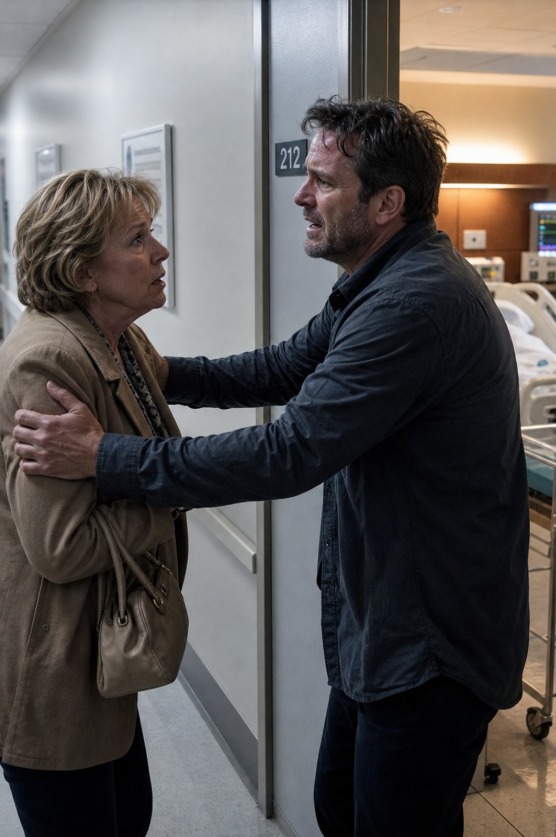
Room 212 was not my daughter’s room.
Or worse.
Maybe it never had been.
In that instant, I understood that the fear in Ezekiel’s eyes hadn’t been the fear of a shattered man. It had been the fear of a man about to be caught.
I pressed myself against the wall, trying to breathe soundlessly. The hallway was still nearly empty. In the distance, an elevator bell chimed. A door closed in another corridor. I had to think. I had to move. But my body was trapped between two impossible realities: either my daughter was alive and they were hiding her from me… or she was dead and everything surrounding her death smelled of a lie.
I looked at the bed again.
The patient was sleeping deeply. At the foot of the bed was a chart. I took it with clumsy fingers. The light from the hallway was just enough to read the name:
Margaret Sullivan, 68 years old. Room 212.
I felt the blood burn in my face.
Ezekiel had given me that number on purpose.
Not by mistake.
Not out of confusion.
On purpose.
He wanted me to return, find a random room, get scared, see a shape under a sheet, and run away believing that yes, he was right—that it was better not to have entered. He wanted to block my path even after letting the lie slip.
I clutched the chart to my chest, and for the first time since his call, the pain mixed with something harder.
Rage.
Not blind rage.
The good kind.
The kind that wakes you up.
I left the room and hid behind a linen cart just as two nurses returned to the station. One set her coffee on the desk, and the other opened a folder while yawning. I tried to listen for names, numbers, anything useful, but they were talking about medications, a shift change, and a patient in OB-GYN who still had a fever.
OB-GYN.
My daughter had come here to give birth. It made no sense for her to be in the North Hallway, between Internal Medicine and General Recovery. I had swallowed that information because I was broken. Because grief makes even the most suspicious mothers clumsy.
I waited until one of the nurses stepped away and slipped out through the service door again. I went down one floor, then back up half a flight, stopping to listen. The hospital was a sleepless hive: the whir of gurney wheels, a distant cry, ringing phones, rubber shoes sliding over tiles. On an illuminated sign, I finally saw the words I was looking for:
Labor & Delivery – Restricted Area
My mouth went dry.
I advanced as far as I could, but an automatic door with an access card reader blocked the way. To one side was a small glass window. I peeked in. A short corridor, an empty station, and at the end, another closed door.
“Can I help you?”
The voice came from behind me, and I nearly screamed. It was a young nurse with a tired face and a tight ponytail. She looked at me with suspicion, though not hostility.
I could have lied.
I could have said I was lost.
But no more lies would come out of my mouth.
“My daughter came here to give birth this afternoon,” I said in a low voice. “My son-in-law told me she died. And he wouldn’t let me see her.”
The nurse stood motionless.
I saw, crystal clear, the instant something in her face changed.
Very slightly.
But enough.
“Ma’am, you need to leave,” she said, but the tone was no longer that of automatic protocol. It was tense. Uncomfortable.
I took a step toward her.
“Just tell me one thing,” I pleaded. “Grace Ezekiel…? No. Grace Miller. Tell me if that name passed through here today.”
The nurse looked down.
And in that gesture, I saw what I needed.
“Please,” I whispered. “I’m her mother.”
It took a few seconds that felt like hours. Then she looked both ways down the hall and leaned in just an inch.
“I can’t talk here.”
My legs buckled with relief and terror at the same time.
“Then talk where you can.”
The girl swallowed hard.
“There are cameras in this corridor. Go down those stairs and wait by the waste disposal room in the basement. My rounds end in ten minutes.”
Before I could thank her, she turned away and kept walking as if she had never seen me.
I obeyed.
I went down to the basement, feeling like every step brought me closer to a truth that might destroy me in a different way. The waste room was next to a metal door that led to the ambulance bay. It smelled of bleach, wet cardboard, and human exhaustion. I stood there with my arms crossed over my chest, shivering from the cold or fear—I no longer know which.
After nine minutes, the nurse appeared.
She had no visible badge. She had taken off her scrubs and was now wearing a gray sweater, as if she wanted to blend in with any other visitor upon leaving.
“My name is Nadia,” she said. “And if anyone asks, I wasn’t here.”
I nodded immediately. “Whatever you need.”
She looked at me with a mixture of pity and resolve.
“Your daughter didn’t die.”
I had to lean against the wall.
Not because I hadn’t suspected it.
But because hearing it out loud split my world in two.
“Where is she?” I asked, and my voice no longer sounded like my own. “Where is my daughter?”
Nadia closed her eyes for a second.
“They took her.”
I felt the floor open up again.
“Who?”
“Her husband signed for a voluntary discharge about three hours ago. But that shouldn’t have happened. The patient had a postpartum hemorrhage. She was weak, sedated at times, disoriented. She was in no condition to leave like that. Neither was the baby.”
“The baby is alive?”
The nurse nodded.
I had to put my hand over my mouth to stifle the sound that escaped me. It wasn’t a laugh. It wasn’t a sob. It was something more primal. The body refusing to understand so much pain and so much relief at once.
“Alive,” Nadia repeated. “He was born with mild respiratory distress but is stable. Your daughter was under observation for several hours. Then there were problems.”
“What problems?”
Nadia looked at me with real fear.
“They argued.”
I felt a blunt thud in my chest.
“Who?”
“Your daughter and her husband. Loudly. In one of the recovery rooms. I didn’t hear everything. Only pieces because he was shouting. She was too. A doctor tried to intervene. Then he came out saying he was taking her, that he had already signed, that he wasn’t going to allow ‘any more confusion’ or ‘any more interference.’”
“What confusion?”
Nadia shook her head.
“I don’t know. But before that, something weird happened. Two people came by asking for the newborn. An older woman and a man in a suit. They weren’t registered relatives. They spoke with your son-in-law in private. Then they left. And after that, the fight started.”
My mind was racing too fast.
“How did he take her? Was she walking? In an ambulance?”
“In a wheelchair through the back exit. I saw her. She was pale, almost asleep. She was holding the baby, but an assistant was carrying him for most of the way because she couldn’t even hold up her arms. He put her into a black SUV.”
“At what time?”
“Around 8:40 PM.”
I had arrived at the hospital shortly after 9:00 PM.
While I was falling apart in the ER believing my son-in-law, my daughter was already gone.
Or perhaps not that far.
“Did you hear where they were going?” I asked.
Nadia hesitated.
“No. But I did hear him say over the phone: ‘We’re out. No, the mother doesn’t know anything. Tell her we’ll be there in an hour.’”
There.
One hour.
Someone was waiting for my daughter as if she were a package.
I felt nauseous.
“Ma’am,” Nadia said, becoming more uneasy, “I don’t know what your son-in-law is caught up in, but I didn’t like this at all. When admissions tried to register the discharge, there was a problem with the baby’s last names. Your husband wanted to put a different one than what your daughter had declared at intake.”
It took me two seconds to understand.
And when I did, I could barely stand.
“Different? What last name?”
“I don’t know which one was correct. I only heard the clerk say: ‘The father registered here is Ezekiel Duarte, not Miller.’ And he replied that it had been a mistake, that it was already fixed, and told them not to bother the patient anymore.”
Ezekiel Duarte.
My legal son-in-law had been going by Ezekiel Miller for years, using his father’s name. Duarte was his mother’s maiden name—a name he almost never used.
Only someone nervous, improvising, would give details like that and correct themselves poorly.
Or someone accustomed to switching versions of the truth.
I stared at her.
Nadia lowered her voice even more.
“Your daughter, before he took her out, grabbed my wrist. Hard. And she said one thing.”
I felt the world stop again.
“What did she say?”
Nadia swallowed hard.
“‘If my mom comes, don’t believe him.’”
The air left me.
“Don’t believe who?”
“She didn’t get to finish. He came back with the discharge form and I had to let go.”
I leaned my forehead against the cold wall.
Everything fit. The fear. The haste. Not letting me see her. The fake room. The clandestine exit. The mismatched names. And Grace’s strange sadness days before, when she asked if I had ever let her be herself.
My daughter had been trying to tell me something for a long time.
And I hadn’t wanted to hear it.
Because it was convenient for me to believe her marriage was fine.
That Ezekiel, though cold at times, was a good husband.
That the life I had helped push her toward didn’t hide anything else.
I felt a fierce shame.
Not because I had caused this, but because mothers also fail when we prefer the bearable version of reality.
I took Nadia’s hand. “Thank you.”
She shook her head immediately. “Don’t thank me yet. Do something. Fast.”
I nodded. “Are there cameras at the back exit?”
“Yes, but I don’t know how long the recordings last or who can erase them. If you’re going to do something, do it now.”
That was all I needed.
I left the hospital without looking back. In the car, my hands were shaking so much it took three tries to start the engine. I didn’t call Ezekiel. I didn’t call my sister. I didn’t call any friends.
I called Mr. Bennett.
My lawyer.
And the only man I trusted enough to say to him, at 12:47 AM:
“I need to find my daughter before my son-in-law makes her disappear.”
He didn’t ask useless questions. Bennett had handled my will years ago, had seen the deed to Grace’s house, had met Ezekiel, and never liked him. He always told me so with that dry elegance older men use when they smell rot in someone: “Your son-in-law smiles too much when talking about paperwork.”
“Where are you?” he asked.
I told him.
“Go home and lock up tight. I’ll call you in twenty minutes.”
I didn’t entirely obey.
I did go home. But instead of locking myself in to wait, I pulled a folder from a drawer where I kept copies of important things: deeds, policies, certificates, and an old set of Grace’s documents she had asked me to keep in case she “ever lost them.” Among them was a copy of her ID, her marriage license, and, folded at the bottom, a lease for a small apartment in The Bronx in the name of a corporation.
I recognized it immediately because months ago I had shown it to Ezekiel when they were arguing about renting a commercial space. He had said that address belonged to “a client’s warehouse.”
That night, with the house still smelling of burnt rice pudding and fear, the document leaped out at me as if it bore my own name.
Bennett called thirteen minutes later.
“I found something strange,” he told me. “Two weeks ago, your son-in-law withdrew a considerable sum from a joint account with Grace. He also tried to move the ownership of a life insurance policy with a beneficiary for a ‘child born alive.’ And three days ago, he requested certified copies of the marriage certificate and prenatal records.”
The world narrowed around me.
“For what?”
“I don’t know yet. But it sounds like preparation, not an emergency. Do you have any suspicious addresses?”
I gave him the one in The Bronx.
There was a silence.
“Drive there,” he said finally, “but don’t arrive alone. I’m heading out with a notary friend and two private security personnel. And Bernice… call 911 and leave a record that your daughter left the hospital in unstable condition and that you fear illegal deprivation of liberty.”
I did it.
I don’t even know how I managed to sound coherent, but I did. I gave names, the time, the hospital, her postpartum state, the newborn baby, and the suspicion of a forced transfer. The operator started with the exasperating slowness of protocol until I mentioned the irregular discharge and the potential risk to a neonate. Then her tone changed.
“A patrol is being dispatched. Do you have the probable address?”
I gave that too.
Then I drove.
The night drive between Charleston and the city felt endless. Grimy lights, closed shops, dogs crossing the road, the weariness of the country pulsing on every corner. I drove with my jaw clenched, repeating my daughter’s name like a prayer: Grace, Grace, Grace.
When I arrived at the building on the contract, it was 2:11 AM.
It was an old three-story apartment complex with a corrugated metal gate, a dying bulb at the entrance, and the smell of dampness. I parked a block away and walked.
There was a black SUV outside.
The same one Nadia had described.
I recognized it by a dent in the front bumper that I had seen before at Grace’s house.
A very strange calm came over me.
The kind of calm that arrives when fear no longer has room to grow because it has turned into a task.
I pressed myself against the wall and looked toward the second-floor windows. In one of them, a faint light turned on. A shadow passed in front of the curtain.
Bennett arrived six minutes later in another car. With him came a stout man in a dark suit, a young woman with a folder and a phone, and behind them, almost at the same time, a local police cruiser.
I have never loved seeing a patrol car so much.
I quickly told the officer the essentials. He looked at me with the usual mix of doubt and bureaucracy until Bennett intervened with names, a questionable hospital discharge, maternal and infant risk, and possible unlawful detention of a temporary incapacitated person due to medical condition. Then the policeman straightened up.
We went up.
Second floor.
Door 2B.
I went first. Not because it was sensible. Because it was my daughter.
I pounded on the door with all the strength I had.
“Grace! It’s Mom!”
Silence.
I pounded again.
“Ezekiel, open up right now!”
There was movement inside. A crash. A male voice saying something I didn’t understand. Then, very faintly, a cry.
A baby.
My knees almost gave out.
“He’s in there!” I shouted. “My grandson is in there!”
The officer now knocked with authority.
“Police! Open the door!”
Inside, there was a rushed murmur. Footsteps. Then Ezekiel’s voice, muffled but recognizable:
“You can’t come in! My wife is resting!”
“Open up,” the policeman repeated.
“Not until she leaves!” he replied, and “she” was me.
The security man who came with Bennett stepped close to the lock. He looked at the officer. The officer hesitated a second too long for my liking.
Then, from inside, there was a blunt thud.
See more on the next page
Advertisement
To see the full cooking instructions, go to the next page or click the Open button (>) and don't forget to SHARE it with your friends on Facebook.