

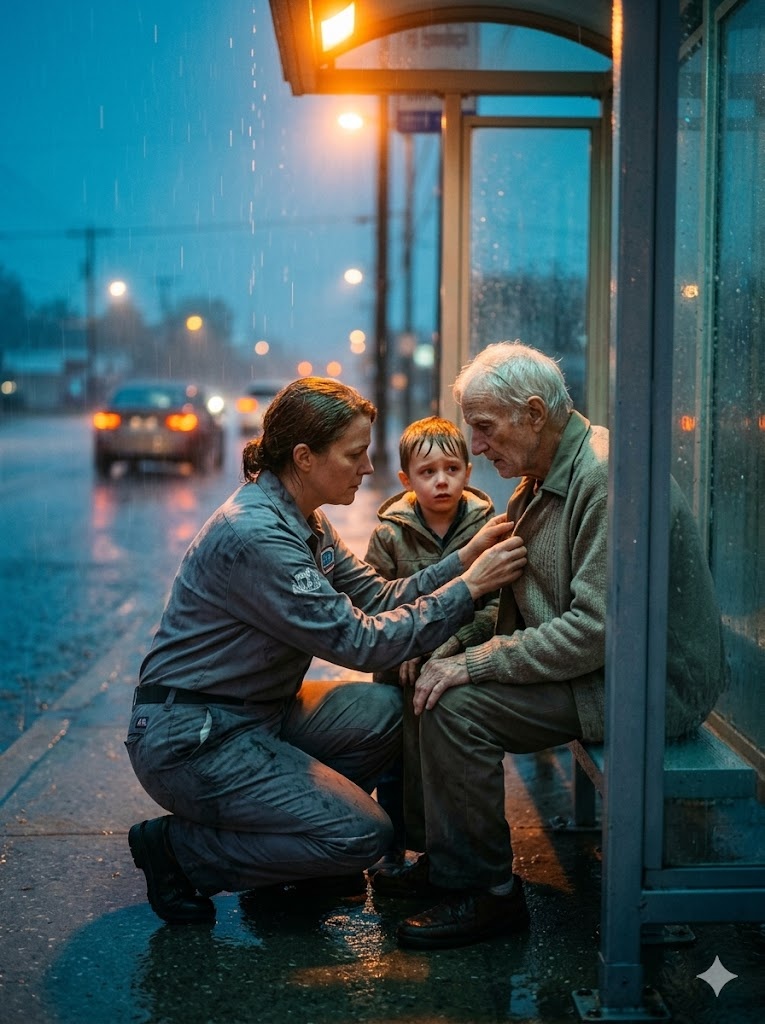
She Gave Her Only Coat To A Shivering Stranger—Then Found Out He Owned The Hospital Refusing To Save Her Son
Part 1
“Mama, that man is shaking. Can we help him?”
Kandra Carter looked down at her seven-year-old son, Malachi, then across the rain-lashed sidewalk to the old man hunched on the bus stop bench. December in Baltimore had turned cruel after sunset, the kind of cold that slipped under your clothes and bit straight into the bones. The old man’s thin jacket was soaked through, his shoulders trembling so hard that even the flickering streetlight seemed to shiver with him.
Kandra had no room in her life for grand gestures. She worked two jobs, counted pennies in grocery aisles, and patched her son’s winter gloves with thread from an old pillowcase. But when she saw that man sitting there alone, looking forgotten by the whole city, she did not think about what she could afford to lose.
She slipped off her brown thrift-store coat, the only coat she owned, and walked toward him.
“Sir,” she said gently, wrapping it around his shoulders. “You need this more than I do tonight.”
The old man lifted his face. Rainwater ran from his white hair down his cheeks, but his eyes were sharp beneath the exhaustion, deep brown eyes that looked as if they had watched too much of the world disappoint them. “No, miss,” he whispered. “I can’t take your coat.”
Kandra smiled, though the cold immediately pressed through her thin restaurant uniform. “Nobody should be freezing alone if someone can help it.”
Malachi stepped closer, his small face serious. “My mama says being kind is free, even when everything else costs money.”
The old man stared at the boy, and for one suspended second, the rain, traffic, and city noise seemed to fade. He noticed Malachi’s lips first, the faint bluish shade around the edges, the subtle sign most people would miss. But Clarence Drummond was not most people.
Two hours earlier, Clarence had been sitting at the head of a polished mahogany table on the fourteenth floor of Drummond Medical Center, the hospital he had built from a failing warehouse and a promise. Above the entrance, his name was carved into stone, but the soul of that place had belonged to his mother. She had died from a treatable heart condition because poverty had stood between her and a surgeon.
Clarence had sworn at her graveside that no child, no parent, no family would ever be turned away from his hospital because they were poor. For forty years, he had believed he kept that promise. Then, that evening, the board placed a sale offer in front of him.
MedVance Health Group, a corporate medical chain from Chicago, wanted to buy Drummond Medical Center for a staggering amount of money. Board members spoke of valuations, profit margins, strategic positioning, and shareholder opportunity. Not one person spoke about the frightened parents in waiting rooms or the children sleeping beneath oxygen masks.
The worst voice in the room belonged to Clarence’s own son.
“Dad, this is business,” Denzel Drummond had said, leaning back in his tailored suit with the cold confidence of a man who had learned to calculate before he learned to feel. “MedVance is offering three times what this hospital is worth on paper.”
“This hospital was not built for paper,” Clarence replied. “It was built for people.”
Denzel’s jaw tightened. “Healthcare is not charity anymore. You can’t run a hospital on emotion.”
Clarence had looked around the table, waiting for someone to stand with him. No one did. The silence hurt more than Denzel’s words.
So he stood, buttoned his raincoat with trembling hands, and said, “This hospital will not be sold while I am alive.”
Then he walked out.
He did not call his driver. He did not take the private elevator to the underground garage. He walked into the storm and kept walking until his expensive shoes filled with water and his wool suit clung to his skin. By the time he reached the bus stop on Eastern Avenue, he no longer looked like a hospital founder worth hundreds of millions; he looked like an abandoned old man with nowhere to go.
That was how Kandra and Malachi found him.
Clarence pulled the cheap coat tighter around his shoulders. It smelled faintly of fried chicken from Mama T’s Kitchen and lavender shampoo, and somehow it warmed him more than any cashmere overcoat he had ever owned.
“What’s your name, young man?” he asked.
“Malachi,” the boy said proudly. “I’m seven. I like rocket ships, drawing, and my mama’s pancakes.”
Kandra placed a protective hand on his shoulder. “Come on, baby. The bus is here.”
The number seven bus hissed to a stop at the curb, its doors folding open with a tired groan. Malachi waved over his shoulder as Kandra guided him up the steps.
“Bye, mister!” he called. “Stay warm!”
The doors closed. The bus pulled away. Clarence sat alone with Kandra’s coat wrapped around him and Malachi’s blue-tinged lips burned into his mind.
For the first time all night, he did not feel defeated. He felt awakened.
He reached into his wet pocket, pulled out his phone, and dialed the one person at Drummond Medical Center he trusted without hesitation.
“Odessa,” he said when the call connected. “I need you to find a child for me first thing tomorrow morning. His name is Malachi. His mother’s name is Kandra.”
On the bus, Kandra pressed Malachi against her side and tried not to shake too obviously. Her son looked up at her with worried eyes.
“Mama, aren’t you cold?”
“A little,” she admitted.
“Why did you give him your coat then?”
Kandra brushed rainwater from his forehead. “Because sometimes, baby, we don’t give because we have extra. Sometimes we give because we know what it feels like to have nothing.”
Malachi leaned against her. “When I’m big, I’m gonna buy you ten coats.”
She laughed softly, even as fear tightened in her chest. His breathing sounded heavier than usual, and the blue around his lips had deepened slightly in the cold. She tucked him closer, praying the bus would move faster.
Kandra was thirty-one years old and tired in a way sleep could not fix. By day, she cleaned hotel rooms at the Harbor View Inn, scrubbing bathtubs used by tourists who spent more on dinner than she spent on groceries in a week. By night, she waited tables at Mama T’s Kitchen, smiling through rude customers, aching feet, and tips that sometimes came in coins.
She lived in a studio apartment on East Baltimore Street, where the heat rattled, the shower turned cold after six minutes, and every bill arrived like a threat. Still, she kept the place spotless. She taped Malachi’s drawings to the walls as if they were priceless artwork, because to her, they were.
Malachi was her miracle and her terror. He had been born with Tetralogy of Fallot, a congenital heart defect that made his blood struggle for oxygen. The doctors had explained the four problems with his heart when he was only three months old, but Kandra remembered only the sentence that mattered.
“He will need surgery before he turns eight.”
Malachi’s eighth birthday was four months away.
The surgery could cost more than two hundred thousand dollars. Medicaid covered some, but not enough, and the deposit alone might as well have been a mountain made of gold. Kandra had applied to every program she could find, filled out forms until her fingers cramped, and begged politely over phone lines where people kept saying, “I understand,” while proving they did not.
That night, after she tucked Malachi into bed, she sat at the kitchen table and counted the money in her wallet. Twenty-three dollars and fifty cents from tips. A five-dollar bill tucked behind her expired library card. Two quarters in the bottom of her purse.
She thought of the old man wearing her coat. She hoped he had found shelter. Then she looked toward the bed where Malachi slept curled beneath two blankets, one hand tucked under his cheek.
“Please,” she whispered into the dark. “Let me find a way.”
She had no idea that across the city, Clarence Drummond was still awake, still wearing her coat over his dry pajamas like a sacred thing, and making a decision that would begin with one child but would not end there.
Part 2
By sunrise, Clarence was back inside Drummond Medical Center, dressed in a dark suit and carrying a grief he could no longer ignore. Nurses greeted him in the hallways, administrators nodded respectfully, and doctors stepped aside when he passed. He answered none of them.
At 6:15, Odessa Monroe called him.
Odessa had run the cardiac nursing floor for twenty-eight years. She had known Clarence when the hospital still smelled of wet paint and borrowed equipment. She knew his moods, his pride, his failures, and the reason he never let anyone remove the old photograph of his mother from the pediatric wing.
“I found them,” Odessa said.
Clarence gripped the edge of his desk. “Tell me.”
“Malachi Carter. Seven years old. Tetralogy of Fallot. Referred here four months ago by East Baltimore Free Clinic. He was supposed to have a surgical consultation in October.”
“Supposed to?”
“It was canceled.”
Clarence closed his eyes. “Why?”
Odessa’s silence answered before her words did. “Financial clearance. His mother could not provide the forty-thousand-dollar deposit required before scheduling. She called four times, Clarence. Four times.”
The office seemed to shrink around him.
“Who told her no?”
“Billing followed policy.”
“Policy,” Clarence repeated, the word bitter in his mouth.
Odessa’s voice softened but did not weaken. “She works two jobs. She applied everywhere. She started a fundraiser. She has raised a little over two thousand dollars. She needs more than eighty thousand. Clarence, that woman gave you her coat while our hospital was giving her a locked door.”
He turned toward the window. Far below, Baltimore moved under a gray winter sky, buses sighing at corners, people hurrying under umbrellas, mothers carrying children across crosswalks. Somewhere out there was Kandra, probably already at work, unaware that the man she had helped now stood inside the very system that had failed her.
“Get me Denzel,” Clarence said. “Today.”
Denzel entered his father’s office that afternoon in a white coat, stethoscope around his neck, every inch the brilliant pediatric cardiac surgeon he had worked his whole life to become. His hands had saved children from across the country. His reputation was spotless. His waiting list was long, his success rate extraordinary, and his heart, Clarence feared, dangerously quiet.
“I have a question,” Clarence said.
Denzel sat. “That never means one question.”
“If a child needed life-saving heart surgery and his mother could not pay the deposit, what should this hospital do?”
Denzel exhaled. “Refer them to assistance programs.”
“What if the child cannot wait?”
“Then emergency stabilization happens, but surgery still requires approval. Dad, you know this.”
“I know what we promised.”
Denzel’s expression tightened. “Promises do not pay operating room staff.”
“No, but without promises, what are we?”
“A functioning hospital,” Denzel snapped. Then he caught himself and lowered his voice. “I’m not heartless. But you cannot save everyone by ignoring reality.”
Clarence studied his son. He remembered Denzel at twelve years old, standing in the pediatric ward after watching a little girl walk for the first time after surgery. Back then, Denzel had said he wanted to fix what was broken inside people. Not just hearts, but everything.
“Reality,” Clarence said slowly, “is a seven-year-old boy whose lips are turning blue because our policy matters more than his pulse.”
Denzel stood. “I have patients.”
“So does that boy.”
Denzel left without answering.
Across town, Kandra spent the day fighting through phone calls that all ended in polite refusal. One agency had no funding until spring. Another required an appeal that could take sixteen weeks. A nonprofit offered prayers and a packet of forms. By noon, Kandra’s voice was hoarse from explaining that her son did not have time.
At three o’clock, Malachi’s school called.
He had gotten tired during recess. He had sat down on the blacktop and told his teacher his chest felt funny. When Kandra arrived, Miss Tanya stood beside him with worry written all over her face.
“He tried to keep playing,” the teacher whispered. “He didn’t want the other kids to think he was weak.”
Kandra knelt in front of her son. “Baby, why didn’t you tell someone sooner?”
Malachi shrugged, embarrassed. “I wanted to run like everybody else.”
His words broke something inside her, but she kept her voice steady. “One day, you will.”
That night, Kandra lay on the floor beside his bed and listened to him breathe. Each breath was shallower than the last, each pause too long. She counted them until the numbers blurred together.
Her mother, Rashida, called after midnight.
“Sell my house,” Rashida said without greeting. “I talked to Mr. Alvarez down the street. He says I could get maybe sixty thousand.”
“No,” Kandra said immediately.
“That boy is my grandson.”
“That house is all you have.”
“Malachi is all we have.”
Kandra pressed her fist against her mouth. “Mama, please. Don’t make me choose between saving my son and ruining your life.”
Rashida went quiet, and in that silence was every sacrifice Black mothers and grandmothers had made in kitchens, hospital rooms, courtrooms, and church pews across America. “Then let me say this,” she finally whispered. “You are not alone, baby. Even when it feels like it.”
But Kandra did feel alone.
Three days later, Clarence walked into Mama T’s Kitchen wearing plain slacks, a gray sweater, and a flat cap. He left his watch at home, took off his cufflinks, and asked his driver to drop him two blocks away. He wanted to see Kandra without the armor of wealth around him.
She recognized him almost immediately.
“Oh my God,” she said, stopping beside his table. “You’re the man from the bus stop.”
Clarence smiled. “I suppose I am.”
“Are you okay? Did you find somewhere warm?”
“I did. Because of you.”
Relief softened her face. “Good. Malachi asked about you.”
“Your son has a good heart,” Clarence said.
Her smile trembled. “The best. Even if it doesn’t work quite right.”
He let the silence open gently. “Tell me about him.”
Kandra hesitated, then sat for half a second before remembering she was working. “He was born with a heart condition. He needs surgery. I’m trying to make it happen.”
“Trying alone?”
She looked away. “Mothers don’t get the luxury of waiting for someone to rescue them.”
Clarence had no answer to that.
He ate the smothered pork chops she recommended and watched her move through the restaurant like someone carrying invisible weight with practiced grace. She remembered which regular needed extra napkins, which old woman liked her tea sweet, which man at table five always complained before leaving no tip. She was exhausted, but she never let exhaustion make her cruel.
When he left, he placed a hundred-dollar bill under the plate.
He was halfway down the block when Kandra ran after him.
“Sir! You made a mistake.”
“No mistake.”
“My meal service wasn’t worth this much.”
Clarence looked at her in the orange glow of the streetlamp. “Kindness usually is.”
Her eyes filled, but she did not cry. “Thank you.”
“No,” he said softly. “Thank you.”
One week later, Malachi collapsed in class.
He had been coloring a rocket ship when his crayon slipped from his fingers. His small hand pressed against his chest. His face turned gray, then blue, then he slid from his chair to the floor.
By the time the ambulance reached Drummond Medical Center, Kandra was running from the Harbor View Inn still wearing her housekeeping uniform. She did not clock out. She did not grab her purse. She ran through downtown Baltimore like a woman outrunning death itself.
When she reached the emergency room, she was breathless and wild-eyed.
“My son,” she gasped. “Malachi Carter. Please, where is my son?”
They took her to him.
He lay in a hospital bed with wires on his chest, an oxygen mask over his face, and an IV in his arm. The machines around him beeped with cold precision, but all Kandra saw was the child who once asked if the moon followed their bus home.
“Mama,” he whispered beneath the mask.
She grabbed his hand. “I’m here, baby. I’m right here.”
The cardiologist came soon after, speaking gently but urgently. Malachi needed open-heart surgery within forty-eight hours. Waiting longer could kill him.
Then billing came.
In a beige office with fluorescent lights and a clock that ticked too loudly, a woman explained that without insurance approval or a forty-thousand-dollar deposit, the procedure could not be scheduled.
Kandra stared at her. “My son is dying upstairs.”
“I understand your concern.”
“No,” Kandra said, her voice shaking with rage. “You understand your computer screen.”
She returned to Malachi’s room hollowed out by helplessness. She sat beside him, took his cold hand, and made the only promise she had left.
“I’m going to save you,” she whispered. “Somehow.”
Two floors above, Odessa Monroe picked up the phone.
“Clarence,” she said. “He’s here. Malachi Carter. And it’s bad.”
Part 3
Clarence listened without interrupting as Odessa explained Malachi’s condition, the emergency timeline, and the surgeon the case required. A standard repair would not be enough. The boy needed the best pediatric cardiac hands in the hospital.
He needed Denzel.
That night, Clarence called his son into his office. The city glittered beyond the window, but the room felt heavy, sealed, almost airless. Denzel arrived in scrubs, tired from a successful surgery on a wealthy patient whose insurance had cleared in less than ten minutes.
“You said it was urgent,” Denzel said.
“It is.”
Clarence did not begin with numbers. He began with the bus stop. He told his son about the rain, the bench, the cold, the little boy who noticed him when everyone else passed by, and the mother who gave away her only coat.
Denzel stood very still.
“That boy is upstairs,” Clarence said. “Room 314. Malachi Carter. Seven years old. His mother begged this hospital for help four times and was refused because she couldn’t pay a deposit. He has forty-eight hours.”
Denzel’s face hardened out of habit. “Dad—”
“No,” Clarence said. “Not as chairman. Not as founder. As your father, I am asking you to look at that boy before you hide behind policy.”
“You think I don’t care?” Denzel’s voice cracked with anger. “You think I became a surgeon because I enjoy spreadsheets? Every charity case becomes a board fight. Every exception becomes a precedent. I am tired.”
“Then stop fighting to protect the system,” Clarence said quietly. “Fight to protect the child.”
For a moment, Denzel looked younger, wounded in a way Clarence had not seen in years. Then he turned toward the door.
“Room 314?” he asked.
Clarence nodded. “Room 314.”
At 6:15 the next morning, Denzel stood outside Malachi’s room with a tablet in his hand and a wall around his heart. He had reviewed the imaging. Large ventricular septal defect. Severe pulmonary stenosis. Thickened right ventricle. Overriding aorta. The case was difficult but operable.
He told himself he would not go inside.
Then Malachi looked up.
“Hi,” the boy said brightly, though an oxygen tube ran beneath his nose. “Are you a doctor?”
Denzel froze. “Yes.”
“Can you fix my heart? It’s broken for real, not like in sad songs.”
Kandra looked up from the chair beside the bed. Her eyes were red, her face pale, but she still managed to smooth Malachi’s blanket before speaking. “Baby, don’t bother the doctor.”
“He isn’t bothering me,” Denzel said.
He stepped inside.
Malachi held up a drawing made with crayons from the pediatric playroom. It showed a woman with curly hair wearing a crooked golden crown. Stars floated around her head, and behind her stood something that might have been a castle or a rocket ship.
“That’s my mama,” Malachi said. “She’s a queen. She just doesn’t know it yet.”
Denzel looked at Kandra. She turned her face away, but not before he saw the tears.
“What makes her a queen?” he asked.
“She fights dragons,” Malachi said seriously.
“What kind of dragons?”
“Bills. Bad phone calls. People who say no.”
The wall around Denzel’s heart cracked.
See more on the next page
Advertisement
To see the full cooking instructions, go to the next page or click the Open button (>) and don't forget to SHARE it with your friends on Facebook.