
PART 2
You wake in the middle of the night with your heart pounding.
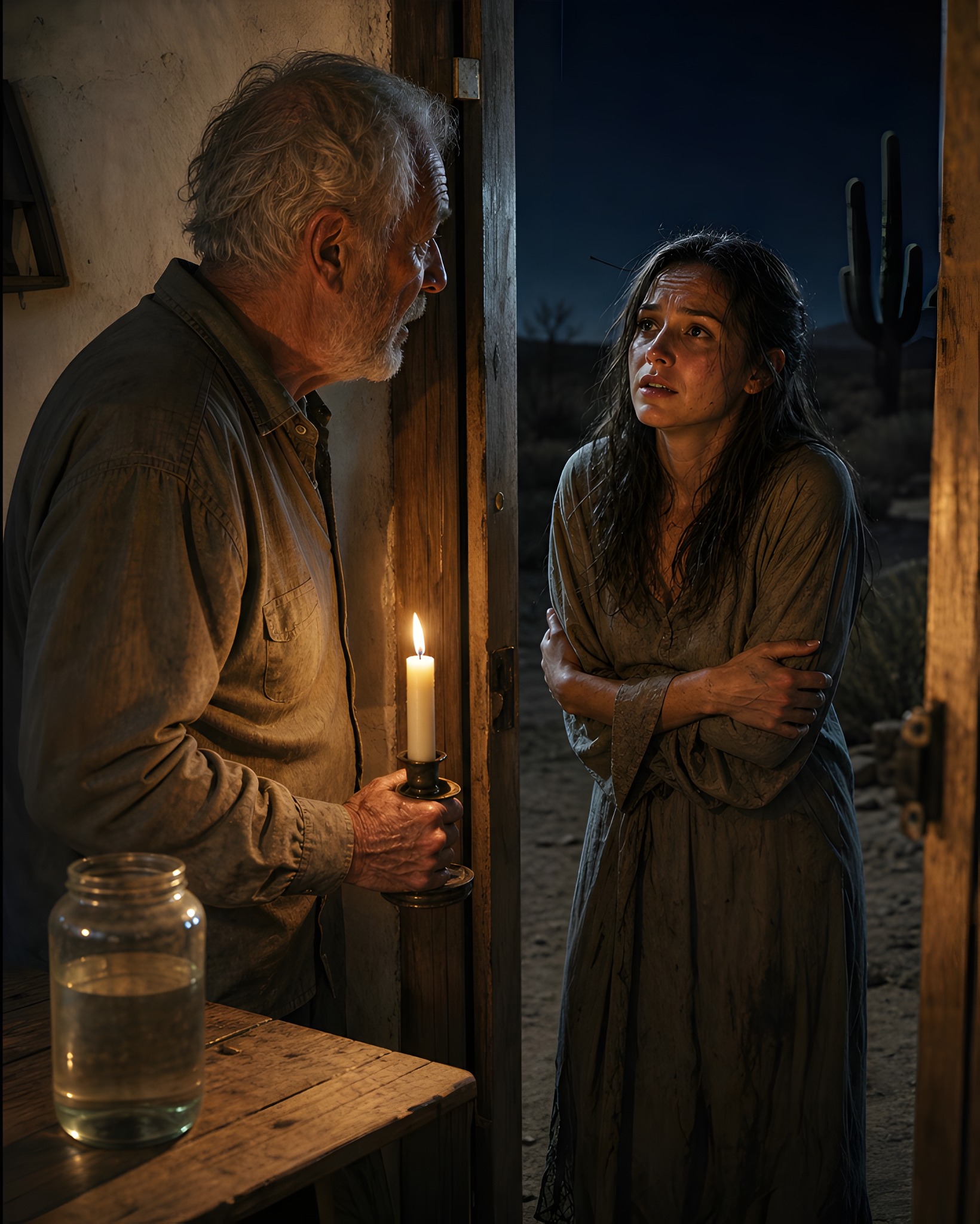
At first, you do not know where you are. The floor beneath your blanket is hard, the air smells like dust, wood smoke, and old coffee, and outside the wind scrapes against the adobe walls like fingernails.
Then you remember.
The empty highway outside Ajo, Arizona. The dead phone. The rental SUV with no gas. The little house in the desert with a candle burning by the door.
And Don Aurelio.
You open your eyes and see him standing a few feet away from you.
He is not touching you. He is not even looking directly at your face. He is staring at the old photograph on the table, the one he had placed face down when you entered.
But now it is upright.
The candlelight flickers across it.
You sit up slowly.
“Why are you watching me?” you ask.
The old man flinches like your voice struck him.
“I’m sorry,” he says. “I heard you crying in your sleep.”
You touch your face and realize your cheeks are wet.
You had been dreaming again.
Same dream as always. A desert road. A broken windshield. Your husband’s voice calling your name from somewhere you can never reach.
You swallow hard.
“I didn’t mean to disturb you.”
He shakes his head.
“You didn’t.”
His voice is low, rough, and strange. But beneath the age, beneath the desert, beneath years of silence, something about it keeps pressing against a locked door inside your chest.
You look at the photograph.
It is too dark to see clearly, but you can make out two figures. A young couple standing in front of an old pickup truck. The woman’s hair is long and black, blowing across her face.
Your breath catches.
“Who is that?”
Don Aurelio reaches for the photo too quickly.
“No one.”
No one.
People only say that when someone once meant everything.
You stare at his hand as he turns the photograph down again. His fingers are bent with age, the knuckles swollen, the nails clean but rough. On his left hand, where a wedding ring should be, there is only a pale groove.
You know that groove.
You wore its twin for thirty-eight years.
Even after the courts told you your husband was legally dead, you kept the ring. Even after your son begged you to stop waiting. Even after your sister said hope was no longer love, just a wound refusing to close.
You still kept it.
The old man notices you staring and hides his hand inside his sleeve.
“You should sleep,” he says.
“Why do you leave a candle by the door?” you ask.
He looks toward the small flame.
For a long time, he does not answer.
Then he says, “For someone who got lost.”
You feel the room tighten around you.
“Did she ever come?”
His jaw moves, but no words come.
Finally, he whispers, “Not yet.”
Something inside you trembles.
You tell yourself it is exhaustion. You tell yourself it is dehydration, fear, the desert playing tricks on your mind. You have been driving for hours, lost between Phoenix and Tucson after taking the wrong road because grief makes people careless.
But the way he says not yet breaks something open.
“Who was she?” you ask.
He turns away.
“My wife.”
The word lands quietly.
Still, it fills the whole room.
You look down at your hands. They are dusty, lined, and older than you ever imagined they would become. Once, those hands held a man’s face at a courthouse in Phoenix while he promised he would come home every night, even if the whole desert tried to keep him.
That man’s name was Elias Navarro.
He disappeared forty years ago.
And you have spent forty years being told men leave when they want to.
“What happened to her?” you ask.
Don Aurelio’s shoulders tighten.
“I lost her.”
“How?”
He gives a dry, broken laugh.
“The way cowards lose things. Slowly first. Then all at once.”
You do not know why the answer hurts.
Maybe because it does not sound like a stranger talking about a woman.
It sounds like a man confessing at a grave.
You pull the blanket around your shoulders.
“What was her name?”
He goes still.
Outside, the wind drops.
For one impossible second, the desert becomes so quiet you can hear the candle burning.
Then he says, “Isabel.”
Your blood turns cold.
You cannot move.
Your name sits in the room between you like a living thing.
Don Aurelio closes his eyes, as if saying it cost him too much.
You force yourself to breathe.
“There are many Isabels.”
He nods.
“Yes.”
But his voice says no.
No, there was only one.
You study his face again. The white beard. The deep wrinkles. The scar above his eyebrow. The sunken cheeks. Nothing in him looks like the young man you buried without a body.
And yet.
There is a scar near his thumb.
A small crescent-shaped scar.
Elias got one exactly like it when he cut himself fixing the broken latch on your first apartment window. You remember scolding him while he laughed and said, “A little blood means the house knows I’m trying.”
Your heart begins to beat so hard you feel dizzy.
“What happened to your hand?” you whisper.
His eyes open.
He looks at the scar.
Then at you.
For the first time, real fear enters his face.
“Old accident.”
You stand slowly.
Your knees ache from sleeping on the floor, but you barely feel them.
“What kind?”
He backs away one step.
“Go back to sleep.”
“No.”
Your voice shakes.
But you do not sit down.
“What kind of accident?”
His mouth trembles. He looks toward the door like a man who survived by running and is suddenly too old to run again.
You step closer to the table.
He grabs the photograph, but you reach it first.
The frame falls.
The old picture slides across the table and lands face up beneath the candle.
You see it clearly.
The young woman in the photo is you.
Not someone who looks like you.
You.
Twenty-eight years old, wearing the yellow dress your mother sewed for your first anniversary. Wind in your hair. One hand resting on the hood of Elias’s old blue Ford truck.
Beside you stands your husband.
Young.
Strong.
Smiling like the world could be hard, but never stronger than the two of you together.
You cannot speak.
The room sways.
The old man whispers your name.
Not like a stranger.
Not like a coincidence.
Like a prayer he has been punished for saying too many times.
“Isabel.”
You look at him.
“No.”
He takes one step toward you.
You step back.
“No,” you say again, louder this time. “No. Don’t you dare.”
His face crumples.
And that is when you see him.
Not the old man.
Not Don Aurelio.
Elias.
Changed by time, burned by sun, thinned by hunger and years, but there. In the eyes. In the way his mouth breaks before the tears come. In the way he raises his hand but stops himself because he no longer believes he has the right to touch you.
You press one hand to your chest.
“You’re dead.”
He lowers his head.
“I should have been.”
The sentence tears through you.
Forty years of grief rush into the room. The police report. The abandoned truck found outside Yuma. Blood on the driver’s seat. No body. No witness who would speak. Men in uniforms telling you he probably ran with the payroll money.
Your family saying you had to accept it.
Your son growing up with a father made of rumors.
And now that father is standing in front of you with dust on his boots and your name in his mouth.
You slap him.
The sound cracks across the tiny room.
Your hand burns.
He does not defend himself.
He does not even lift his face.
Good.
Because there is no gentle way to meet a ghost who stayed alive without you.
“How?” you demand.
He closes his eyes.
“Sit down.”
“No.”
Your voice is shaking now, rising with every year he stole from you.
“You don’t get to ask me to sit. You don’t get to offer me water and blankets and secrets like you’re some kind desert saint. You were my husband.”
“I know.”
“You were my husband,” you repeat, because maybe if you say it enough, your heart will understand the shape of the betrayal.
He nods.
“I know.”
“You left me pregnant.”
His head snaps up.
The blood leaves his face.
“What?”
You laugh, but it comes out broken.
“You didn’t know?”
He stares at you.
His lips part.
Nothing comes out.
You see it then.
Not performance.
Not excuse.
Shock.
Real, brutal shock.
You whisper, “You didn’t know about Daniel.”
His knees nearly give.
He grabs the chair to steady himself.
“Daniel,” he says, as if the name is a door opening over an abyss.
“Your son,” you say. “Your son who learned to ride a bike without you. Your son who asked every birthday if maybe this was the year his father would come back. Your son who stopped asking when he was twelve because hope embarrassed him.”
Elias covers his mouth.
A sound leaves him.
Not a sob.
Something worse.
The sound of a man being shown a life sentence after believing the trial was over.
You want to hate him.
You need to hate him.
But the pain on his face confuses your anger, and that makes you even angrier.
“You didn’t know,” you say again.
He shakes his head slowly.
“I swear to God, Isabel, I didn’t.”
“Then talk.”
He looks toward the window.
The first gray light of dawn is beginning to touch the desert.
“No more waiting,” you say. “You lit that candle for forty years. Now tell me what you were hiding from.”
He sits because his legs will not hold him anymore.
You remain standing.
You need the height.
You need the distance.
He begins with the night he vanished.
He had been working for a contractor in Yuma, hauling payment records and cash for a crew that had not been paid in weeks. It was not glamorous work, but it was honest, and Elias had been proud because you two were finally saving for a small house outside Mesa.
He had called you from a pay phone.
You remember the call.
He told you he would be home by midnight. He said he had bought you a turquoise bracelet from a roadside stand because “my girl deserves something pretty before we become boring old parents someday.”
You had laughed.
You had not known you were already pregnant.
He says he was driving back when another truck forced him off the road.
Two men pulled him out.
One was a stranger.
The other was Victor Salazar, his business partner and oldest friend.
You remember Victor.
Of course you do.
Victor came to your apartment after Elias vanished. He brought groceries, spoke gently, sat at your kitchen table, and told you Elias had been under pressure. He was the first person to suggest your husband might have run away.
You feel sick.
Elias says Victor had been stealing from the company. Not small money. Tens of thousands of dollars. Enough to ruin contracts, enough to make dangerous men angry. Elias had found documents proving it.
Victor wanted them.
Elias refused.
“So he left me in the desert,” Elias says.
His voice is flat now, as if he has told the story to the walls so many times the horror has gone dull.
“They beat me. Took the truck. Took the money. I remember headlights. Sand. My mouth full of blood.”
You grip the back of the chair.
“Why didn’t you go to the police?”
He looks at you.
“I don’t remember the first months.”
The answer stops you.
He tells you an old Tohono O’odham rancher found him half-dead near a wash after a storm. No ID. No memory clear enough to give more than fragments. A mission clinic treated him under the name Aurelio because he kept repeating “oro,” “luz,” and “Isabel” in fever.
Gold.
Light.
You.
By the time pieces of memory returned, almost a year had passed.
He went looking for you.
Your throat closes.
“What?”
He nods.
“I went back to Phoenix.”
You stop breathing.
“I found Victor first,” he says. “That was my mistake.”
Victor told him you had remarried. He said you believed Elias had stolen the money and run. He showed him a paper, a statement supposedly signed by you, saying you wanted no contact if Elias ever returned.
Your knees weaken.
“I never signed anything.”
“I know that now.”
He looks down at his hands.
“I didn’t then.”
You think of the years after he disappeared. Victor visiting. Victor offering help. Victor insisting Elias was not who you thought. Victor slowly trying to turn pity into something else until you finally told him never to come back.
He had wanted the widow.
Or maybe he had wanted to control the story.
Maybe both.
Elias continues.
“Victor said if I went near you, he’d tell the men I owed money that I was alive. He said they would not only come for me. They would come for you.”
“You believed him?”
“I was broken,” he whispers. “My head wasn’t right. I had seizures. I couldn’t remember whole days. I had no papers. No money. No proof. And I thought you hated me.”
You close your eyes.
Forty years.
Built on lies, fear, and a forged signature.
When you open your eyes, the sun is rising.
The desert outside turns gold.
You should feel relief.
Instead, you feel robbed.
“You could have written.”
“I did.”
He stands slowly and walks to a wooden chest near the wall.
From inside, he removes a bundle tied with string.
Letters.
Dozens of them.
Maybe hundreds.
Your name written on each envelope in handwriting you recognize so deeply that your bones remember it.
Isabel Navarro.
Phoenix, Arizona.
Some are yellowed. Some are newer. None are stamped.
“I wrote every year,” he says. “Sometimes every month. I never sent them.”
You stare at the bundle.
“Why?”
He cannot look at you.
“Cowardice.”
That answer is worse because it is honest.
“I told myself I was protecting you. Then I told myself too much time had passed. Then I told myself you had a life and I had no right to destroy it.” His voice breaks. “After a while, shame became a house. I moved into it.”
You do not know what to do with that.
Part of you wants to tear the letters open and swallow every lost year.
Part of you wants to throw them into the stove.
Instead, you ask the only question that matters.
“Why the candle?”
He looks at the door.
“Because every night I imagined you lost somewhere, the way I was. I thought if the universe ever gave me one mercy, maybe you would see the light.”
You sit down then.
Not because you forgive him.
Because your body can no longer carry the weight standing.
He kneels in front of you, old bones and all.
You hate that he does.
See more on the next page
Advertisement
You hate that you want to touch his face.
“I am sorry,” he says.
The words are too small for forty years.
He knows it.
You know it.
Still, they are the first true thing between you since the photograph.
You take one breath.
Then another.
“What happened to Victor?”
Elias’s eyes harden.
“He became rich.”
Of course he did.
Victor Salazar became a developer. You saw his name in Phoenix real estate stories over the years: Salazar Holdings, affordable housing projects, luxury desert communities, charity galas, city council dinners. You never connected him to Elias because you had spent so long trying not to connect anything to the wound.
Elias opens the chest again.
More papers.
Old contracts.
Copies of bank ledgers.
Photographs.
A tape recorder.
He has been collecting proof for decades, piece by piece, from former workers, courthouse archives, and men who talked too much when they thought Don Aurelio was just a desert nobody selling firewood.
Your hands go cold.
“You had evidence?”
“Some,” he says. “Not enough. Not then.”
“And now?”
He looks at you.
“Enough to bury the lie, maybe not the man.”
You almost laugh.
Elias has lived like a ghost for forty years while Victor built towers on stolen money and your grief.
And now you have stumbled into the one house holding the truth.
No.
You did not stumble.
Something brought you here.
The dead GPS. The wrong turn. The empty gas tank. The candle in the window.
You do not know if you believe in fate.
But you believe in doors.
And you knocked.
By full morning, you are sitting at the table with coffee so bitter it tastes like punishment. Elias makes eggs with trembling hands. You do not eat much. Neither does he.
You ask for a phone.
He has an old landline connected through a solar-powered system that only works when it feels like it. He also has a radio and a satellite phone for emergencies.
You call your son.
Daniel answers on the third ring, voice thick with sleep and worry.
“Mom? Where are you? I’ve been calling all night.”
You close your eyes.
“I’m safe.”
“Where?”
You look at Elias.
He is staring at the floor, terrified of a voice he has never heard.
“Near Ajo,” you say. “I got lost.”
Daniel curses softly.
“I’m coming.”
“Daniel,” you say.
Something in your voice stops him.
“What’s wrong?”
You grip the phone.
There is no gentle way to introduce a dead father.
“I found someone.”
Silence.
“What does that mean?”
You look at Elias again.
His face is wet.
“It means,” you whisper, “your father is alive.”
The line goes so quiet you think the call dropped.
Then Daniel says, “That’s not funny.”
“I know.”
“Mom.”
“I know.”
His voice changes, hardening in the way it did when he was twelve and finally decided tears were too expensive.
“No. No, don’t do this. Who is with you? Is someone scamming you?”
You cannot blame him.
If anything, his disbelief proves what Elias’s absence did.
You say, “He knows about the turquoise bracelet.”
Daniel says nothing.
“He has the scar on his thumb. The photograph from the Ford truck. Letters. Documents. His name was Elias Navarro before someone buried him alive in a lie.”
You hear Daniel breathing.
Then one broken word.
“Where?”
You give him the location as best you can.
He says he is leaving Phoenix immediately.
You hang up and sit very still.
Elias looks at you like a condemned man waiting for the sentence.
“He hates me,” he says.
You look out the window.
The desert is bright now, merciless.
“He doesn’t know you well enough to hate you.”
That is cruel.
It is also true.
By late afternoon, Daniel arrives in a cloud of dust.
He steps out of his truck wearing jeans, work boots, and the face of a man trying very hard not to be a little boy. He is thirty-nine now, nearly the same age Elias was when he disappeared. Your son has your eyes and his father’s shoulders.
The sight of them facing each other almost splits time in half.
Elias stands in the doorway.
Daniel stops ten feet away.
No one moves.
You can see Daniel searching his face. Looking for proof. Looking for betrayal. Looking for the man he imagined, blamed, missed, and rejected in equal measure.
Elias speaks first.
“Daniel.”
Your son flinches.
Because it is the first time his father has ever said his name.
Daniel laughs once, but there is no humor in it.
“You don’t get to say it like you earned it.”
Elias lowers his head.
“No.”
That answer disarms Daniel for half a second.
He expected excuses.
He gets surrender.
Daniel looks at you.
“Are you sure?”
You nod.
He looks back at Elias.
“You knew about me?”
“No.”
“Convenient.”
Elias takes the hit.
“I deserve that.”
Daniel steps closer.
“You deserve worse.”
“Yes.”
Your son’s jaw tightens.
“Stop agreeing with me.”
For some reason, that almost makes you cry.
Because beneath the anger is grief trying to find a shape.
Elias looks at Daniel with a hunger so deep it hurts to witness.
“I don’t know what right I have to say anything,” he says. “But I am sorry I was not there.”
Daniel’s eyes flash.
“You missed everything.”
“I know.”
“No, you don’t. You missed Mom working doubles. You missed rent notices. You missed me asking why other dads came to baseball games.” His voice breaks, and he hates it. “You missed me deciding you were probably a coward because coward hurt less than dead.”
Elias closes his eyes.
Daniel points toward you.
“She buried you without a body. Do you understand what that did to her?”
Elias whispers, “Yes.”
Daniel steps closer.
“No. You don’t.”
The old man nods.
“You’re right.”
Daniel looks ready to shout more, but the agreement keeps cutting the rope.
Finally, he says, “Why didn’t you come back?”
Elias tells him.
Not quickly.
Not dramatically.
He tells the ugly version. The injury. The memory loss. Victor’s lie. The threat. The letters not sent. The shame.
Daniel listens with his arms folded.
When Elias finishes, the sun is low, and the desert has begun turning red.
Your son looks at the chest of documents.
“Victor Salazar?” he asks.
You nod.
Daniel’s face changes.
He works in construction safety for Maricopa County.
You see the exact second he understands the name.
“Salazar Holdings has three city contracts under review,” he says.
Elias looks up.
Daniel walks to the chest and picks up a folder.
“Do you know what these are?”
“Old records,” Elias says.
Daniel flips through them.
“These aren’t just old records. These are original subcontractor ledgers. If these match county archives, he didn’t just steal from you. He built half his company with stolen contract money and forged ownership transfers.”
You feel the room shift.
The family wound opens into something bigger.
Daniel looks at you.
“Mom, we need an attorney.”
You almost laugh through the exhaustion.
“I was driving to Tucson to meet one.”
His face softens.
“To finally sign the death declaration?”
You nod.
Elias turns away.
Daniel looks at him, and for the first time, anger is not the only thing in his eyes.
“You picked a dramatic day to stop being dead.”
Elias stares at him.
Then Daniel almost smiles.
Almost.
It is not forgiveness.
But it is the first crack in the wall.
The next morning, the three of you drive toward Tucson.
You sit in the passenger seat of Daniel’s truck. Elias sits in the back like a man being transported between worlds. He holds the bundle of letters in his lap.
The desert passes outside in long stretches of gold, cactus, and sky.
For forty years, you imagined finding Elias in a hospital, a jail, a grave, another woman’s kitchen. You never imagined finding him alive in a desert house with your old photograph turned face down because he could not survive looking at you too long.
At the attorney’s office, everything becomes paperwork.
Proof of identity.
Medical records from the mission clinic.
Old fingerprints from a union card.
Dental records from before he vanished.
Your marriage certificate.
The attorney, a sharp woman named Rachel Monroe, listens without interrupting. She has the calm face of someone who has seen families explode and learned not to flinch near fire.
When Elias finishes, she says, “Mr. Navarro, legally speaking, you are a complicated miracle.”
Daniel mutters, “That’s one way to put it.”
Rachel studies the documents.
“If these are authentic, Victor Salazar has a serious problem.”
You ask, “Can we prove what he did?”
“Some of it,” she says. “Maybe not the assault after forty years. But the forged transfers, stolen contracts, false statements, and estate fraud may still have paths, especially if his company used those documents in later transactions.”
Elias looks down.
“I don’t care about money.”
You turn to him.
“I do.”
He looks startled.
You lean forward.
“Not because I want his money. Because he bought his life with ours.”
No one speaks.
You continue.
“He got influence. I got pity. He got contracts. Daniel got no father. You got a candle in the desert. So yes, I care.”
Rachel nods slowly.
See more on the
To see the full cooking instructions, go to the next page or click the Open button (>) and don't forget to SHARE it with your friends on Facebook.