
Before the stroke, I was a retired shop teacher, a tomato grower, a bad fisherman, and the kind of husband who pretended not to need help even when Ellen stood behind me with a wrench and corrected everything I had just fixed.
After the stroke, I became a man in a wheelchair who learned the shape of every object he could still reach.
The coffee mug.
The pill box.
The phone.
The brake on the right wheel.
That was my world.
Ellen’s world had always been bigger.
She loved the backyard more than any room in the house.
She knew which rosebush needed shade, which tomato plant was sulking, and which corner of the shed held the coffee can full of the screws I swore I would sort one day.
She sang while she worked.
Old Patsy Cline songs, mostly.
Her voice was not pretty in the way people mean pretty, but it was hers, and it filled that yard until even the birds seemed to pause and reconsider their own noise.
Ranger followed her everywhere.
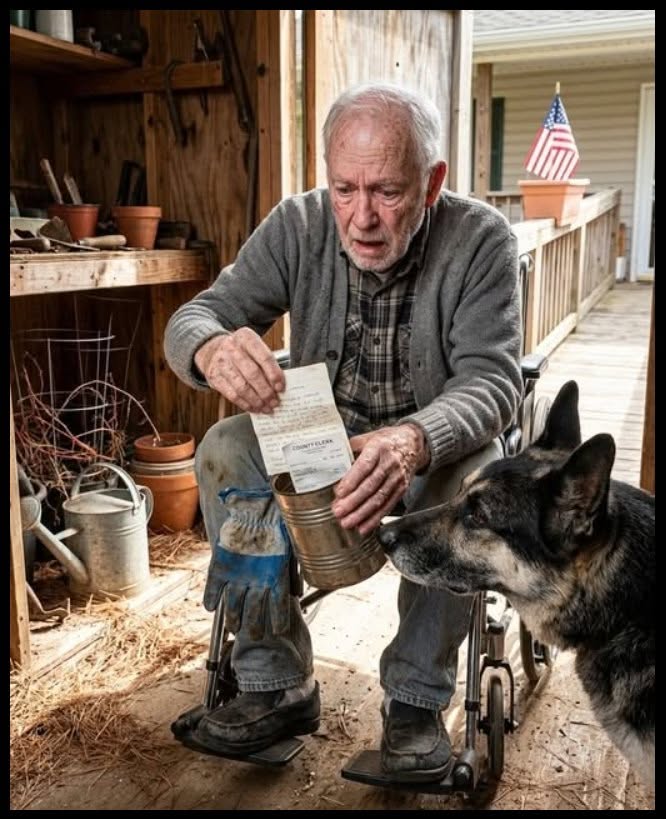
He was a big German Shepherd with coal-black ears, a silver line down his muzzle, and paws heavy enough to announce him on tile before he entered a room.
Ellen called him her second shadow.
I called him spoiled.
He answered to both.
When Ellen died, the house did not become empty all at once.
It emptied in small, cruel installments.
Her shoes stayed by the door for three weeks.
Her coffee cup stayed in the cabinet where she liked it.
Her straw hat stayed on the hook by the laundry room because I could not make myself move it, and because moving it felt like volunteering to lose her twice.
The backyard was worse.
The backyard still belonged to her.
So I did not go there.
Not after the funeral.
Not after the first hard freeze.
Not when the roses went wild.
Not when the tomato cages rusted and leaned like tired men.
Two years passed, and I became skilled at not looking through the back window.
Then Ranger started bringing me the glove.
It was blue, faded almost gray in places, frayed at the fingertips, with old dirt stiff along the seams.
Ellen had worn that glove for years.
She never threw anything useful away, even when useful had become a generous description.
The first time Ranger dropped it in my lap, I touched it with my thumb and felt my chest fold inward.
“Miss her too, huh, boy?” I said.
He looked at me, then walked behind my chair.
I thought he wanted to rest his head there.
Instead, he pressed his chest against the handles and pushed.
The wheelchair moved maybe two inches toward the back door.
I grabbed the brake.
“No,” I told him.
He circled around and stared at me.
Ranger had a way of staring that made a man feel poorly assembled.
The next afternoon, he did it again.
At 4:03 p.m., the glove landed on my lap.
At 4:05 p.m., he pushed.
At 4:06 p.m., I locked the brake and called him a stubborn old fool, which was rich coming from me.
By the fourth day, I had begun writing the times on the back of an old physical therapy appointment card.
Monday, 4:03.
Tuesday, 4:05.
Wednesday, 4:06.
Thursday, 4:07.
It was not random.
Dogs can be trained into habits, but grief can train humans into blindness.
I was very blind.
Ranger had already proven he understood things nobody taught him.
If I dropped my spoon, he picked it up and set it near my hand.
If the blanket slipped from my knees, he tugged it back.
If the refrigerator stayed shut too long, he bit the towel Ellen had tied to the handle and pulled until cold air spilled across the floor.
The first time he opened that refrigerator, I laughed until my side hurt.
“Planning dinner?” I asked him.
He looked at me, then looked at the orange juice on the bottom shelf.
That should have been the moment I understood Ellen had been teaching him more than tricks.
Instead, I called our neighbor Daniel and told him the dog was getting too smart for both of us.
Daniel lived two houses down and checked on me every Friday morning after his shift at the hardware store.
He offered to fix the backyard ramp twice.
I refused twice.
Not because it did not need fixing.
Because fixing the ramp meant admitting I might use it.
Pride is a quiet thief.
It does not break in.
It waits until you hand it the key.
On the eighth day, Ranger dropped the glove in my lap and did not push right away.
He stood in front of me instead.
See more on the next page
Advertisement
To see the full cooking instructions, go to the next page or click the Open button (>) and don't forget to SHARE it with your friends on Facebook.