

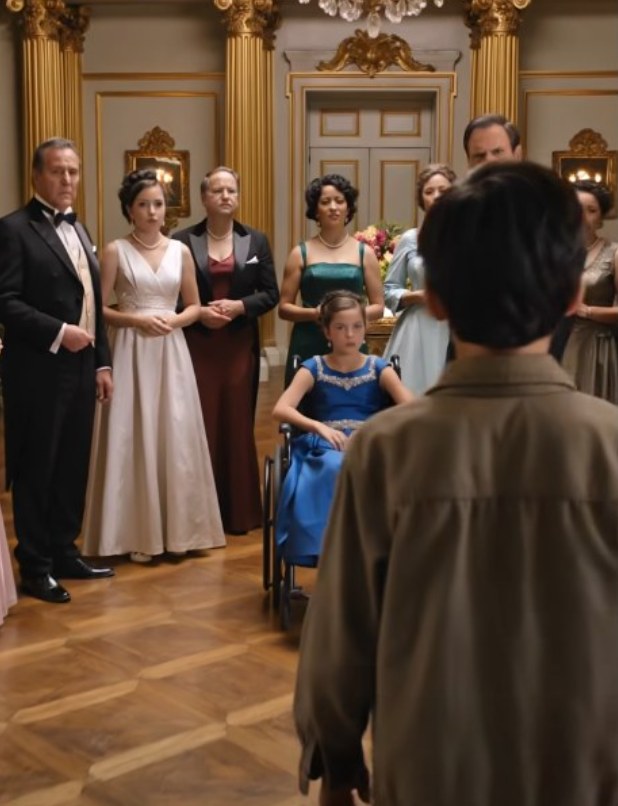
The orchestra never stopped playing.
That was the strange part.
Even after the barefoot boy crossed the polished marble floor of Blackthorn Hall — even after whispers spread through the ballroom like cold wind through cathedral ruins — the violins continued their slow waltz as though the old aristocratic families surrounding him were too stunned to breathe, let alone intervene.
Outside, rain hammered against the Atlantic cliffs below the estate. Beyond the towering windows, the sea churned black beneath the moonlight, swallowing the distant lighthouse in fog.
Inside, beneath chandeliers older than most governments, England’s political elite watched a stranger walk directly toward Lady Eleanor Whitmore.
She sat near the center of the ballroom in a silver wheelchair trimmed with ivory. The gown around her legs shimmered softly beneath candlelight, though she barely seemed aware of it. Her hands rested calmly in her lap, pale and motionless.
She had perfected stillness years ago.
At twenty-three, Eleanor carried herself with the quiet restraint of someone long accustomed to being observed. The newspapers called her graceful. Courageous. The lost jewel of the Whitmore dynasty.
The truth was less poetic.
She had not walked since she was twelve.
And everyone in that room knew it.
The barefoot boy stopped in front of her.
Up close, he looked thinner than he first appeared. Rainwater darkened the collar of his shirt. One sleeve was torn near the wrist. Yet there was nothing uncertain in his expression.
Security finally reached him.
“Sir,” one guard said sharply, “step away from Lady Whitmore.”
The boy ignored him.
His eyes remained fixed on Eleanor’s.
Not with pity.
Recognition.
It unsettled her immediately.
“You shouldn’t be here,” whispered a woman somewhere behind him.
The orchestra faltered slightly before recovering.
Then the boy extended his hand.
And quietly, with impossible confidence, he said:
“Because I can make her stand.”
The room froze.
Not metaphorically.
Actually froze.
Even the servants stopped moving.
Across the ballroom, Lord Cedric Whitmore slowly lowered the glass in his hand. One of Britain’s most powerful political figures rarely revealed emotion publicly. Years in Parliament had carved caution into every expression he wore.
But for a brief moment, the color left his face entirely.
Eleanor noticed.
And suddenly, something cold moved through her chest.
Not hope.
Fear.
Because her father looked less shocked by the claim…
than by the boy himself.
The guards stepped forward again.
“Remove him,” Cedric said.
His voice was calm.
Too calm.
The boy finally looked away from Eleanor.
Directly at Cedric.
“It’s been twenty-one years,” he said softly. “You buried the wrong child.”
The ballroom erupted into confused murmurs.
Cedric Whitmore did not move.
But Eleanor saw his fingers tighten around the crystal glass hard enough to whiten his knuckles.
Old dynasties fear witnesses more than enemies.
The boy lowered his hand slowly.
“My mother died trying to protect your family,” he continued. “And you repaid her by pretending I never existed.”
Eleanor stared at him.
“What are you talking about?” she whispered.
The boy looked back at her.
And for the first time since entering the ballroom, his expression finally cracked.
Not anger.
Grief.
“My name,” he said quietly, “is Daniel Vale.”
The name hit Cedric like a physical blow.
Several older guests exchanged alarmed glances immediately.
A woman near the orchestra covered her mouth.
Because everyone over fifty in that room remembered the Vale scandal.
Twenty-one years earlier, Amelia Vale — a gifted pianist employed at Whitmore Estate — had vanished after rumors surfaced involving Lord Cedric during his rise through Parliament. Officially, she drowned during a storm crossing the northern cliffs.
Unofficially, the servants whispered different things.
That she had threatened to expose someone.
That she had been pregnant.
That too many records disappeared afterward.
The Whitmores buried the scandal quickly.
Money helps silence become tradition.
Eleanor’s heartbeat quickened.
She looked between Daniel and her father.
And suddenly the room around her no longer felt elegant.
It felt rehearsed.
“Take him out,” Cedric repeated.
This time the command sounded sharper.
The guards reached for Daniel’s arms.
Then Eleanor spoke.
“Wait.”
Silence returned instantly.
Cedric turned toward his daughter. “Eleanor—”
“No.” Her voice trembled slightly. “I want him to speak.”
Something unreadable passed through her father’s face.
For years Eleanor had obeyed every carefully controlled expectation surrounding her life. Smile for photographs. Attend charity galas. Never discuss the accident. Never ask why certain servants disappeared after that winter.
But now, for the first time in years, she saw genuine fear in her father’s eyes.
And fear always points toward truth.
Cedric exhaled slowly.
“You’re upsetting her,” he said to Daniel.
“No,” Daniel replied quietly. “The truth is.”
Rain battered the windows harder.
The chandeliers flickered once.
Eleanor swallowed. “How do you know my father?”
Daniel looked toward the sea beyond the glass.
“My mother worked here before I was born,” he said. “She kept journals. Letters. Records.”
Cedric moved suddenly. “Enough.”
But Daniel continued.
“She wrote about the winter your daughter stopped walking.”
The room became deathly still.
Eleanor felt the blood drain from her face.
Because nobody ever spoke directly about that winter.
Not publicly.
Not even privately.
At age twelve, Eleanor Whitmore had fallen from the eastern staircase during a Christmas gathering attended by half the British cabinet. The injury damaged her spine permanently.
At least that was the official story.
See more on the next page
Advertisement
To see the full cooking instructions, go to the next page or click the Open button (>) and don't forget to SHARE it with your friends on Facebook.