
SHE CHOSE THE MASKED BROTHER TO SAVE HER EMPIRE… BUT ON THEIR HONEYMOON, WHAT HE HID BENEATH IT LEFT HER SPEECHLESS
You do not hear him arrive.
The garden is too full of other sounds. Water slipping from the marble fountain in soft silver threads. Leaves stirring against one another in the warm Mexico City night. Music from the ballroom filtering through the glass doors behind you, muted by distance and money until it becomes little more than a polished murmur.
You keep your palms braced against the cool edge of the fountain and try to steady your breathing.
Inside, a thousand chandeliers are shining over the polite execution of your future. Men in tailored suits are pretending this is a gala when everyone in that ballroom knows it is a market, and the thing being appraised is you. Your father’s empire. Your surname. The shape of your obedience.
You stare at the black surface of the water until your reflection blurs.
It has been twelve hours since your father told you to choose a husband before dawn. Twelve hours since he reduced romance, companionship, and the rest of your life to a strategic merger. Twelve hours since he gave the three Alsaba brothers names that should have sounded like options but somehow felt like sentences.
The peacock.
The glutton.
The monster.
And now the monster is here.
You sense him before you see him because the air changes subtly, the way it does when someone enters a room without asking permission from the silence. You lift your head. Across the terrace, near a row of dark cypresses and white climbing roses, a tall figure stands half in shadow.
Zafir Alsaba.
Even from a distance, he does not look like his brothers.
Khalil announces himself with polish and performance. Amar moves like a golden retriever raised in a bank vault. Zafir is stillness wrapped around danger. The black suit he wears is cut as sharply as theirs, but on him it looks less like fashion and more like armor. His shoulders are broad, his posture almost unnervingly controlled, and the lower half of his face is hidden behind a matte black mask that covers from cheekbones to jaw, leaving only his mouth and eyes visible.
His eyes are the first thing people notice.
Not because they are bright. They are not. They are dark, almost severe, with the unsettling attentiveness of a man who misses nothing and forgives even less. Rumors about him have always moved through the city like underground water. Burned in an accident. Scarred in a kidnapping. Disfigured in a political attack. Mad. Dangerous. Reclusive. Violent.
No one ever seems to know which story came first.
You know only two things for certain.
He has attended exactly three public events in five years.
And every room he enters becomes quieter.
He does not approach right away.
That alone makes him different.
Khalil would already be arranging your face into some photogenic angle under the moonlight. Amar would be at your elbow, smiling too broadly, mistaking invasion for charm. Zafir remains where he is, as if he understands the value of distance or perhaps the violence of taking up space in a woman’s bad moment.
Finally he says, “You left your own auction.”
The voice catches you off guard.
You expected something theatrical. Rough. Menacing, perhaps. Instead it is low and even, the kind of voice that does not need to push because it already assumes it will be heard. There is dry humor in it too, though so faint it might have been imagined.
You turn toward him fully.
“I stepped out for air,” you say.
His gaze flicks once to the ballroom doors. “Air is not usually scented with jasmine and existential dread.”
The laugh escapes you before you can stop it.
It is small. Surprised. Almost rude in how honest it is. You have spent the evening smiling with precision, speaking in carefully measured phrases, wearing your blue silk like a shield. Nothing about this night has invited real laughter. The fact that it appears now, in the garden, because the masked brother said something absurdly accurate, irritates you more than it should.
“I didn’t realize you told jokes,” you say.
“I don’t.”
“Then what was that?”
“A diagnosis.”
You study him.
Up close, the mask is stranger than gossip suggested. It is not decorative, not some dramatic affectation designed to invite mystery. It is functional. Beautifully made, yes, with clean lines that contour to his face, but practical in its austerity. It gives nothing away. His mouth is firm, unsmiling. His hands, visible where they rest at his sides, are large and scarred across the knuckles.
You had not heard rumors about his hands.
“Do you always eavesdrop on women trying not to hyperventilate by fountains?” you ask.
“No,” he says. “Only heiresses being herded toward sacrifice.”
The music from inside swells briefly as someone opens a ballroom door, then dies again when it closes.
You should go back in.
That is what duty would dictate. Return to the stage. Smile at the eligible brothers. Pick the least objectionable face and let the machinery of survival roll over you before sunrise. But something in Zafir’s presence holds you still. Not because he is gentle. He is not. Not because he is easy to read. He is impossible. It is because for the first time all night someone has spoken as if you are a person standing at the edge of a cliff rather than a company waiting to be acquired.
“You don’t seem enthusiastic about any of this either,” you say.
He tilts his head slightly. “Enthusiasm is for men choosing watches. Not for this.”
You almost ask then why he came.
Instead you say, “My father called you a monster.”
That gets the smallest visible reaction. Not shock. Not offense. Just the faint narrowing of one eye, as if he finds the title less interesting than your honesty.
“Did he?” he says.
“You don’t seem surprised.”
“Your father and I have never had a sentimental relationship.”
You lean one hip against the fountain and fold your arms. “So tell me, then. Are the stories true?”
“Which ones?”
“That you are dangerous.”
At that, something shifts in his face. Not softness. Not amusement exactly. Recognition, perhaps. As if you have finally asked a question worth answering.
“Yes,” he says.
The simplicity of it travels through you like a cold wire.
He does not dress it in false modesty. Does not insist that the media exaggerates, that people misunderstand him, that all powerful men are painted unfairly by smaller minds. He answers yes and leaves the word standing there between you in the moonlight like a blade.
You should be frightened.
Instead, inconveniently, you are intrigued.
“Dangerous to whom?” you ask.
His gaze does not leave your face. “That depends on who decides to make a woman’s life smaller.”
The answer lands harder than any practiced seduction could have.
You think suddenly of Khalil calculating camera angles before touching your hand. Amar announcing you would “handle being pretty” while he handled money. Your father, weak in bed but still strong enough to convert your future into a defensive wall around his towers. Every man in the ballroom has spent tonight discussing your life as if it were real estate.
And this one, the rumored monster, is the first to frame danger in terms that include your safety instead of his convenience.
That, you realize with a pulse of unease, is more disarming than charm.
“Why did you agree to this arrangement?” you ask quietly.
He does not answer immediately. A breeze moves through the jasmine vines and catches the hem of your caftan. Somewhere behind the glass, champagne laughter erupts, brittle and bright.
“At first?” he says. “For my family.”
“And now?”
His eyes drop briefly to the folder still pressed against your chest, your ridiculous attempt at carrying steel and fear in leather form. Then they return to yours.
“Now I’m curious which kind of woman stands at a fountain on the night she is supposed to save an empire and looks like she might drown the empire herself.”
You inhale sharply, not because the line is romantic, but because it is too close to the truth.
You have thought about it.
In ugly, tired flashes. Let it all collapse. Let the bureaucrats feast. Let the board members panic. Let your father’s ghost rage at your refusal from whatever costly heaven he intends to haunt. There are moments, fewer now than when you were younger, when destruction seems cleaner than submission.
But survival is a more deeply trained instinct than rebellion.
“Curiosity is dangerous,” you say.
“So is marriage.”
Another almost-laugh presses at your throat. You kill it before it escapes.
“Tell me something true,” you say instead.
“I just have.”
“No. Something useful.”
He studies you for a long second, and again you get the sense that his stillness is not passivity but calculation. He chooses words the way other men choose weapons, not often, and only once he knows where they will land.
“My brothers think tonight is about acquisition,” he says. “Your father thinks it is about continuity. The men inside think it is about optics.” He pauses. “It is actually about whether you survive the next twelve months with your name, your voting shares, and your will intact.”
You straighten.
It is one thing to suspect the trap. Another to hear someone else outline its dimensions with surgical calm.
“You believe I could lose all three?”
“I know you could.”
“How?”
He steps closer then, not enough to crowd you, but enough that his face is no longer only shadow and rumor. “Because the moment your father dies, everyone who fears your independence will begin speaking the language of concern. Instability. Protection. Prudence. Proper transition. They will try to cage you with softer bars than outright theft, but bars all the same.”
You hate how instantly you believe him.
Because he is describing a world you know intimately. The polished vocabulary of men who take and call it stewardship. Men who never say no woman should lead, but ask whether now is really the right time. Whether continuity might be better served by temporary structure. Whether perhaps a husband’s counsel would calm the market.
“Why are you telling me this?” you ask.
“Because if you choose Khalil, he’ll smile while selling pieces of you in exchange for applause. If you choose Amar, he’ll gamble with your empire out of boredom and call it confidence.” Zafir’s mouth hardens. “If you choose me, at least you’ll know the contract you’re signing.”
The honesty is almost violent.
You stare at him, the fountain water hissing softly between you like a witness.
“And what contract is that?”
“A cold marriage. Public unity. Private autonomy. You keep operational control of Salgado Holdings. I lend my family name and my reputation for making men reconsider foolish behavior. In return, we stabilize both houses and keep governments, boards, and parasites out of our internal structures long enough to secure succession.”
You blink.
There is no poetry in it. No fantasy. No seduction disguised as rescue. He is offering you a treaty, not a dream.
For some reason, that steadies you more than anything else tonight.
“And if I refuse all three of you?” you ask.
He glances toward the ballroom. “Then by this time tomorrow, the state will smell blood, your competitors will smell vacancy, and men who smile at you tonight will start drafting memos about fiduciary necessity.”
The old fury rises in you, clean and bitter. “I hate all of you.”
That, finally, earns the first visible sign of amusement. Not a smile exactly. More the ghost of one, quickly buried. “That may be the wisest thing you’ve said all evening.”
Before you can answer, a voice like liquid ego drifts from the ballroom doors.
“Amira.”
Khalil.
Of course.
He emerges into the garden with the practiced concern of a man who never misses the chance to be seen looking noble. He has loosened the top button of his jacket in that deliberate way rich men do when they want to signal emotional accessibility without sacrificing tailoring. His eyes go from you to Zafir and back again.
“There you are,” he says warmly, though the warmth does not survive contact with his brother. “Everyone’s waiting.”
“Then they can continue waiting,” you say.
His smile tightens by half a millimeter.
He recovers quickly. “Your father asked for you.”
That gets your full attention.
“Now?”
“Yes. He’s weaker.”
The folder in your arms suddenly feels heavier.
You look at Zafir. He does not move to stop you. Does not issue warning or command. He only watches, unreadable behind the mask, as though he knows whatever happens next will happen inside a room no brother can enter for you.
When you pass him, he says quietly, just for you, “Choose the man whose terms are clear.”
You do not answer.
But the sentence follows you inside like a second pulse.
Your father’s room smells more sharply of antiseptic now.
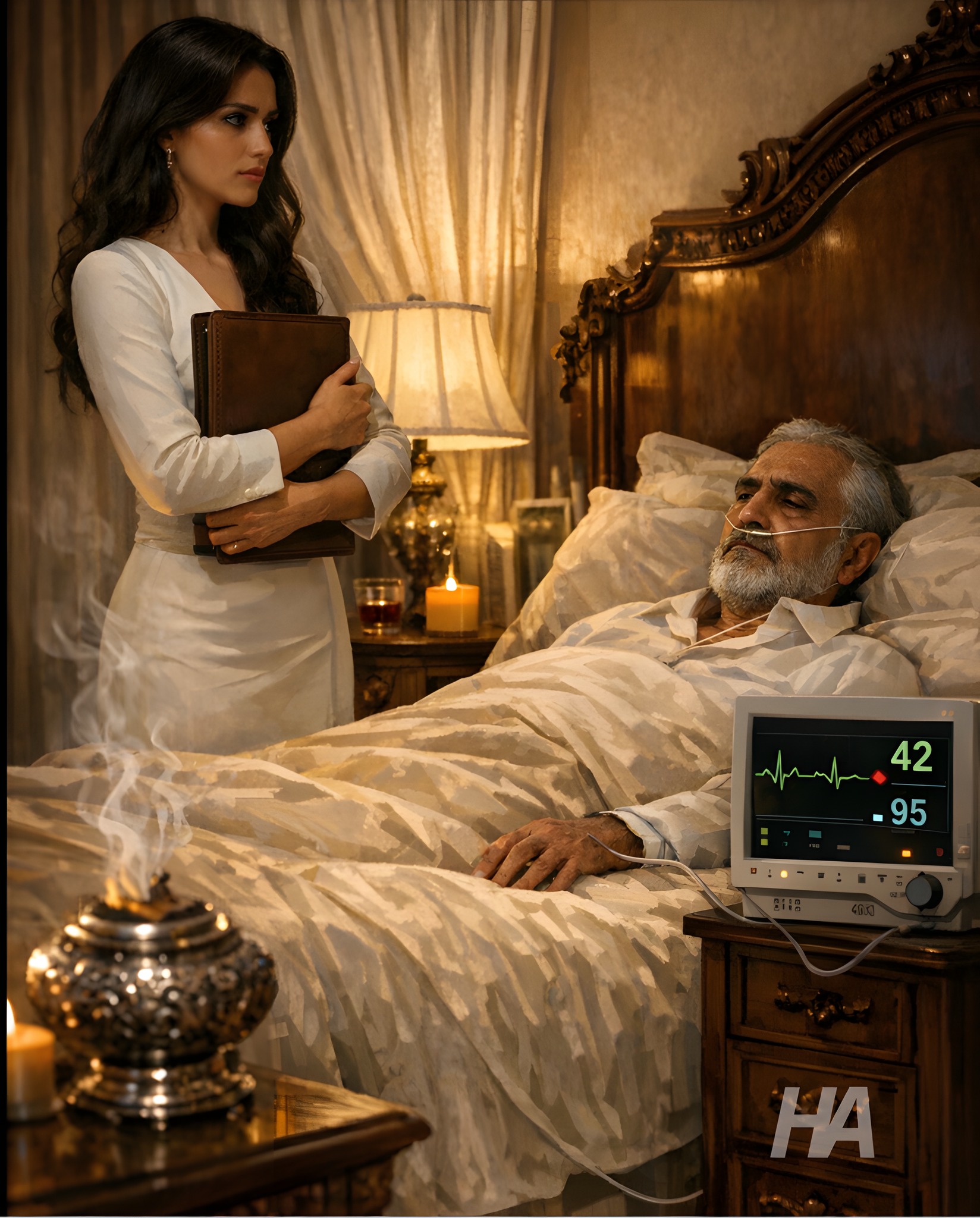
The incense still burns, stubborn and elegant, but the clinical scent has begun winning. Don Hassan lies propped against a tower of embroidered pillows, his skin stretched thin over bone and authority. The man who once made senators wait in marble foyers now seems held together by linen, medication, and sheer spite.
Even half dead, he still knows how to make a room feel owned.
When you enter, his eyes open immediately.
“Well?” he asks.
You set the folder down on the carved side table. “Khalil wants magazine covers. Amar wants a decorative wife.”
“And Zafir?”
You hate that he sounds most interested in that answer.
“Zafir wants a contract.”
Your father exhales through his nose, almost a laugh. “Of course he does.”
“He was the only one who spoke to me like a person.”
Your father turns his head slightly toward the dark window. “That’s because he has spent most of his life being treated like something less convenient than one.”
You go still.
See more on the next page
Advertisement
To see the full cooking instructions, go to the next page or click the Open button (>) and don't forget to SHARE it with your friends on Facebook.