

Part 1
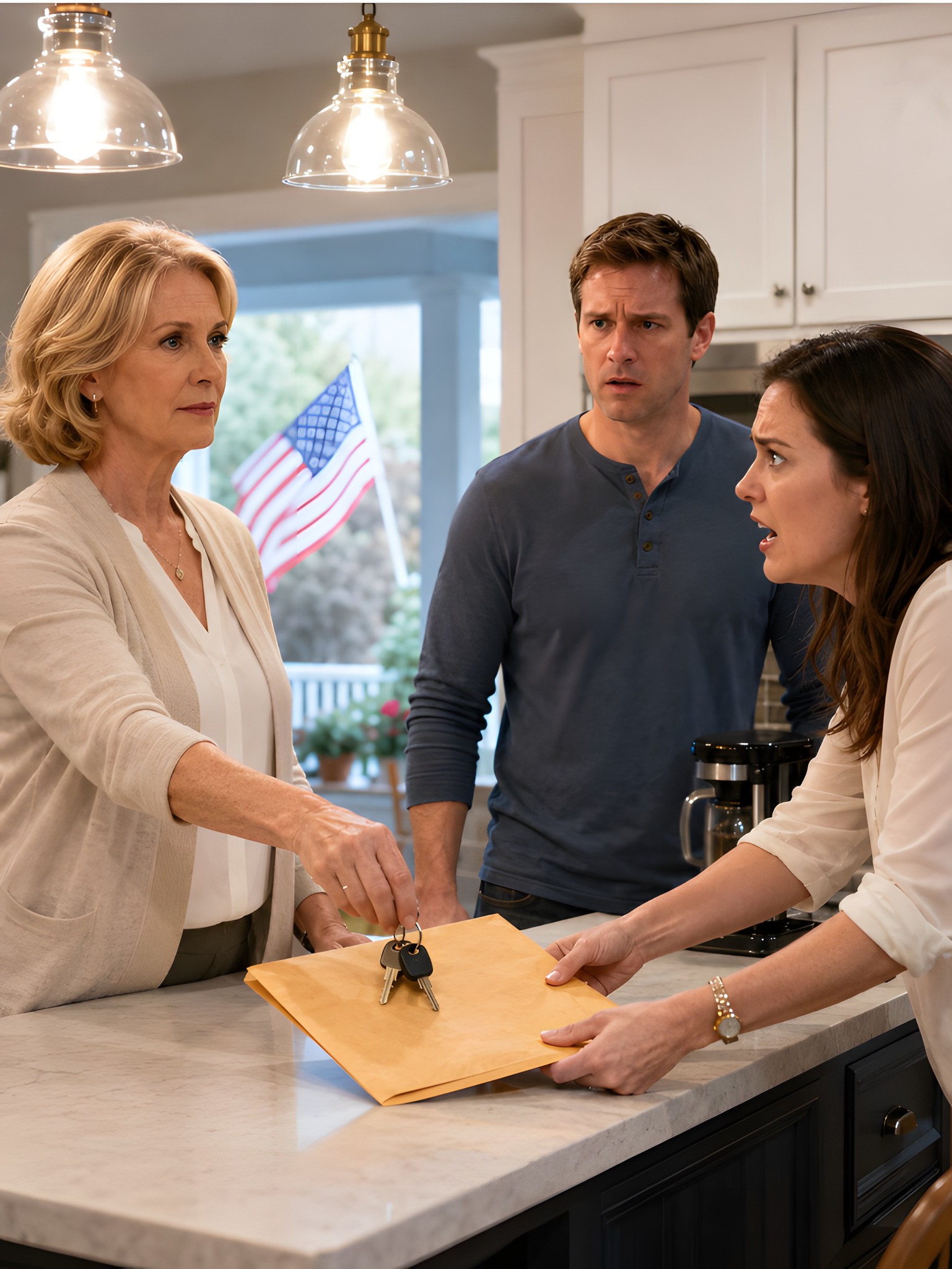
Twenty-four hours before my sixty-fifth birthday, my daughter-in-law stood in the middle of my kitchen and told me my party was canceled.
Not postponed. Not adjusted. Not scaled down.
Canceled.
Brooke had both arms crossed tightly over her cream-colored sweater, the kind she bought from boutiques where the price tags were tucked so carefully inside the sleeves that you had to search for them like secrets. She stood beside the island my late husband had installed with his own hands, under the pendant lights I had chosen after three weekends of driving around hardware stores with him, and she spoke as if she were doing me a favor.
“Mom feels uncomfortable,” she said.
That was all at first. Just those three words, floating in my kitchen like smoke.
Her mother, Lorraine, had arrived two days earlier from Arizona with four suitcases, a jeweled cane she barely used, and a talent for making every room rearrange itself around her mood. She had been offended by the way I seasoned the soup. She had sighed when I put fresh flowers on the dining table because lilies gave her headaches, though she had spent the previous afternoon with her face buried in my garden roses. She had cried, apparently, because I had “taken over” preparations for my own birthday dinner.
My son Julian stood near the coffee maker, his jaw tight, his eyes fixed on the machine as though it might suddenly open and give him instructions on how to be a man.
I waited for him to say something.
He did not.
Brooke continued, her voice wrapped in that soft, reasonable tone people use when they are doing something cruel and want it to sound mature. “It’s just better if we let the dinner slide this year. For peace. You understand, don’t you?”
I looked from her to my son.
Julian gave a small nod without meeting my eyes.
That tiny movement did more damage than Brooke’s words ever could have. It was not dramatic. There was no shouting, no broken glass, no thunder shaking the windows. Just my son, the boy I had raised, the man who had moved back into my home with his wife three years earlier, nodding along while my birthday was erased because another woman had thrown a tantrum.
I did not cry.
That surprised me.
There had been a time when I would have felt the tears rise immediately. I would have swallowed them down, smiled too brightly, and said, “Of course. Don’t worry about me.” I would have made peace with my own disappointment before anyone else had to feel guilty for causing it.
But that afternoon, standing in my own kitchen, I felt something very different.
Clarity.
It moved through me cold and clean, like the first breath after stepping outside on a winter morning. For three years, I had been telling myself that I was being generous. I had told myself Julian and Brooke needed time to save money, needed support while they settled into their careers, needed family around them. I had told myself that letting Brooke move my furniture to the basement was simply a matter of taste. I had told myself that giving up my sitting room was practical because they worked from home sometimes. I had told myself that waking early to clean the kitchen, make coffee, buy groceries, and keep the house running was love.
But love has warmth.
This had become servitude.
The house had been mine before Brooke ever stepped through the door. My husband, Daniel, and I had bought it when the neighborhood still had more trees than fences. We raised Julian there. We painted the nursery yellow because we had wanted to be surprised. We planted the maple tree out front on Julian’s first birthday. Daniel built shelves in the den, fixed the porch railing twice, and taught our son to ride a bike on the driveway.
After Daniel died, the house became too quiet, but it was still mine. Every floorboard held memory. Every corner had history.
Then Julian and Brooke moved in “temporarily.”
Temporary became three years.
At first, I was grateful for the company. Then I began noticing small changes. My photographs disappeared from the mantel and were replaced with Brooke’s abstract vases. My old armchair, the one Daniel used to tease me for loving more than him, was moved to the basement because it “didn’t match the flow.” My morning radio bothered Brooke. My cooking smelled too heavy. My gardening tools were unsightly near the back door. My friends were “a lot” when they visited for tea.
Slowly, carefully, my home stopped looking like my life.
And somehow, I let it happen.
I let it happen because Julian was my only child. I let it happen because grief had made me soft around the edges. I let it happen because I mistook silence for peace.
Now Brooke stood in front of me canceling my sixty-fifth birthday because her mother felt uncomfortable with me existing too strongly in my own kitchen.
I set my mug down on the counter.
The sound was small, but both of them looked at it.
“All right,” I said.
Brooke blinked, almost disappointed. She had expected resistance. She had prepared for an argument she could later describe as me being dramatic.
Julian looked relieved, which hurt more than anything.
I took my tea and walked out through the sliding glass doors into the backyard.
Lorraine was in my garden, strolling between the rose bushes with a pleased little smile on her face. The same woman who had apparently been too emotionally fragile to endure my birthday preparations was now happily admiring the flowers I had spent years cultivating. She bent toward a pink bloom, touched it, and called over her shoulder to no one in particular, “These really are lovely.”
The crisis, it seemed, had passed.
Only my birthday remained dead.
I sat on the porch and watched her. Not with hatred. Not even with anger. Anger is hot. Anger makes you reckless. What I felt was cooler, sturdier, more useful.
I had spent three years holding up a life that did not respect me.
I was done.
The decision did not arrive like lightning. It settled into me like a key turning in an old lock.
I finished my tea, stood up, and went into my home office. It was one of the last rooms Brooke had not fully conquered, mostly because I kept the door locked. Inside were my files, my laptop, Daniel’s fountain pen, and a framed photograph of him leaning against our old station wagon, laughing at something I no longer remembered.
I looked at his face for a long moment.
“Oh, Danny,” I whispered. “You would have hated this.”
Then I sat down, opened my laptop, and began taking my life back.
Part 2
The first thing I did was nothing.
That may not sound like much, but in my house, my nothing was powerful.
Every morning for years, I had risen before six. I cleaned the espresso machine because Brooke hated when the milk steamer clogged. I emptied the dishwasher because Julian never remembered whether the clean light meant clean or dirty. I wiped the counters, took out the compost, and drove to the bakery for fresh bagels because Brooke liked them from a particular place that charged too much and always had a line.
Nobody asked me to do it anymore.
They simply expected it.
So, on the morning after my canceled birthday, I stayed in bed.
I woke at six out of habit, saw the pale gray light behind my curtains, and almost swung my feet to the floor. Then I stopped. I pulled the blanket up to my chin and listened to the house breathe without me. Pipes clicked. A car passed outside. Somewhere upstairs, Brooke’s alarm chirped and stopped.
I picked up a novel from my nightstand and began reading.
At seven-thirty, I heard footsteps overhead. At seven-forty, a cabinet slammed. At seven-fifty, someone muttered. At eight, the kitchen sounded like a small machine shop collapsing.
Then came the knock.
“Mom?” Julian called.
I waited a few seconds before answering, not out of cruelty, but because I was finishing a sentence.
“Yes?”
He opened the door halfway and peered in. He was already dressed for work, tie slightly crooked, hair damp from the shower. “Are you okay?”
“I’m fine.”
He looked confused by my robe, my book, my calm expression. “The coffee machine isn’t working.”
“Oh,” I said. “It probably needs descaling.”
He waited.
I smiled. “The manual is in the junk drawer.”
His mouth opened, then closed. “Right. And breakfast?”
“I’m not having any yet.”
“No, I mean…” He rubbed the back of his neck. “We usually have bagels.”
“Yes,” I said pleasantly. “You usually do.”
He stared at me for one long second, and I saw the first tiny crack appear in the world he thought he understood.
Downstairs, Brooke shouted, “Julian, we’re going to be late!”
He retreated.
Ten minutes later, the front door slammed hard enough to rattle the hall mirror.
I finished my chapter.
When I finally went downstairs, the kitchen looked like a crime scene involving coffee grounds. There were mugs on the counter, water spilled near the machine, a butter knife abandoned on the floor, and one sad half-toasted piece of bread burned black along the edges.
Normally, my hands would have moved before my mind caught up. Sponge, towel, broom, dishwasher. I would have restored order and told myself I liked a tidy home.
That morning, I moved one dirty plate aside to make space for my tea.
Then I left everything else exactly as it was.
After breakfast, I opened my bank account.
There it was, the monthly transfer I had almost stopped noticing: fifteen hundred dollars into the joint household account Brooke used for groceries, cleaning supplies, and “shared expenses.” Shared, in Brooke’s language, meant organic berries I did not eat, imported cheese I did not like, specialty sparkling water I never touched, and enough charcuterie to entertain a small embassy.
I had been paying for the privilege of being treated like an inconvenience.
I clicked through the settings and canceled the recurring transfer.
No announcement. No argument. No raised voice.
Just one quiet click.
I sat back in my chair and felt something unfamiliar spread through my chest.
Relief.
Then I put on a navy coat, picked up my purse, and drove into the city.
The condo was in a quiet building with wide hallways, good security, and a little garden out front maintained by someone else, which sounded heavenly. The realtor was a young man named Miles who spoke too quickly and wore shoes without socks. He showed me a ground-floor unit with floor-to-ceiling windows, a small sunny patio, and no stairs.
No stairs mattered more at sixty-five than I ever thought it would.
The kitchen was compact, but bright. The bedroom looked out at a line of trees. The living room was just large enough for my favorite chair, my books, and perhaps a small round table where I could have coffee with a friend.
It was not the house Daniel and I had built.
It was not meant to be.
It was something else entirely.
Mine.
“I’ll take it,” I said.
Miles blinked. “You don’t want to think it over?”
“I have been thinking it over for three years.”
By late afternoon, I had filled out the application, called my banker, and arranged the deposit. My savings were strong. That was one thing Brooke and Julian had never understood. While they bought luxury cars, took weekend trips, and ordered food delivery four nights a week, I had lived simply. I paid the bills, yes, but I had not wasted money. Daniel had left me secure, and I had guarded that security like a promise.
Now I intended to use it.
That evening, Brooke came home carrying two grocery bags and a face full of fury.
I was in the living room, knitting a scarf I did not need but enjoyed making. She dropped the bags on the kitchen counter with enough force to bruise the peaches.
“Did you forget something?” she asked.
I looked up. “Did I?”
“The household account.” Her laugh was sharp and false. “My card was declined. In public.”
“How uncomfortable for you.”
Her eyes narrowed. “You were supposed to top it up.”
“I canceled that transfer.”
Silence.
She stared at me as if I had just announced I was joining the circus.
“You what?”
“I canceled it,” I said. “From now on, I’ll be paying for my own groceries. I mostly cook and eat by myself anyway.”
Her face flushed. “Julian and I work hard. We don’t have time to separate every little expense.”
“You’ll learn.”
Her voice dropped into the tone she used when she wanted to make me feel small. “You live here rent-free.”
I set my knitting down in my lap and looked directly at her.
“No, Brooke. I own this house. You live here rent-free.”
For the first time in three years, she had no immediate reply.
Her mouth opened, then shut. She made a wounded sound, turned, and stormed upstairs. A few seconds later, I heard her bedroom door slam.
I picked up my knitting again.
The scarf was coming along beautifully.
Part 3
See more on the next page
Advertisement
To see the full cooking instructions, go to the next page or click the Open button (>) and don't forget to SHARE it with your friends on Facebook.