

Once I stopped playing the role they had written for me, the entire house began revealing the truth.
The next morning, I reclaimed the guest room.
Brooke called it her “overflow space,” which sounded more refined than what it was: piles of Amazon boxes, yoga mats, seasonal decorations, half-open clothing packages, and three storage bins labeled in gold marker but filled with chaos. It was a large room on the main floor, filled with morning light, and it had once been my painting room before Brooke decided her lifestyle needed somewhere to spill.
I carried her boxes into the hallway one by one.
I did not throw anything. I did not damage anything. I stacked everything neatly in front of the stairs, creating a wall of her own excess. Then I brought in my easel, my paints, a small bookshelf, Daniel’s old desk lamp, and a chair with a cushion embroidered by my mother thirty years ago.
When I was finished, the room looked like a place where a person could breathe.
I locked the door and put the key in my pocket.
That afternoon, I was pruning roses when I heard the scream.
“Julian!”
A moment later, my son appeared at the back door looking like a man sent into battle without armor.
“Mom,” he said carefully, stepping onto the porch. “Did you move Brooke’s things?”
“Yes.”
“She’s upset.”
“I heard.”
He glanced back toward the house. Brooke was still making noise somewhere inside. “She says she needs that room.”
“So do I.”
“It’s just that she uses it for her hobbies.”
“What hobbies?”
He looked trapped. “Organizing.”
I nearly laughed, but did not. “The hallway is available.”
“Mom…”
I clipped a dead bloom from the rose bush. “Julian, I’m not debating this. That room is mine now.”
His face tightened at the word mine, as though ownership had become rude simply because I was the one claiming it.
I turned back to my roses.
He stood there a moment longer, then went inside.
That was how the next two weeks unfolded. Not with a war, but with boundaries. One small border at a time.
I rerouted the utility bills.
For years, I had paid the electric, water, gas, trash collection, lawn service, and home insurance. I paid them because the accounts were already in my name, and because I had always paid them, and because Julian and Brooke were “just getting on their feet.” But their feet, I had noticed, were wearing designer shoes.
I called the utility companies, updated billing information, and arranged for statements to go to Julian and Brooke’s joint account.
That evening, Julian stood in the hallway holding the mail.
“Mom?” His voice was cautious. “Did something happen with the bills?”
“What do you mean?”
“They’re showing my name now.”
“Yes. Since you and Brooke are the primary users of the house, it makes sense for you to cover the overhead.”
He looked genuinely stunned. “All of it?”
“You use most of it.”
“But the house is yours.”
“Exactly. And I have covered it long enough.”
From upstairs, Brooke shouted something I chose not to hear.
Julian lowered his voice. “This is sudden.”
“No,” I said. “It only feels sudden because I stopped absorbing the impact before it reached you.”
He did not understand that yet. Maybe one day he would.
Meanwhile, my own plan moved forward quietly.
I bought small moving boxes, the kind that could fit in the trunk of my car. Every morning after Brooke left for Pilates and Julian drove to the office, I packed. Photo albums first. Daniel’s watch. My legal papers. My grandmother’s china cups wrapped carefully in old towels. My cashmere sweaters that Brooke liked to borrow without asking. My jewelry box. The quilt my mother made for my wedding.
I carried my life out in pieces.
No one noticed.
That was perhaps the saddest part. The closets thinned. Shelves emptied. Drawers lost their contents. Still, Brooke and Julian saw only what affected them directly: the coffee not made, the bills not paid, the groceries not funded, the room no longer available for Brooke’s overflow.
They did not notice I was disappearing.
One Saturday, Brooke staged a brunch in my garden.
She invited three friends, ordered pastries, opened champagne before noon, and laughed loudly under my pergola as if volume could establish ownership. None of them asked if I minded. One of them set a handbag on my herb bed.
I looked out the window, watched them for thirty seconds, then picked up my purse and left.
Downtown, I found a café with blue cups and a waitress who called everyone honey. I ordered tomato soup, a grilled cheese sandwich, and a slice of lemon cake. I ate slowly, read a magazine, and felt no urge to rush home.
When I returned, the garden table was still covered with plates. Crumbs dotted the patio. Champagne glasses leaned dangerously near the edge. Brooke was on the couch scrolling through her phone, one foot tucked beneath her, completely at ease in the mess she expected someone else to clean.
I walked past her, poured myself water, and went to my painting room.
Behind the locked door, I sat in the quiet and understood something important.
Leaving was not just about changing addresses.
It was about refusing to be trained back into obedience.
On Monday morning, Brooke arrived at breakfast in a cheerful mood that immediately made me suspicious.
She sat beside Julian with her laptop open and began discussing caterers, flowers, and balloon arrangements. Lorraine’s birthday was coming up, and Brooke, it seemed, intended to host an elaborate celebration.
At my house.
For the mother whose tears had canceled my own birthday.
“The garden will be perfect,” Brooke said brightly. “And we’ll need the whole downstairs, obviously.”
Julian glanced at me.
I buttered my toast.
Brooke continued, gaining confidence from my silence. “It may be easier if you spend Saturday night with a friend. Just so Mom can relax. You know how sensitive she is.”
I looked at her and smiled.
“That’s a wonderful idea.”
She blinked. “It is?”
“Yes. I won’t be home that weekend anyway.”
Her face lit with triumph. She thought she had won. She thought she had finally managed to push me out of my own house for her mother’s comfort.
What she did not know was that I had already booked the movers for Friday morning.
Part 4
The final week in the house felt strangely peaceful.
Brooke mistook my calm for surrender. Julian mistook it for forgiveness. Both of them moved around me with the careless relief of people who believed the storm had passed, never realizing the ground beneath them had already shifted.
I helped clear space for Lorraine’s party.
At least, that was what Brooke thought I was doing.
When I took down the curtains in the sitting room, she said, “Oh, good, those were too heavy anyway.”
When I rolled up the rug Daniel and I bought on our twentieth anniversary, she said, “That opens the room so much.”
When I removed framed photographs from the hallway, she barely looked up from her phone.
Every act of packing looked, to her, like preparation for her mother’s celebration. She saw what she wanted to see. People like Brooke often do. Reality, to them, is something servants arrange in the background.
On Thursday afternoon, I met with a property management company.
The office smelled faintly of printer ink and peppermint. A woman named Ms. Alvarez reviewed my paperwork with brisk competence. She confirmed market rent for my house, discussed tenant screening, maintenance arrangements, insurance requirements, and legal notice periods. She did not ask why I was moving out of a house I owned while my son and daughter-in-law still lived there.
I appreciated that.
Not every wound needs an audience.
“The fair market rent would be about thirty-two hundred a month,” she said, tapping her pen against the folder. “Possibly more, given the size and neighborhood, but this is a reasonable starting point.”
I almost laughed.
Julian and Brooke had lived there for free while complaining about the cost of brunch.
Ms. Alvarez prepared a formal notice. Julian and Brooke could either sign a lease at the stated rent or vacate within ninety days. Utilities and maintenance would be their responsibility during that period. The language was clean, professional, and impossible to argue with.
I signed the agreement with Daniel’s fountain pen.
For a moment, my hand trembled.
Not because I doubted myself. Because I understood the size of what I was doing. I was not just moving. I was ending a version of motherhood that had consumed me whole. I was stepping out of the role of rescuer, fixer, cleaner, payer, smoother-over, peacekeeper.
I was becoming a person again.
Friday morning arrived bright and cold.
At seven-thirty, Brooke hurried through the kitchen in workout leggings and a camel coat, talking into her phone about floral arrangements.
She paused near the door. “There’s a liquor delivery coming around ten. Can you sign for it?”
I looked at her. “Of course.”
“Thanks,” she said, already turning away. “And please don’t let them leave it somewhere weird.”
Somewhere weird, apparently, included any place she had not personally approved.
Julian came downstairs a few minutes later, distracted and late. He kissed my cheek quickly, something he had not done in weeks, perhaps because he sensed something without knowing what it was.
“See you tonight, Mom.”
“Yes,” I said. “Goodbye, Julian.”
He did not hear the difference.
At eight sharp, their cars were gone.
At eight-oh-five, the moving truck arrived.
The movers were efficient men with kind eyes and strong backs. They loaded my bed, my wingback chair, Daniel’s antique desk, the remaining boxes, my painting supplies, and the small dining table I had chosen for the condo. Piece by piece, the last visible parts of my life left the house.
The rooms echoed when empty.
I walked through them slowly.
In the bedroom, I touched the wall where Daniel’s side of the bed had been. In the hall, I paused near the pencil marks we had made when Julian was growing, each line dated in Daniel’s handwriting. Age six. Age eight. Age ten. I photographed them before I left. I had no need to cut the wall out like a madwoman. Memory did not require possession of plaster.
By ten, the liquor delivery arrived. I signed for it, helped the young man stack crates neatly in the garage, and even made sure the receipt was placed on the kitchen counter where Brooke would find it.
My last duty, fulfilled.
Then I cleaned my rooms.
Not for Brooke. Not for Julian. For myself. I wanted to leave with dignity, not wreckage.
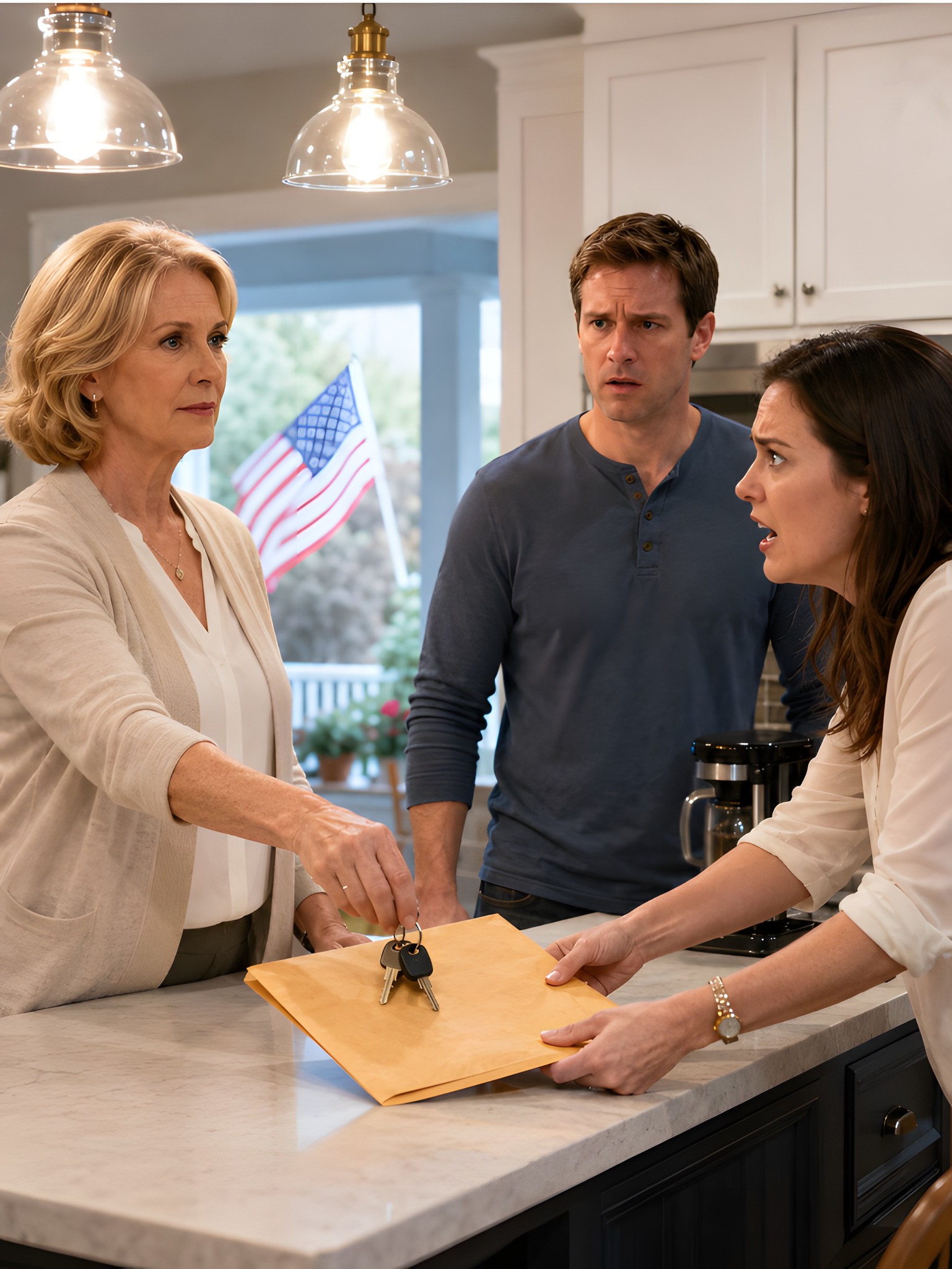
At eleven-thirty, I placed a thick envelope in the center of the kitchen table.
Inside was the formal notice from the property management company. No emotional letter. No accusations. No list of grievances. The facts were stronger than any speech I could give.
I had moved out.
They could remain in the property by signing a lease and paying thirty-two hundred dollars per month, plus utilities and maintenance.
Or they had ninety days to vacate.
I placed my house keys on top of the envelope.
Then I stood there for a moment in the kitchen where Brooke had canceled my birthday. The same island. The same pendant lights. The same coffee machine, now stained and neglected because no one had learned to clean it properly.
I waited for sadness to crush me.
It did not.
There was sadness, yes, but it was clean sadness. The kind that comes when something long sick is finally allowed to die.
I put on my coat, picked up my bag, and walked to the front door.
Before leaving, I looked back once.
The house stood quiet and beautiful, full of memories and consequences. It had sheltered my marriage, my motherhood, my grief, and my humiliation. Now it would become something else: an asset, a source of income, a piece of my future rather than a cage built from my past.
I closed the door softly behind me.
As I drove away, sunlight flashed across the windshield. The maple tree Daniel and I had planted all those years ago stood tall by the curb, its branches bare but strong.
I whispered, “I did it.”
Then I drove to my new home.
That night, I unpacked my books, arranged my tea cups, and placed Daniel’s photograph on the small table beside the window. I opened a bottle of Cabernet, poured one glass, and sat on my patio wrapped in a cardigan.
My phone was on silent in the kitchen.
At nine, curiosity got the better of me. I checked it.
Eighteen missed calls from Julian. Six from Brooke. More text messages than I cared to count.
Julian’s first message was simply: Mom?
The next was longer. Mom, what is going on? Please call me.
Then: Is this real?
Brooke’s messages began with confusion, moved quickly into outrage, and ended with accusations. I had ruined everything. I had sabotaged her mother’s party. I had embarrassed them. I was selfish, cruel, unstable, dramatic.
I read the messages with surprising calm.
Then I turned the phone face down and finished my wine.
Part 5
See more on the next page
Advertisement
To see the full cooking instructions, go to the next page or click the Open button (>) and don't forget to SHARE it with your friends on Facebook.