
Saturday morning, I woke to sunlight pouring through my new windows.
For a moment, I forgot where I was. The ceiling was unfamiliar. The air smelled faintly of fresh paint and cardboard. Then I turned my head and saw Daniel’s photograph on the table, my books stacked neatly beside the wall, and my blue robe hanging from a hook near the closet.
Home, I thought.
Not the old home. Not the family home. Not the house everyone else had used as an excuse to use me.
My home.
I made coffee in a small French press, buttered a slice of toast, and carried breakfast to the patio. The morning was crisp. Somewhere nearby, a dog barked twice and then quieted. A woman jogged past the building in a red jacket. The world continued without crisis.
At the old house, I imagined chaos.
Brooke trying to smile while panic sharpened her voice. Julian rereading the notice, hoping the words would rearrange themselves into mercy. Lorraine arriving to find the atmosphere poisoned by consequences. Caterers asking where to set up. Decorations half-hung. The oven confusing everyone because I had been the only one who knew its stubborn habits.
Part of me expected guilt.
It came, but weakly, like a knock at a door I did not have to open.
I had not abandoned children. I had not left anyone helpless in a burning building. I had stopped funding two capable adults who had mistaken my kindness for obligation.
That distinction mattered.
On Tuesday afternoon, Julian came to my condo.
I knew it was him before I opened the door. A mother knows the rhythm of her child’s knock, even when that child has disappointed her deeply.
I looked through the peephole. He stood in the hallway with his shoulders slumped, his hair messy, his face gray with exhaustion. For a second, I saw the boy who used to come into my room after nightmares. Then I saw the man who had stood silent while his wife canceled my birthday.
Both were true.
I opened the door but did not invite him in.
“Hi, Mom,” he said.
“Hello, Julian.”
His eyes moved past me, taking in what little he could see of the condo. “So this is it?”
“Yes.”
“It’s nice.”
“It is.”
He swallowed. “The party was a disaster.”
I said nothing.
“Lorraine left early. The caterer was late, the oven wouldn’t heat properly, Brooke was crying, and everyone kept asking where you were.”
“I see.”
He looked at me then, really looked, and I could tell he was waiting for the old reflex. The apology. The soothing. The offer to fix what had gone wrong even after I had been mistreated.
I gave him none of it.
He rubbed both hands over his face. “Mom, we can’t afford thirty-two hundred a month.”
“I know.”
The honesty startled him. “Then why would you ask for it?”
“Because that is what the house is worth.”
“But we’re family.”
“Yes,” I said. “And for a long time, I confused that with permission.”
His eyes reddened. “I never meant for things to get this bad.”
“That may be true.”
“Brooke just… she likes things a certain way.”
“So do I.”
He flinched.
I softened my voice, but not my boundary. “Julian, I love you. I will always love you. But being your mother does not mean being your maid, your landlord, your banker, and your emotional shock absorber. You are a grown man. You and Brooke made choices. Now you have to live with them.”
He looked down at the hallway carpet.
“I should have said something,” he whispered.
“Yes,” I said. “You should have.”
That hurt him. I saw it land. But pain is not always harm. Sometimes pain is the first honest thing a person has felt in years.
He asked me to come back. Not confidently, but desperately. He said the house felt wrong without me. He said Brooke was angry, but she would calm down. He said they could work something out.
I listened.
Then I said, “No.”
One word. Clean and complete.
His face crumpled, but he nodded slowly, as if some part of him had expected it.
“What are we supposed to do?” he asked.
“Find a place you can afford.”
He gave a humorless laugh. “Just like that?”
“Yes,” I said. “Just like everyone else.”
We stood in silence for a few seconds.
Then he stepped back. “I’m sorry, Mom.”
I believed he meant it. I also knew an apology was not a time machine.
“Thank you,” I said.
He turned and walked down the hall. I watched until the elevator doors closed behind him.
When I stepped back inside and locked the door, I cried for the first time.
Not loudly. Not dramatically. I sat in my chair, pressed a handkerchief to my eyes, and let the tears come. I cried for Daniel, because he was not there to tell me I had done the right thing. I cried for the boy Julian had been. I cried for the woman I had become after years of shrinking quietly inside her own life.
Then the tears passed.
And when they were gone, I felt lighter.
Two months later, Julian and Brooke moved out of the house.
They found a modest two-bedroom apartment across town, in a building with no garden, no guest room, and no invisible older woman making their lives effortless. Julian told me this himself during one of our short Sunday calls. He sounded tired, but different. Less polished. More real.
Brooke did not speak to me.
I did not lose sleep over it.
The property management company found tenants within three weeks: a young family with two children, steady jobs, and excellent references. They loved the garden. The mother sent a note through Ms. Alvarez saying the roses made the house feel like a storybook.
That pleased me more than I expected.
The first rent check arrived on the first of the month.
I looked at the deposit in my account and laughed so hard I had to sit down.
Not because of the money alone, though the money was certainly nice. I laughed because for years, I had treated that house as a burden I had to carry for everyone else. Now it was carrying me.
My sixty-sixth birthday came the following spring.
I celebrated on my sunny terrace with three close friends, a lemon cake from the expensive bakery I had once visited every morning for other people, and a bottle of champagne I opened without asking anyone’s permission. We ate from my grandmother’s china plates. We told stories. We laughed until the woman next door leaned over the patio divider and asked what was so funny, then joined us for a slice.
Julian called in the afternoon.
“Happy birthday, Mom,” he said.
“Thank you, sweetheart.”
There was a pause. “Are you having a good day?”
“I am.”
“Good.” His voice softened. “I’m glad.”
We did not have a grand reconciliation. Life is rarely that neat. He did not rush over with flowers and confess every failure. I did not invite him to move into my spare room, because I did not have one and did not want one. We spoke for ten minutes. It was civil, warm in places, awkward in others.
But it was honest.
That was enough for now.
After the call, I returned to my friends, my cake, and the afternoon light. I looked around at my little terrace, my potted herbs, my comfortable chair, and the life I had chosen at an age when some people expect women to fade politely into the background.
I did not fade.
I drew a line.
I used to think strength had to announce itself. I imagined it as shouting, fighting, slamming doors, making everyone understand the size of your hurt. But real strength, I learned, can be almost silent. It can look like canceling a bank transfer. Locking a room. Signing a lease. Leaving keys on a table. Refusing to explain your worth to people committed to misunderstanding it.
I did not get revenge on my son and daughter-in-law.
I simply stopped paying for their illusion with my life.
Now, every morning, I wake when I choose. Sometimes I make coffee. Sometimes I drink tea. Sometimes I leave dishes in the sink until noon because no one is watching, no one is judging, and no one is waiting for me to make their world smooth.
My life is smaller now in square footage, but larger in every way that matters.
I sit by my window and look out at the park. Children race their scooters along the path. Old men play chess at a stone table under the trees. In the late afternoon, sunlight spills across my floor like a blessing.
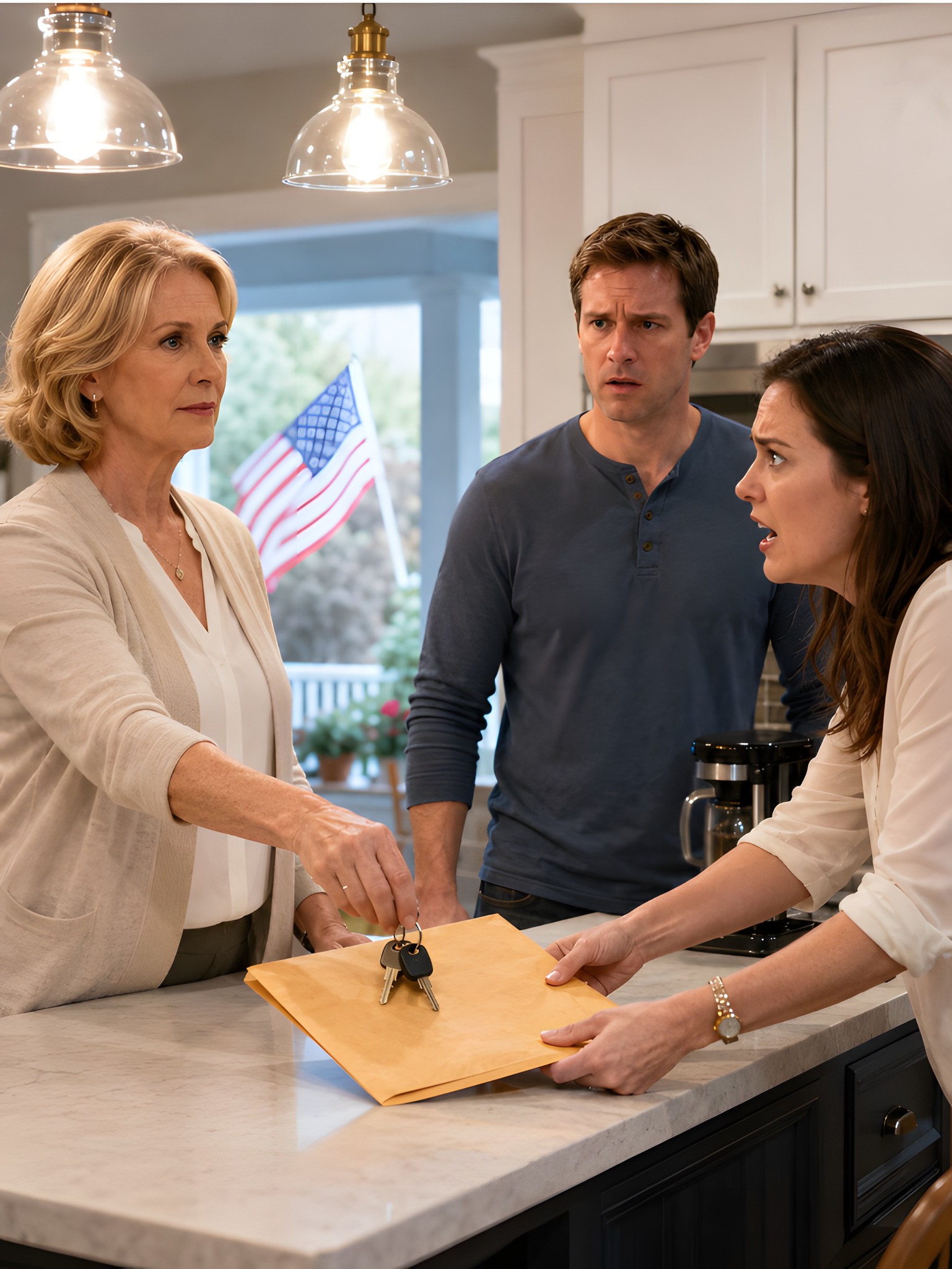
I think about the woman I was in that kitchen, standing before Brooke and Julian while they canceled my birthday. I wish I could go back and take her hand. I would tell her that the pain she felt was not the end of her story. It was the door opening.
And on the other side of that door was peace.
Not loud happiness. Not perfect justice. Not a movie ending with everyone crying and embracing in the rain.
Peace.
The kind you build when you finally choose yourself.
The kind no one can take unless you hand it over.
I will not hand mine over again.
THE END
See more on the next page
Advertisement